Overview
New York, NY – Nov 04, 2026 – The global Pipeline Integrity Market is gaining importance as energy companies, pipeline operators, and industrial facilities focus on improving pipeline safety, preventing leaks, and extending the life of existing infrastructure. Pipeline integrity solutions help identify corrosion, cracks, metal loss, pressure-related damage, and other defects that can affect pipeline performance. These solutions include inspection services, cleaning, repair, rehabilitation, digital monitoring, and risk assessment.
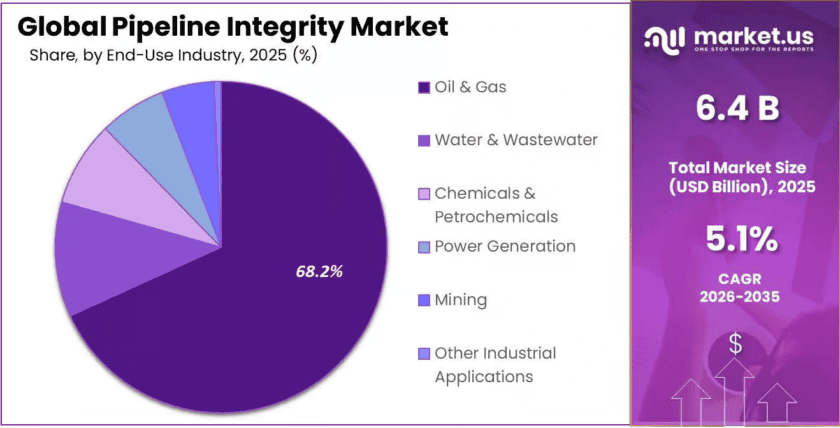
According to the market estimates, the global Pipeline Integrity Market was valued at USD 6.4 billion in 2025 and is projected to reach USD 10.6 billion by 2035, registering a compound annual growth rate (CAGR) of 5.1% from 2026 to 2035. Increasing natural gas transportation, ageing pipeline networks, and stricter safety requirements are supporting industry demand.
In the United States, the Pipeline and Hazardous Materials Safety Administration (PHMSA) oversees approximately 3.3 million miles of pipelines, operated by nearly 3,000 companies. This extensive infrastructure creates continuous requirements for inspection, maintenance, corrosion prevention, and leak detection.
The growing use of advanced inspection tools, remote monitoring, and predictive maintenance is also changing how operators manage pipeline assets. Oil and gas companies remain important customers, while water utilities, chemical manufacturers, and emerging hydrogen and carbon dioxide transportation projects are creating additional opportunities.
Key Takeaways
- Market Valuation: The global Pipeline Integrity Market was valued at USD 6.4 billion in 2025.
- Future Projection: The market is expected to reach USD 10.6 billion by 2035.
- Growth Rate: The market is projected to expand at a CAGR of 5.1% during 2026–2035.
- Dominating Region: North America accounted for 37.00%, representing USD 2.3 billion in market revenue in 2025.
- Leading Service Segment: Inspection Services dominated with a 39.50% share in 2025.
- Leading Pipeline Medium: Natural Gas accounted for 46.30% of the market.
- Leading Pipeline Type: Transmission Pipelines captured 39.00% of the market.
- Leading Solution Component: Services held a 54.00% share in 2025.
- Leading End-Use Industry: Oil & Gas accounted for 68.00% of the market.
Regional Analysis
North America – Dominating Region
North America held a dominant position in the Pipeline Integrity Market in 2025, accounting for 37.00% of the global market, valued at USD 2.3 billion. The region benefits from its extensive oil and gas transportation infrastructure, established safety regulations, and regular investment in pipeline inspection and maintenance.
The United States has approximately 300,217 miles of natural gas transmission pipelines, while Canada’s regulated interprovincial and international pipeline network covers approximately 73,000 kilometres. PHMSA’s inspection and enforcement activities further strengthen the regional focus on pipeline safety. Demand is supported by in-line inspection, corrosion monitoring, leak detection, repair, and rehabilitation services.
Asia-Pacific – Strong Growth Opportunity
Asia-Pacific is creating important growth opportunities through expanding natural gas transportation, industrial development, and investment in energy infrastructure. China, Japan, South Korea, and other regional economies require dependable pipeline networks to support industrial production, electricity generation, and energy distribution.
According to Global Energy Monitor’s 2025 pipeline tracker, approximately 15,000 kilometres of crude oil and natural gas liquids pipelines were under construction worldwide, with Asia accounting for more than 60% of oil pipeline development activity. These projects are increasing the future requirement for pipeline inspection, corrosion protection, digital monitoring, and preventive maintenance. Growing investment in energy security and infrastructure reliability is expected to strengthen regional demand.
Market Dynamics
1. Driver – Increasing Need for Pipeline Safety and Mandatory Inspections
Ageing pipeline infrastructure and increasing safety requirements are major drivers of the Pipeline Integrity Market. Pipeline operators must regularly assess corrosion, cracks, pressure damage, and leakage risks to maintain safe transportation.
According to PHMSA, approximately 3.3 million miles of pipelines are under its oversight in the United States. In January 2025, PHMSA advanced updated gas pipeline leak detection and repair requirements covering approximately 2.8 million miles of gas pipeline facilities. The agency estimated potential annual public benefits of up to USD 1.5 billion and methane emission reductions of up to 500,000 metric tons. These requirements support demand for inspection and repair services.
2. Trend – Digital Monitoring and Predictive Maintenance
Digital monitoring and predictive maintenance are becoming important trends in pipeline integrity management. Pipeline operators are increasingly using advanced sensors, automated inspection equipment, artificial intelligence, and data analytics to identify possible defects before they develop into major failures.
These technologies help monitor pressure, temperature, corrosion, vibration, and methane leakage. The U.S. Department of Energy has highlighted research into low-cost pipeline sensors and predictive analytics for monitoring corrosion and infrastructure conditions. Remote monitoring also helps operators reduce unnecessary field inspections and improve maintenance planning. Growing interest in real-time pipeline information is encouraging service providers to develop connected inspection and monitoring platforms.
3. Restraint – High Inspection and Maintenance Costs
High inspection costs and technical limitations remain important restraints for the Pipeline Integrity Market. Some pipelines cannot accommodate conventional inspection tools because of tight bends, reduced-diameter sections, unsuitable pressure conditions, or limited access facilities. Operators may need additional engineering work, cleaning, modifications, and temporary operating arrangements before inspection can begin.
These requirements increase project costs and may delay maintenance schedules. Specialist equipment and trained inspection personnel also add to operating expenses. Smaller pipeline operators may face difficulty funding regular assessments and advanced monitoring systems. As a result, inspection access, maintenance budgets, and project scheduling can restrict the adoption of comprehensive integrity management solutions.
4. Opportunity – Hydrogen, Carbon Dioxide, and Water Pipeline Assessment
The development of hydrogen transportation, carbon capture and storage, and water infrastructure is creating new opportunities for pipeline integrity providers. Existing natural gas pipelines may require material testing, pressure assessments, corrosion evaluation, and technical qualification before conversion to hydrogen service. Carbon dioxide transportation also requires specialised monitoring and leakage prevention.
The U.S. Environmental Protection Agency estimates that USD 422.9 billion will be required over 20 years for drinking water transmission and distribution improvements, including the replacement or rehabilitation of ageing pipelines. This creates opportunities for inspection companies, digital monitoring providers, and rehabilitation specialists to serve municipal utilities and emerging energy infrastructure projects.
Emerging Trends
1. Artificial Intelligence-Based Pipeline Inspection
Pipeline operators are increasingly adopting artificial intelligence to analyse inspection records, identify corrosion patterns, and predict potential failures. The U.S. Department of Energy supports research into predictive analytics and advanced sensors for pipeline monitoring, improving maintenance planning and infrastructure reliability.
2. Advanced In-Line Inspection Technologies
Magnetic flux leakage and ultrasonic inspection tools help identify corrosion, cracks, and metal loss inside pipelines. PHMSA tracks pipeline mileage inspected through different assessment methods, encouraging operators to improve inspection coverage and defect identification across large transportation networks.
3. Remote Methane Detection
Remote methane detection is gaining importance as operators seek faster ways to identify gas leaks. PHMSA’s January 2025 rule covers approximately 2.8 million miles of gas pipeline facilities and estimates potential methane emission reductions of up to 500,000 metric tons.
4. Hydrogen Pipeline Qualification
Hydrogen transportation is encouraging specialised pipeline testing and material assessments. Operators must examine material compatibility, pressure conditions, leakage risks, and pipeline suitability before conversion. These requirements are creating opportunities for specialised inspection and engineering service providers.
5. Water Pipeline Rehabilitation
Water utilities are increasing their focus on detecting underground leakage, corrosion, and structural damage. The EPA identifies USD 422.9 billion in drinking water transmission and distribution infrastructure needs, supporting demand for advanced inspection, diagnostics, and pipeline rehabilitation.
Use Cases
1. Natural Gas Transmission Pipeline Inspection
Natural gas operators use in-line inspection tools, pressure monitoring, and leak detection systems to identify pipeline defects. PHMSA oversees approximately 3.3 million miles of pipelines in the United States, highlighting the importance of regular condition assessments and maintenance.
2. Crude Oil Pipeline Corrosion Management
Oil transportation companies use ultrasonic testing, corrosion monitoring, and protective coatings to reduce pipeline deterioration. These solutions help prevent product leakage, environmental damage, and transportation interruptions across long-distance crude oil pipeline networks.
3. Municipal Water Pipeline Monitoring
Water utilities use acoustic sensors, pressure monitoring, and robotic inspection tools to locate leaks and structural damage. The EPA estimates USD 422.9 billion in transmission and distribution infrastructure needs, supporting inspection and rehabilitation projects.
4. Hydrogen Pipeline Conversion Assessment
Energy companies use material testing, pressure evaluation, and engineering assessments to determine whether existing gas pipelines can safely transport hydrogen. These services help identify material compatibility issues and reduce the risks associated with pipeline conversion projects.
5. Carbon Capture and Storage Pipeline Monitoring
Carbon capture operators require specialised inspection and leakage monitoring for carbon dioxide transportation pipelines. Integrity assessments help evaluate pressure conditions, corrosion risks, and material performance, supporting safer transportation from industrial facilities to storage locations.
Frequently Asked Questions
1. What is the Pipeline Integrity Market?
The Pipeline Integrity Market covers inspection, monitoring, maintenance, repair, and rehabilitation services used to maintain pipeline safety. It serves oil and gas, water, chemical, petrochemical, and other industrial pipeline operators.
2. What was the global Pipeline Integrity Market size in 2025?
The global Pipeline Integrity Market was valued at USD 6.4 billion in 2025. Demand was supported by ageing pipeline infrastructure, regulatory requirements, corrosion management, and increasing investment in inspection and monitoring technologies.
3. What is the expected market size by 2035?
The global Pipeline Integrity Market is projected to reach USD 10.6 billion by 2035, expanding at a CAGR of 5.1% between 2026 and 2035, supported by infrastructure maintenance and pipeline safety requirements.
4. Which region dominates the Pipeline Integrity Market?
North America dominated the market in 2025, accounting for 37.00%, equivalent to USD 2.3 billion. Its position is supported by extensive pipeline infrastructure, established regulations, and strong demand for inspection and maintenance services.
5. Which service segment holds the largest market share?
Inspection Services dominated the market in 2025, capturing 39.50%. These services help pipeline operators identify corrosion, cracks, metal loss, and other defects through advanced inspection tools and condition assessment methods.
6. What are the major factors driving market growth?
Major growth factors include ageing pipelines, mandatory integrity assessments, stricter leak detection requirements, increasing natural gas transportation, and the adoption of digital monitoring. These factors encourage operators to invest in regular inspection and preventive maintenance.
Conclusion
The Pipeline Integrity Market is expected to experience steady growth as pipeline operators focus on safety, reliability, and infrastructure life extension. Its valuation is projected to increase from USD 6.4 billion in 2025 to USD 10.6 billion by 2035, reflecting a CAGR of 5.1%.
North America will continue to benefit from its established pipeline network and regulatory framework, while Asia-Pacific offers opportunities through infrastructure expansion. Inspection services, digital monitoring, corrosion management, and preventive maintenance will remain important industry activities. Emerging hydrogen, carbon dioxide, and water infrastructure projects are also expected to create additional business opportunities for pipeline integrity providers.
Discuss your needs with our analyst
Please share your requirements with more details so our analyst can check if they can solve your problem(s)