Overview
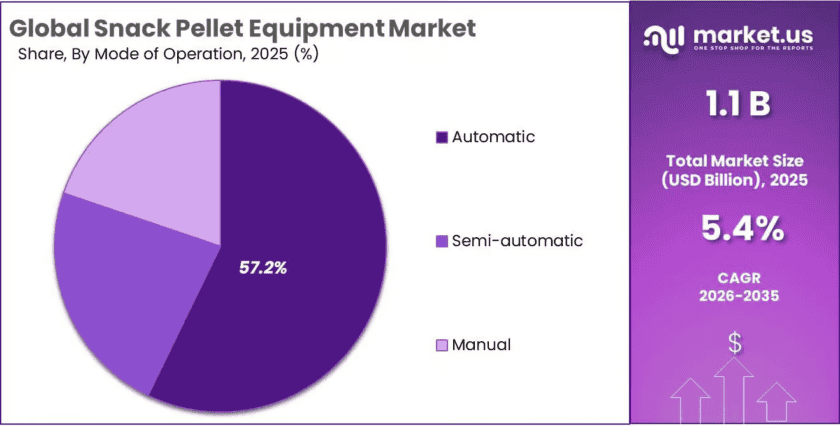
New York, NY – Sep 21, 2026 – The global Snack Pellet Equipment Market is expanding as food manufacturers invest in faster, more flexible, and automated systems for producing cereal-, potato-, corn-, wheat-, and multigrain-based snacks. The market was valued at USD 1.1 billion in 2025 and is projected to reach approximately USD 1.8 billion by 2035, growing at a 5.4% CAGR from 2026 to 2035. Extrusion, mixing, cutting, drying, frying, and seasoning equipment form the core of commercial snack pellet production. Extrusion equipment held more than a 32.00% share, while automatic equipment accounted for more than 57.00%. Strong agricultural output provides a broad raw-material base.
U.S. corn production reached a record 17.0 billion bushels in 2025, while wheat production totaled 1.98 billion bushels. Global cereal production increased 6.1% to approximately 3.043 billion tonnes in 2025/26. Manufacturers are increasingly investing in automated controls, flexible dies, energy-efficient heating, hygienic construction, and lines capable of handling multiple grain formulations. Asia Pacific remained the largest regional market, supported by expanding food manufacturing and processing capacity.
Key Takeaways
- The global Snack Pellet Equipment Market was valued at USD 1.1 billion in 2025 and is projected to reach approximately USD 1.8 billion by 2035, growing at a 5.4% CAGR.
- Extrusion equipment led the equipment category with more than a 32.00% share in 2025.
- Single-screw extruders held more than a 59.00% share, supported by simple operation and continuous cereal processing.
- 2D pellets accounted for more than a 47.00% share of the pellet-form category.
- Automatic equipment captured more than a 57.00% share, reflecting increasing demand for continuous and consistent processing.
- Asia Pacific dominated the global market with more than a 37.80% share.
- Asia Pacific generated approximately USD 0.40 billion in Snack Pellet Equipment Market revenue in 2025.
Regional Analysis
Asia Pacific Leads with 37.80% Share and USD 0.40 Billion Revenue
Asia Pacific held the dominant position in the Snack Pellet Equipment Market in 2025, capturing more than a 37.80% share and generating approximately USD 0.40 billion in revenue. The region benefits from large cereal-processing industries, expanding packaged-food manufacturing, urban food demand, and increasing investment in automated processing lines. UNIDO reported that Asia and the Pacific recorded the strongest regional manufacturing-production growth during the first quarter of 2026, while global manufacturing increased 1.2% quarter over quarter. Large cereal availability also supports pellet manufacturing. FAO estimated global cereal production at about 3.043 billion tonnes in 2025/26, representing growth of 6.1%. These conditions encourage manufacturers to add extrusion, drying, frying, seasoning, and automated handling systems. Demand is also moving toward flexible machines capable of processing corn, wheat, rice, potatoes, and multigrain recipes while maintaining consistent shapes, texture, moisture, and production speed.
Market Dynamics
Driver – Growing Raw-Material Availability Supports Pellet Production
Large supplies of cereals and potatoes are supporting investment in snack pellet processing equipment. USDA estimated U.S. corn production at a record 17.0 billion bushels in 2025, increasing 14% from 2024, while the average yield reached 186.5 bushels per acre. U.S. wheat production totaled about 1.98 billion bushels, providing another major raw material for extruded products. At the global level, FAO estimated cereal production at 3.043 billion tonnes in 2025/26, up 6.1%. Large raw-material volumes allow processors to expand corn, wheat, rice, potato, and multigrain snack production, supporting demand for extrusion, mixing, cutting, drying, and seasoning equipment.
Trend – Automation Is Becoming More Important in Food Processing
Automation is becoming increasingly important as food manufacturers seek consistent throughput, lower manual handling, and tighter process control. U.S. food manufacturing employed approximately 1.765 million workers in August 2026, including about 1.390 million production and nonsupervisory employees. The industry also employed 168,370 packaging and filling machine operators and 144,690 food batchmakers in 2025. These large production workforces highlight opportunities to automate ingredient dosing, mixing, extrusion, conveying, cutting, seasoning, inspection, and packaging. Automatic snack pellet lines can also improve repeatability between production batches and allow processors to manage higher volumes with centralized controls, sensors, programmable recipes, and integrated material-handling systems.
Restraint – Energy-Intensive Heating and Drying Raise Operating Pressure
Energy requirements remain an important restraint for snack pellet equipment because extrusion, drying, frying, heating, and cooling can consume substantial electricity and thermal energy. The U.S. Department of Energy reports that about two-thirds of end-use energy consumed at food and beverage manufacturing plants is associated with manufacturing processes such as process heating. High energy dependence can increase the operating cost of dryers, fryers, ovens, steam systems, and other thermal equipment. Manufacturers therefore need better insulation, heat recovery, efficient motors, optimized airflow, advanced combustion, and electrified heating systems. Smaller processors may delay equipment replacement when energy savings cannot quickly justify additional capital expenditure.
Opportunity – Flexible Multigrain Processing Creates New Equipment Demand
Flexible equipment capable of processing different grain and starch combinations creates an important market opportunity. FAO reported that global cereal production reached approximately 3.043 billion tonnes in 2025/26, after increasing 6.1% from the previous season. U.S. production alone included 17.0 billion bushels of corn, 1.98 billion bushels of wheat, and around 207 million cwt of rice in 2025. This broad ingredient base allows snack manufacturers to develop corn, wheat, rice, pulse-blended, potato, and multigrain pellets. Equipment suppliers can respond with adjustable extruders, interchangeable dies, programmable controls, precision dosing, and flexible drying systems that allow faster product changes on the same line.
Emerging Trends
1. Higher Automation Across Processing Lines
Automatic systems are gaining attention as processors seek more consistent output and reduced manual handling. U.S. food manufacturing employed around 1.765 million people in August 2026, creating opportunities for automated dosing, extrusion, conveying, inspection, seasoning, and packaging systems.
2. Energy-Efficient Drying and Heating
Energy efficiency is becoming more important for dryers, ovens, and fryers. The U.S. Department of Energy estimates that roughly two-thirds of food and beverage manufacturing plant end-use energy is linked to manufacturing processes such as process heating.
3. Growing Use of Multigrain Formulations
Large cereal supplies are encouraging processors to develop more diverse pellet recipes. FAO estimated global cereal output at around 3.043 billion tonnes in 2025/26, an increase of 6.1%, supporting wider use of corn, wheat, rice, and mixed grains.
4. Stronger Hygienic Equipment Requirements
Hygienic equipment design is receiving greater attention under food-safety regulations. FDA’s 21 CFR Part 117 covers plant equipment, sanitary operations, facility sanitation, and production controls, encouraging processors to use equipment that is easier to clean, inspect, maintain, and validate.
5. Flexible Extrusion for Larger Raw-Material Choices
Flexible extrusion is becoming valuable as ingredient choices expand. U.S. production reached 17.0 billion bushels of corn and 1.98 billion bushels of wheat in 2025, encouraging processors to adopt lines that can switch between different cereal-based formulations.
Use Cases
1. Corn-Based Snack Pellet Extrusion
Extruders convert corn flour and starch mixtures into uniform snack pellet shapes. USDA reported record U.S. corn production of 17.0 billion bushels in 2025, with an average yield of 186.5 bushels per acre, providing a substantial processing base.
2. Wheat-Based Pellet Processing
Snack pellet equipment can process wheat flour into flat, shaped, and expandable products. U.S. wheat production reached approximately 1.98 billion bushels from 37.2 million harvested acres in 2025/26, supporting dependable ingredient availability for industrial-scale snack processing.
3. Potato-Based Snack Pellets
Potato starch and flakes can be mixed, extruded, shaped, dried, and expanded using pellet-processing lines. USDA reported U.S. potato production of approximately 412.86 million cwt in 2025, with an average yield of about 460 cwt per acre.
4. Rice and Multigrain Pellet Production
Flexible systems are used for rice and multigrain pellets where different moisture and extrusion conditions are required. U.S. rice production totaled approximately 207 million cwt in 2025, providing another raw-material option for differentiated snack shapes and textures.
5. Automated High-Volume Production Lines
Automatic equipment combines mixing, extrusion, cutting, drying, frying, seasoning, and conveying into continuous production. U.S. food manufacturing employed 168,370 packaging and filling machine operators in 2025, highlighting the scale of manufacturing activities where automation can improve productivity.
Frequently Asked Questions on Snack Pellet Equipment
What is snack pellet equipment?
Snack pellet equipment includes machines used for mixing ingredients, extrusion, shaping, cutting, drying, frying, seasoning, cooling, and handling semi-finished snack pellets made from corn, wheat, rice, potatoes, starches, and other cereal ingredients.
How large is the Snack Pellet Equipment Market?
The global Snack Pellet Equipment Market was valued at USD 1.1 billion in 2025 and is projected to reach approximately USD 1.8 billion by 2035, growing at a 5.4% CAGR during 2026–2035.
Which equipment type leads the market?
Extrusion equipment held the dominant position in 2025, accounting for more than a 32.00% share. Extruders are widely used because they combine mixing, pressure, heat, shaping, and continuous processing within commercial snack pellet production lines.
Which type of extruder dominates the market?
Single-screw extruders accounted for more than a 59.00% share in 2025. Their relatively simple design, continuous operation, reliable output, and suitability for common corn-, wheat-, and potato-based formulations support widespread commercial adoption.
Which pellet form holds the largest market share?
The 2D pellet category held more than a 47.00% share in 2025. Flat forms such as strips, rings, wheels, and squares can be produced efficiently using standard extrusion, cutting, and drying technologies.
Why is automatic equipment increasingly important?
Automatic equipment captured more than a 57.00% share in 2025. These systems support continuous production, controlled ingredient dosing, uniform pellet dimensions, stable processing conditions, lower repetitive handling, and integration across extrusion, drying, seasoning, and packaging operations.
Which region leads the Snack Pellet Equipment Market?
Asia Pacific led the global Snack Pellet Equipment Market in 2025 with more than a 37.80% share, generating approximately USD 0.40 billion in revenue, supported by growing food manufacturing and cereal-processing capacity.
What factors will support future market growth?
Future growth is expected to come from automated production, flexible multigrain extrusion, energy-efficient dryers and fryers, hygienic equipment, expanding cereal availability, product diversification, and replacement of older processing lines with programmable and integrated manufacturing systems.
Conclusion
The Snack Pellet Equipment Market is positioned for steady expansion as manufacturers increase automation, production flexibility, and energy efficiency. The market is projected to grow from USD 1.1 billion in 2025 to approximately USD 1.8 billion by 2035 at a 5.4% CAGR. Extrusion equipment remains central to pellet manufacturing, while automatic systems continue to gain importance across high-volume facilities.
Strong corn, wheat, rice, and potato availability supports diversified snack formulations. Asia Pacific remains the leading regional market. Future equipment demand will increasingly center on flexible extrusion, hygienic processing, automated controls, efficient heating, faster product changeovers, and consistent product quality.
Discuss your needs with our analyst
Please share your requirements with more details so our analyst can check if they can solve your problem(s)