Overview
New York, NY – Oct 07, 2026 – The global Mushroom Cultivation Market is developing steadily as fresh-food demand, specialty varieties, controlled-environment agriculture, and organic production encourage growers to expand cultivation capacity. The market was valued at USD 21.6 Billion in 2025 and is projected to reach USD 33.6 Billion by 2035, expanding at a 4.5% CAGR during 2026–2035. Button mushrooms remained the leading type with a 44.21% share, supported by their established production systems and broad food use.
Commercial cultivation is increasingly supported by climate-controlled rooms, improved substrates, automated environmental management, better spawn quality, and refrigerated distribution. USDA reported that U.S. mushroom sales volume reached 636.2 million pounds during the 2025–2026 season, generating approximately USD 921.5 million in farm sales. Agaricus mushrooms represented 619.8 million pounds, while fresh-market Agaricus sales reached 558.9 million pounds.
Specialty cultivation is also widening the industry beyond conventional button varieties. U.S. growers produced 17.75 million pounds of specialty mushrooms during 2025–2026, including shiitake, oyster, and other exotic types. At the same time, certified-organic production reached 114.7 million pounds. These developments support investment in indoor cultivation, sustainable substrates, automation, organic farming, cold-chain infrastructure, and higher-value mushroom varieties.
Key Takeaways
- The global Mushroom Cultivation Market was valued at USD 21.6 Billion in 2025 and is projected to reach USD 33.6 Billion by 2035, expanding at a 4.5% CAGR.
- Button Mushroom dominated the type segment in 2025 with more than a 44.21% share, supported by mature cultivation techniques and widespread food consumption.
- Outdoor Cultivation accounted for more than 66.78% of the market in 2025, supported by lower infrastructure requirements and natural substrate systems.
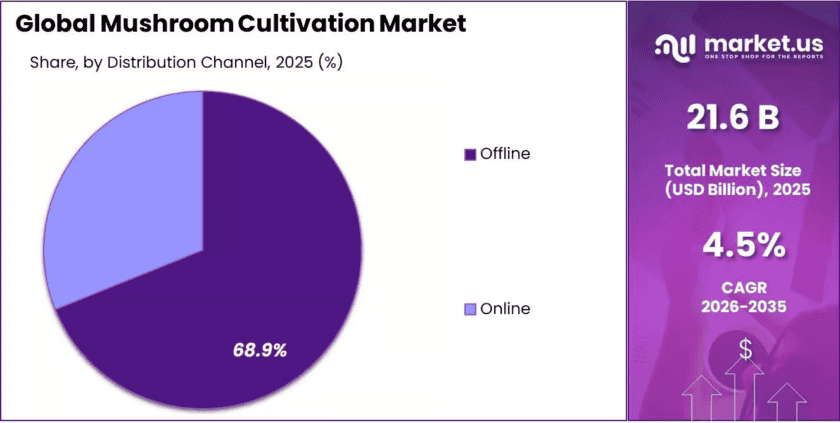
- Offline distribution captured more than a 68.90% share, reflecting the importance of supermarkets, fresh-produce retailers, wholesalers, and foodservice channels.
- Asia-Pacific led the global market in 2025 with more than a 46.67% share, supported by large cultivation capacity, agricultural-residue availability, and established mushroom consumption.
- USDA recorded 636.2 million pounds of U.S. mushroom sales during 2025–2026, with total farm value reaching approximately USD 921.5 million.
Regional Analysis
Asia-Pacific held the dominant position in the Mushroom Cultivation Market in 2025, capturing more than a 46.67% share. The region benefits from established mushroom-growing traditions, large food-processing industries, suitable agricultural residues for substrates, and increasing adoption of controlled cultivation. Button, oyster, shiitake, and other mushroom varieties have developed sizeable production bases across Asian economies, while urban food demand continues to encourage year-round production.
Europe is developing as another important cultivation region as farms focus on climate-controlled production, food traceability, energy efficiency, organic certification, and year-round supply. European statistical rules specifically cover cultivated mushroom production within official crop-production reporting, strengthening visibility across the sector. North America also maintains a mature commercial base. USDA reported 636.2 million pounds of U.S. mushroom sales during 2025–2026, including 619.8 million pounds of Agaricus mushrooms.
Market Dynamics
Driver – Strong Fresh Mushroom Consumption Supports Commercial Cultivation
Fresh-food demand continues to support mushroom cultivation because most commercial production is sold directly into fresh retail and foodservice channels. USDA reported that U.S. Agaricus fresh-market sales reached 558.9 million pounds during the 2025–2026 season. Fresh mushrooms represented approximately 90% of Agaricus sales volume, compared with 10% for processing.
Pennsylvania alone accounted for 74% of total U.S. Agaricus sales volume. These figures demonstrate the scale of regular fresh-market demand. Growers are therefore investing in harvesting systems, refrigerated storage, packaging, and climate management to deliver consistent mushrooms with the appearance and shelf life required by retailers and foodservice customers.
Trend – Controlled and Indoor Production Becomes More Important
Controlled cultivation is becoming an important operating trend as growers seek stable yields throughout the year. USDA recorded 20.302 million square feet of Agaricus growing area in the U.S. during 2025–2026, supported by 112.158 million square feet of total fillings. Specialty producers also operated approximately 7.207 million indoor or undercover natural-wood logs and 4.755 million square feet of other production media.
These facilities allow closer management of temperature, carbon dioxide, ventilation, moisture, and contamination. Greater use of sensors, automation, insulated growing rooms, and environmental controls is helping professional farms improve production consistency while reducing dependence on outdoor weather conditions.
Restraint – Lower Farm Prices and Sales Pressure Grower Margins
Profitability remains a challenge when production expenses rise faster than mushroom selling prices. USDA reported that U.S. mushroom sales value declined 16% during 2025–2026 to approximately USD 921.5 million, while sales volume decreased 5% to 636.2 million pounds. The average producer price declined to USD 1.45 per pound, down USD 0.18 from the previous season.
Specialty mushroom sales value also declined 21% to about USD 75.0 million. These pressures can limit investment by smaller farms because growers must continue paying for labour, substrate preparation, refrigeration, sanitation, heating, cooling, and packaging even when farm-gate prices weaken.
Opportunity – Specialty and Organic Mushrooms Create Higher-Value Niches
Specialty and organic cultivation offers growers opportunities beyond conventional mushroom production. USDA reported U.S. specialty mushroom production of 17.749 million pounds during 2025–2026, with shiitake production reaching 5.799 million pounds. Specialty growers received an average of USD 4.56 per pound, substantially above the overall mushroom average of USD 1.45 per pound.
Certified-organic mushroom production also reached 114.72 million pounds, with 62.37 million pounds sold under organic certification. These figures highlight opportunities for growers to develop premium shiitake, oyster, organic, locally produced, and specialty mushroom offerings while investing in traceable substrates, controlled farming, direct retail supply, and differentiated packaging.
Emerging Trends
1. Indoor Cultivation Systems Expand
Controlled production is becoming more important for stable year-round supply. USDA recorded 20.302 million square feet of U.S. Agaricus growing area and 112.158 million square feet of fillings during 2025–2026, supporting wider use of automated temperature, humidity, and ventilation systems.
2. Organic Mushroom Production Gains Attention
Organic cultivation continues to create a differentiated product category. U.S. growers produced approximately 114.72 million pounds of certified-organic mushrooms during 2025–2026, while 62.37 million pounds were sold as certified organic, according to USDA.
3. Specialty Varieties Broaden Farm Portfolios
Growers are increasingly cultivating shiitake, oyster, and other specialty varieties alongside Agaricus mushrooms. USDA recorded 17.749 million pounds of specialty production in 2025–2026, including 5.799 million pounds of shiitake and 3.308 million pounds of oyster mushrooms.
4. Fresh Market Remains the Main Sales Route
Fresh supply continues to shape cultivation and distribution strategies. USDA reported 558.935 million pounds of fresh Agaricus sales during 2025–2026 compared with 60.825 million pounds sold for processing, making refrigeration, packaging, rapid delivery, and shelf-life management increasingly important.
5. Promotion Investment Is Increasing
USDA approved a higher industry assessment for mushroom promotion and research. The rate will rise to USD 0.00875 per pound from January 2027 and USD 0.01 per pound from July 2027 for qualifying fresh-market producers and importers.
Use Cases
1. Fresh Retail Food
Mushroom cultivation supplies supermarkets and produce retailers with white button, crimini, portobello, oyster, and shiitake mushrooms. USDA reported 558.9 million pounds of fresh-market Agaricus sales in 2025–2026, demonstrating the importance of cultivation to fresh grocery supply.
2. Processed Food Manufacturing
Cultivated mushrooms are used in soups, sauces, pizzas, frozen meals, canned products, and prepared foods. USDA recorded 60.825 million pounds of Agaricus mushrooms sold for processing during 2025–2026, an increase of approximately 5% from the previous season.
3. Specialty Foodservice
Shiitake, oyster, and exotic mushrooms provide differentiated ingredients for restaurants and premium foodservice menus. USDA reported specialty mushroom sales volume of 16.46 million pounds during 2025–2026, with growers receiving an average price of USD 4.56 per pound.
4. Organic Food Supply
Controlled mushroom farms can serve certified-organic food channels using documented substrates and production practices. USDA recorded approximately 114.72 million pounds of certified-organic mushroom production in 2025–2026, of which 62.37 million pounds were marketed as certified organic.
5. Agricultural Residue Utilization
Mushroom cultivation can convert lignocellulosic materials such as straw and sawdust into edible biomass. FAO notes that small-scale growers can prepare mushroom substrates from clean agricultural waste, allowing cultivation to create food and income without requiring conventional farmland.
Frequently Asked Questions on Mushroom Cultivation
What is mushroom cultivation?
Mushroom cultivation is the controlled production of edible fungi using prepared substrates, spawn, moisture, ventilation, and suitable environmental conditions. Commercial farms grow varieties such as button, oyster, shiitake, crimini, and portobello mushrooms using indoor or outdoor systems.
How large is the Mushroom Cultivation Market?
The Mushroom Cultivation Market was valued at USD 21.6 Billion in 2025 and is projected to reach approximately USD 33.6 Billion by 2035, representing a 4.5% CAGR during the 2026–2035 forecast period.
Which mushroom type holds the largest market share?
Button Mushroom held the leading market position in 2025 with more than a 44.21% share. Its dominance reflects established commercial cultivation methods, broad consumer familiarity, standardized substrates, and widespread use across fresh retail and foodservice applications.
Which cultivation method dominates the market?
Outdoor Cultivation accounted for more than a 66.78% share in 2025. The approach remains widely used because certain mushrooms can grow on natural wood and agricultural materials without the full capital requirements associated with sophisticated indoor climate-controlled facilities.
Which distribution channel leads mushroom sales?
Offline distribution held more than a 68.90% market share in 2025. Supermarkets, produce stores, wholesalers, and foodservice distributors remain central because fresh mushrooms require quick turnover, refrigeration, careful handling, and frequent replenishment to maintain quality.
Which region leads the Mushroom Cultivation Market?
Asia-Pacific led the global Mushroom Cultivation Market in 2025 with more than a 46.67% share. Large production bases, established mushroom consumption, agricultural substrate availability, and expanding commercial cultivation support the region’s strong position.
How important is the U.S. mushroom industry?
USDA reported U.S. mushroom sales volume of 636.2 million pounds during 2025–2026, valued at approximately USD 921.5 million. Agaricus varieties represented about 619.8 million pounds of the total commercial sales volume.
Are specialty mushrooms becoming commercially important?
Specialty mushrooms remain a meaningful premium category. U.S. growers produced 17.749 million pounds during 2025–2026, including shiitake, oyster, and other varieties, while average specialty mushroom prices reached approximately USD 4.56 per pound.
What factors support future mushroom cultivation growth?
Future development is supported by controlled farming, specialty varieties, organic production, automation, efficient substrates, refrigerated distribution, and value-added processing. These improvements can help growers achieve more consistent production while serving retail, foodservice, and premium food markets.
What are the main challenges facing mushroom growers?
Mushroom growers face contamination, labour requirements, temperature and humidity control, refrigeration costs, substrate quality, and short shelf life. USDA reported the average U.S. mushroom price fell to USD 1.45 per pound in 2025–2026.
Conclusion
The Mushroom Cultivation Market is moving toward more specialized, controlled, and value-oriented production. With the global market projected to rise from USD 21.6 Billion in 2025 to USD 33.6 Billion by 2035, growers are expected to focus increasingly on productivity, specialty varieties, organic certification, automation, and efficient distribution.
USDA’s 636.2 million pounds of U.S. mushroom sales in 2025–2026 illustrates the established commercial scale of the industry. Although lower producer prices and operating costs remain challenges, demand for fresh, organic, specialty, and processed mushrooms continues to create investment opportunities across cultivation systems, substrate technology, cold-chain infrastructure, and value-added production.
Discuss your needs with our analyst
Please share your requirements with more details so our analyst can check if they can solve your problem(s)