Overview
New York, NY – May 25, 2026 – The global PU Films Market is projected to grow significantly, reaching approximately USD 1,794.7 million by 2034, up from USD 758.1 million in 2024, registering a CAGR of 9.0% during the forecast period from 2025 to 2034. PU (polyurethane) films are widely recognized for their flexibility, durability, abrasion resistance, elasticity, and strong chemical barrier properties, making them highly suitable for applications across automotive, medical, textile, electronics, and packaging industries.
Rising demand for lightweight and high-performance materials, combined with increasing emphasis on sustainable manufacturing practices, continues to drive market expansion globally. In particular, the growing adoption of medical-grade PU films, breathable textile films, and protective industrial films is creating substantial long-term growth opportunities.
Scientific studies further support the increasing adoption of polyurethane films in advanced applications. Research indicates that polyurethane films with thicknesses below 25 μm can maintain corrosion resistance without placing additional stress on stent structures. In addition, films strained up to 225% and treated with plasma demonstrated improved biocompatibility while preserving their mechanical integrity.
Another study conducted by Mazumder et al. showed that corrosion rates were reduced dramatically from 275 μm/year in uncoated materials to less than 13 μm/year after applying a 30 g/m polyurethane coating layer. Studies revealed that specific microbial strains survived exclusively on polyether polyurethane for 30 days, while Alternaria sp. PURDK2 achieved 27% degradation within one week.
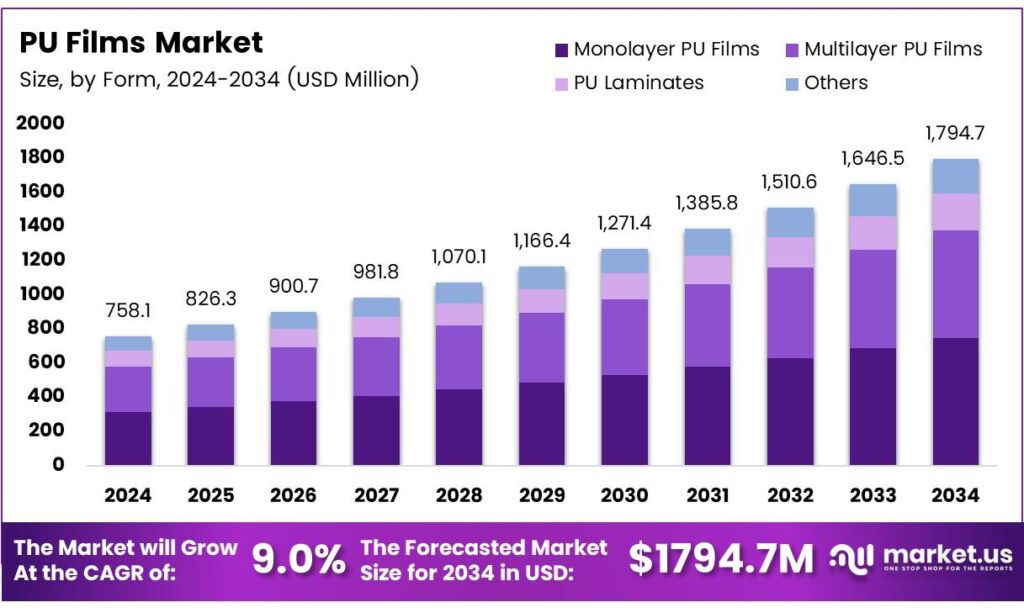
PU Films Market Size
- The global PU Films Market is anticipated to expand from USD 758.1 million in 2024 to nearly USD 1,794.7 million by 2034, registering a CAGR of 9.0% over the forecast period from 2025 to 2034.
- In terms of form type, Monolayer PU Films accounted for the leading market position, securing a 38.4% share of the global market.
- Based on application, Surface Protection Films emerged as the dominant category, contributing 37.8% of the total market share.
- Among end-use industries, the Automotive and Transportation segment held the largest share, representing 29.6% of the overall PU Films Market.
- Regionally, Asia Pacific maintained its leading position with a 44.1% market share and was valued at approximately USD 334.3 million.
Regional Analysis
The Asia Pacific region holds the leading position in the global PU Films Market, accounting for 44.1% of the total market share and reaching a valuation of USD 334.3 million. This dominance is primarily driven by the presence of strong manufacturing hubs, increasing automotive production, and the growing adoption of PU films in medical and hygiene applications. Additionally, rising investments in advanced polymer technologies and the expanding demand for durable, protective, and technical films are further supporting market growth across the region.
Segment Analysis
By Form Analysis: In 2025, Monolayer PU Films emerged as the leading segment in the PU Films Market, accounting for a 38.4% market share. Their dominance was supported by an ideal balance of strength, flexibility, transparency, and material efficiency, making them highly cost-effective for a wide range of industrial applications. Meanwhile, Multilayer PU Films experienced steady growth due to increasing demand for enhanced durability, advanced barrier protection, and multi-functional performance, particularly in automotive, medical, and industrial sectors.
By Application Analysis: Surface Protection Films dominated the application segment in 2025, capturing a 37.8% share of the global PU Films Market. Their strong market presence was driven by increasing demand for scratch resistance, environmental protection, and long-lasting surface quality across automotive, electronics, and industrial products. Technical Membrane Films also recorded notable growth, supported by their superior filtration efficiency, breathability, and moisture-control properties, which made them suitable for outdoor equipment, infrastructure, and high-performance textiles.
By End-Use Analysis: The Automotive and Transportation segment held the leading position in the PU Films Market in 2025, accounting for a 29.6% market share. Growth in this segment was primarily driven by increasing use of lightweight, durable, and protective materials in vehicle interiors, surface protection systems, and advanced automotive components. The Medical and Healthcare sector also experienced significant expansion, as PU films provided flexible, safe, and biocompatible solutions for wound care, medical devices, and hygiene products.
Emerging Trends
- The PU Films Market is witnessing a strong shift toward sustainable and high-performance materials, as manufacturers increasingly focus on developing eco-friendly, recyclable, and bio-based PU film solutions with reduced environmental impact.
- Companies are investing heavily in research and innovation to introduce biodegradable PU films that can deliver performance standards comparable to conventional polyurethane materials.
- The rapid growth of the electric vehicle (EV) industry is influencing demand dynamics within the PU Films Market. Global electric car sales exceeded 17 million units in 2024, reflecting growth of more than 25% compared to the previous year.
- According to the IEA, electric vehicles accounted for over 20% of total global car sales in 2024, with China contributing more than 11 million EV sales during the year, highlighting expanding opportunities for PU film applications in automotive manufacturing.
- The increasing complexity of compliance requirements, workforce training, and procurement processes is encouraging some manufacturers to seek simpler and more efficient material handling solutions within PU film production and supply chains.
Use Cases
1. Automotive Paint Protection: PU films are widely used as paint protection films on cars, motorcycles, aircraft, and electronic surfaces. They help protect surfaces from stone chips, scratches, road debris, bug stains, and minor abrasions. This use case is growing with vehicle demand, especially EVs, as global electric car sales crossed 17 million units in 2024, rising over 25% year-on-year. China alone sold more than 11 million electric cars in 2024.
2. Medical Wound Dressings: PU films are used in transparent wound dressings because they are thin, flexible, breathable, and comfortable on skin. They allow moisture vapor and gases to pass through while blocking water, liquids, and bacteria. In wound care, controlled moisture is important; one study found that a water vapor transmission rate of around 2,028.3 g/m²/24 h helped maintain suitable wound moisture conditions.
3. Sportswear and Outdoor Clothing: PU films are used in jackets, sportswear, footwear, ski suits, nautical suits, and protective clothing. They provide waterproofing while allowing breathability, which improves user comfort. Waterproof breathable membranes are widely used in outdoor and protective garments because they help protect the body while supporting comfort during movement or harsh weather.
4. Flexible Electronics and Wearables: PU films are becoming important in flexible electronics, smart wearables, and medical sensors. Their stretchability, flexibility, and lightweight structure make them suitable for skin-contact devices and wearable sensors. Research highlights TPU-based films as useful substrates for flexible strain sensors, including applications in healthcare and automotive systems.
Frequently Asked Questions on PU Films
1. What are PU films?
PU films, also known as polyurethane films, are flexible and durable polymer-based films widely used in automotive, medical, textile, electronics, and packaging industries. They offer excellent abrasion resistance, elasticity, transparency, waterproofing, and chemical stability, making them suitable for high-performance industrial and consumer applications.
2. What is driving the growth of the PU Films Market?
The PU Films Market is growing due to rising demand for lightweight, protective, and durable materials across automotive, healthcare, electronics, and textile sectors. Increasing electric vehicle production, medical applications, and demand for breathable waterproof fabrics are also supporting long-term market expansion globally.
3. What are the major types of PU films available in the market?
The major types of PU films available in the market include Monolayer PU Films, Multilayer PU Films, PU Laminates, and other specialty polyurethane films designed for customized industrial applications. Among these, Monolayer PU Films held the leading market position in 2025, accounting for a 38.4% share in the By Form segment. Their dominance is mainly driven by their balanced combination of strength, flexibility, clarity, and material efficiency, along with their cost-effective nature, which supports widespread adoption across multiple industries.
4. Which region dominates the global PU Films Market?
Asia Pacific leads the global PU Films Market due to its strong manufacturing infrastructure, growing automotive production, and increasing demand for medical and hygiene applications. The region accounted for a dominant 44.1% market share, valued at approximately USD 334.3 million. Rising investments in high-performance polymer materials, along with growing demand for protective and technical films across industries, continue to strengthen the region’s market position.
5. What is the future outlook for the PU Films Market?
The future outlook for the PU Films Market remains positive due to increasing demand for advanced materials, sustainable products, and flexible technologies. Growth in electric vehicles, medical devices, smart wearables, and high-performance textiles is expected to create new long-term business opportunities.
Conclusion
The PU Films Market is expected to witness steady long-term growth as industries continue shifting toward lightweight, durable, and high-performance materials. Increasing demand from automotive, medical, textiles, electronics, and protective packaging sectors is supporting wider adoption of PU films across global markets. According to the International Energy Agency (IEA), global electric car sales exceeded 17 million units in 2024, accounting for more than 20% of total car sales worldwide, highlighting strong future demand for advanced protective and flexible materials.
Discuss your needs with our analyst
Please share your requirements with more details so our analyst can check if they can solve your problem(s)