Overview
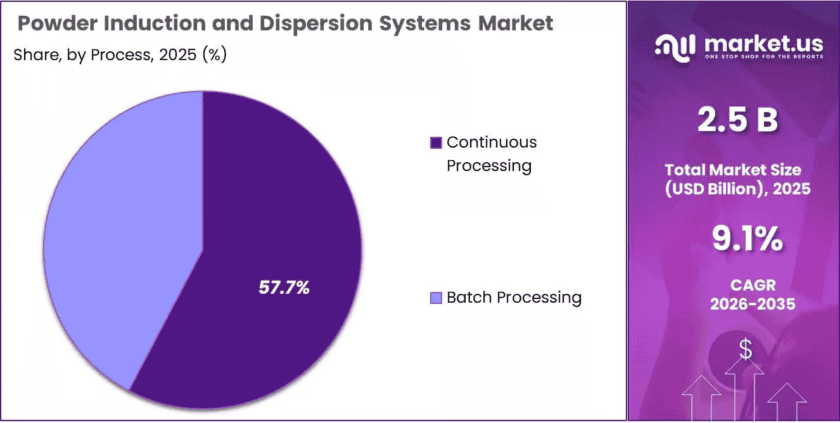
New York, NY – Sep 23, 2026 – The global Powder Induction and Dispersion Systems Market is expected to grow from USD 2.5 billion in 2025 to around USD 5.8 billion by 2035, expanding at a 9.1% CAGR during 2026–2035. These systems are increasingly used across food and beverages, pharmaceuticals, chemicals, cosmetics, coatings, adhesives, and specialty-material processing, where powders must be rapidly incorporated into liquids without lumps, excessive dust, or inconsistent particle distribution.
The industry is shifting toward inline dispersion, continuous processing, closed powder transfer, sanitary designs, and automated recipe control. In 2025, Powder Dispersion Systems accounted for more than 56.00%, Inline Mixing held over 58.00%, Continuous Processing represented more than 57.00%, and Food & Beverages captured above 48.00%.
Demand is supported by broader manufacturing investment. U.S. Bureau of Economic Analysis data show that new foreign investment in American manufacturing reached USD 121.8 billion in 2025, equal to 52.5% of total new investment spending, while chemical manufacturing attracted USD 45.4 billion.
Manufacturers are also giving greater attention to operator safety, hygiene, automated ingredient handling, energy consumption, batch consistency, and production uptime. These factors are encouraging replacement of open manual powder charging with enclosed induction and high-shear dispersion technologies.
Key Takeaways
- The global Powder Induction and Dispersion Systems Market was valued at USD 2.5 billion in 2025 and is projected to reach approximately USD 5.8 billion by 2035, expanding at a 9.1% CAGR.
- Powder Dispersion Systems dominated the product category in 2025 with more than a 56.00% share, supported by their ability to improve powder wetting and formulation uniformity.
- Inline Mixing accounted for more than a 58.00% share as manufacturers increasingly preferred direct powder incorporation within processing lines.
- Continuous Processing captured more than a 57.00% share, benefiting from demand for higher throughput, fewer material-transfer stages, and repeatable processing.
- Food & Beverages led applications with more than a 48.00% share, driven by the processing of proteins, starches, gums, milk powders, stabilizers, flavors, and sweeteners.
- North America led the market with a 36.50% share and approximately USD 0.90 billion in revenue during 2025.
Regional Analysis
North America Leads with 36.50% Share and USD 0.90 Billion Market Value
North America held a dominant position in 2025, capturing more than a 36.50% share and generating approximately USD 0.90 billion. Demand is supported by a large base of chemical, pharmaceutical, food, coatings, and specialty-processing facilities seeking cleaner powder transfer and automated dispersion. U.S. BEA data show that foreign investors spent USD 232.2 billion acquiring, establishing, or expanding U.S. businesses in 2025, up 49.5% from 2024. Manufacturing received USD 121.8 billion, while chemicals attracted USD 45.4 billion, supporting investments in mixers, sanitary process skids, automation, pumps, and powder-handling equipment.
Asia Pacific is developing rapidly as chemical, food, battery, pharmaceutical, and machinery production expands. This creates opportunities for continuous mixers, high-shear dispersers, automated feeding systems, and closed powder-transfer technologies, particularly in high-volume processing plants.
Market Dynamics
Driver – Automation of Powder Handling Improves Production Efficiency
Automation is a major driver for powder induction and dispersion systems as manufacturers seek to reduce manual powder charging, dust generation, processing time, and operator exposure. OSHA warns that finely divided combustible materials can create fire or deflagration risks when dispersed in air and recommends minimizing dust escape, using collection systems, and maintaining controlled housekeeping procedures. U.S. manufacturing investment also remains strong, with USD 121.8 billion in new foreign direct investment entering manufacturing during 2025. Chemical manufacturing alone attracted USD 45.4 billion, creating a strong base for automated process-equipment upgrades. Enclosed induction, automated feeding, and inline dispersion can therefore improve safety while supporting faster and more repeatable production.
Trend – Continuous and Inline Processing Gains Wider Acceptance
Manufacturers are increasingly moving toward continuous and inline processing instead of relying entirely on traditional batch mixing. Inline systems can combine powder induction, wetting, dispersion, and liquid circulation within one processing route, reducing intermediate transfers and equipment requirements. Eurostat reported that EU food-product sold production increased 3.8% in constant-price terms during 2025, while output was 11.2% higher than in 2015. Growing food, beverage, pharmaceutical, coatings, and chemical volumes require processing equipment capable of maintaining consistency at higher throughput. This is encouraging investments in continuous mixers, automated dosing, variable-speed drives, digital recipe control, and real-time process monitoring.
Restraint – High Installed Cost and Engineering Complexity
High initial investment remains a restraint, particularly for small and medium processors. A complete powder induction installation may require sanitary vessels, powder hoppers, pumps, mixers, instrumentation, PLC controls, dust extraction, piping, electrical work, commissioning, and cleaning systems. Financing conditions can make these projects difficult when operators require short payback periods. Equipment also needs to meet application-specific hygiene and safety requirements. FDA Current Good Manufacturing Practices address plant equipment, sanitary operations, facility sanitation, and production controls within food manufacturing. OSHA likewise requires careful management of combustible powder hazards. These requirements improve safety and quality but can raise engineering, validation, installation, and maintenance costs.
Opportunity – Pharmaceutical and Specialty Formulation Investment
Pharmaceutical production offers an important growth opportunity because liquid medicines, suspensions, excipients, coatings, and specialty formulations require precise powder wetting and uniform dispersion. The U.S. FDA approved 46 novel drugs in 2025, demonstrating continued pharmaceutical product development. Of these approvals, 32, or 70%, received U.S. approval before other countries, while 23 received orphan-drug designation. This development supports demand for validated sanitary mixers, closed powder induction units, clean-in-place systems, and automated recipe management. Equipment suppliers also have opportunities in modular skids, continuous pharmaceutical processing, high-purity systems, digital batch records, and formulation-specific dispersion technologies designed for regulated production environments.
Emerging Trends
1. Closed Powder Transfer Systems
Manufacturers are moving toward enclosed powder transfer to reduce airborne material and operator contact. OSHA defines combustible dust as material capable of creating a fire or deflagration hazard when suspended in air, supporting wider adoption of vacuum induction, sealed hoppers, and dust-controlled feeding equipment.
2. Inline and Continuous Mixing
Continuous mixing is gaining attention as factories seek higher throughput with fewer transfer stages. EU food-product manufacturing output increased 3.8% in 2025, while machinery and equipment production rose 3.3%, supporting demand for high-capacity inline dispersion and continuous-processing equipment.
3. Greater Pharmaceutical Process Control
Pharmaceutical manufacturers increasingly require repeatable powder incorporation, sanitary designs, and controlled formulations. FDA approved 46 novel drugs during 2025, creating continued activity around new drug manufacturing, excipients, coatings, suspensions, and other formulations where accurate dispersion and validated processing are important.
4. Energy-Efficient Processing Equipment
Energy performance is becoming more important as process manufacturers seek lower operating costs. The U.S. Department of Energy states that chemical and petrochemical industries account for about 40% of U.S. industrial energy use, increasing interest in efficient motors, pumps, mixers, separations, and process intensification.
5. Automated Sanitation and Cleaning
Cleanability is becoming a stronger purchasing factor in hygienic processing. USDA updated its Dairy Program Plant Survey Manual in December 2025, with new criteria taking effect on February 1, 2026, reflecting modernization of sanitation, equipment, and processing practices.
Use Cases
1. Food and Beverage Processing
Powder induction systems mix milk powders, cocoa, proteins, starches, gums, sweeteners, minerals, and stabilizers into liquids. U.S. food and beverage manufacturing represents 16.8% of manufacturing sales, demonstrating the large industrial base requiring hygienic ingredient handling and reliable mixing equipment.
2. Pharmaceutical Formulations
Pharmaceutical plants use dispersion equipment for active ingredients, excipients, coatings, suspensions, and liquid medicines. FDA approved 46 novel drugs in 2025, highlighting continued formulation activity and the need for sanitary, repeatable and closely controlled mixing systems across regulated pharmaceutical manufacturing facilities.
3. Chemical Production
Chemical manufacturers use powder dispersion equipment for polymers, additives, fillers, catalysts, pigments, and specialty formulations. U.S. chemical manufacturing attracted USD 45.4 billion in new foreign direct investment during 2025, supporting modernization of mixing, feeding, pumping, automation, and material-handling infrastructure.
4. Paints and Coatings
Paint and coating production requires pigments, fillers, thickeners, and additives to be evenly dispersed into liquid carriers. OSHA guidance identifies finely divided solids below 420 microns as potentially combustible under appropriate conditions, making controlled induction and dust management important in powder-processing areas.
5. Dairy and Nutritional Products
Dairy processors use powder induction for milk solids, proteins, stabilizers, vitamins, minerals, and nutritional ingredients. USDA’s revised dairy plant inspection requirements took effect on February 1, 2026, emphasizing updated sanitation, equipment, and processing practices that support hygienic mixing-system upgrades.
Frequently Asked Questions on Powder Induction and Dispersion Systems Market
What is the Powder Induction and Dispersion Systems Market?
The market covers equipment designed to introduce dry powders into liquids and distribute particles evenly. These systems are used in food, pharmaceutical, chemical, cosmetics, coatings, and other manufacturing processes where fast wetting and consistent formulations are required.
How large was the Powder Induction and Dispersion Systems Market in 2025?
The global Powder Induction and Dispersion Systems Market was valued at approximately USD 2.5 billion in 2025. It is expected to reach around USD 5.8 billion by 2035, representing a 9.1% CAGR.
Which product type dominated the market in 2025?
Powder Dispersion Systems held the leading product position in 2025, accounting for more than a 56.00% share. Their strong use comes from their ability to improve powder wetting, break agglomerates, and deliver consistent formulations.
Which mixing technology held the largest share?
Inline Mixing captured more than a 58.00% share in 2025. It allows powders to be incorporated directly into flowing liquids, helping processors reduce additional material transfers while improving throughput, repeatability, and integration with automated production lines.
Which process dominated the market?
Continuous Processing accounted for more than a 57.00% share in 2025. The process supports steady ingredient introduction, wetting, mixing, and dispersion, making it useful for high-throughput food, chemical, pharmaceutical, coating, and personal-care manufacturing operations.
Which application leads the market?
Food & Beverages held more than a 48.00% share in 2025. Powder induction equipment is widely used for proteins, starches, gums, cocoa, milk powder, stabilizers, sweeteners, flavors, and minerals in processed foods and beverages.
Which region dominates the market?
North America led the Powder Induction and Dispersion Systems Market in 2025 with more than a 36.50% share and approximately USD 0.90 billion in revenue, supported by extensive food, chemical, pharmaceutical, and industrial manufacturing activity.
Why are enclosed powder induction systems becoming important?
Enclosed systems can reduce uncontrolled airborne powder and manual handling. OSHA recognizes combustible dust as an industrial explosion hazard and recommends controlling dust escape, collection, housekeeping, and ignition risks, encouraging manufacturers to adopt better-contained powder-processing equipment.
What limits adoption of powder induction systems?
High capital cost, plant modification, sanitation requirements, dust controls, validation, and operator training can slow investment. Different powders also behave differently during feeding and wetting, meaning equipment often requires application testing and process-specific engineering before commercial installation.
What creates future growth opportunities?
Growth opportunities come from pharmaceutical investment, automated food processing, closed powder handling, specialty chemicals, battery materials, digital recipe control, and continuous manufacturing. Increasing factory automation is encouraging processors to replace manual charging with cleaner, faster, and more repeatable systems
Conclusion
The Powder Induction and Dispersion Systems Market is moving toward cleaner, faster, and increasingly automated production. Valued at USD 2.5 billion in 2025, the market is projected to reach USD 5.8 billion by 2035, expanding at a 9.1% CAGR. Demand is being supported by food processing, pharmaceuticals, chemicals, coatings, and other industries requiring accurate powder incorporation. Enclosed induction, inline mixing, continuous processing, automated dosing, and sanitary equipment are becoming increasingly important. Strong manufacturing investment and stricter attention to dust control and product consistency should continue creating opportunities for equipment upgrades, process automation, and energy-efficient dispersion technologies.
Discuss your needs with our analyst
Please share your requirements with more details so our analyst can check if they can solve your problem(s)