Report Overview
In 2025, the Global Perovskite Quantum Dots Market was valued at USD 1.0 billion. From 2026 to 2035, the market is projected to grow at a CAGR of 20.7%, reaching approximately USD 6.6 billion by 2035. Asia-Pacific held the leading position in 2025, accounting for more than 41.3% of the market and generating revenue of USD 0.4 billion.
Perovskite quantum dots are an emerging class of semiconductor nanomaterials with applications across photovoltaics, light-emitting devices, photodetectors, sensors, and other optoelectronic systems. Their key industrial benefits include tunable optical properties, strong light absorption, solution-based processing, and compatibility with relatively low-temperature manufacturing.
- Research from the National Renewable Energy Laboratory has reported perovskite quantum-dot solar-cell efficiencies of 16.6%. At the broader perovskite technology level, laboratory development during 2025 achieved about 27% single-junction efficiency and more than 34.5% efficiency for perovskite-silicon tandem cells. These results highlight the potential of quantum-dot-based absorber and interface technologies for future high-efficiency devices.
The market is also benefiting from the rapid expansion of solar photovoltaic deployment worldwide. According to the International Energy Agency, global renewable capacity additions reached approximately 800 GW in 2025, while solar PV installations surpassed 600 GW for the first time. As a result, cumulative global solar PV capacity increased to around 2,800 GW. This rapid growth is creating a broader technology platform for next-generation materials that can improve power density, lower material consumption, and support lightweight or flexible photovoltaic products.
- IEA data indicate that solar PV generation increased by approximately 600 TWh in 2025, while renewable sources accounted for around 34% of global electricity generation. Wind and solar PV together contributed about 17% of worldwide electricity output. Increasing renewable energy penetration is encouraging manufacturers and research institutions to develop higher-efficiency photovoltaic materials capable of generating more electricity from limited surface areas.
Despite these opportunities, commercial adoption will depend significantly on improvements in durability, manufacturing consistency, environmental protection, and large-area processing. In April 2025, an NREL-led perovskite study demonstrated approximately 26% laboratory efficiency with only around 2% degradation after 2,100 hours of continuous operation under elevated-temperature testing. At the policy level, the U.S. Department of Energy’s FY2025-27 solar laboratory program also includes dedicated research on perovskite-enabled tandems and scalable vapor-transport deposition of metal-halide perovskites.
The IEA forecasts nearly 4,600 GW of additional renewable capacity during 2025-2030, with solar PV expected to represent almost 80% of global renewable electricity expansion. Competitive auctions are also projected to account for nearly 60% of utility-scale renewable additions during this period, increasing pressure on technology suppliers to lower electricity costs and improve energy output. In this environment, perovskite quantum dots could become increasingly important for tandem photovoltaics, flexible solar products, building-integrated PV, LEDs, photodetectors, and printable optoelectronics, provided that challenges related to stability, lead management, encapsulation, and scalable production continue to be addressed.
Key market segment
- The Global Perovskite Quantum Dots Market was valued at USD 1.0 billion in 2025.
- The market is projected to grow at a CAGR of 20.7% and is estimated to reach USD 6.6 billion by 2035.
- On the basis of Type, Lead-based dominated the market, constituting 60.6% of the total market share.
- Based on the Application, Solar Cells dominated the market, with a substantial market share of around 34.8%.
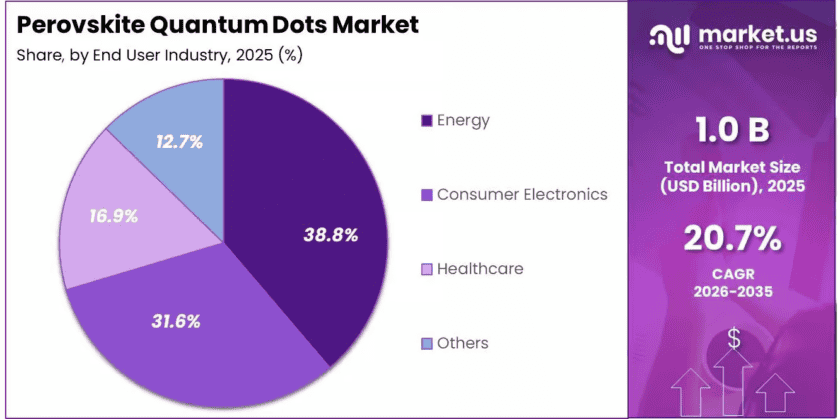
- Based on the End User Industry, Energy led the market, comprising 38.8% of the total market.
- In 2025, Asia-Pacific was the most dominant region in the market, accounting for 41.3% of the total global consumption.
Type Analysis
Lead-based dominates with 60.6% share, supported by stronger optoelectronic performance
In 2025, Lead-based held the leading position with more than a 60.6% market share, supported by the strong light absorption, efficient charge transport, tunable emission, and solution processability of lead-halide compositions such as CsPbBr₃, CsPbI₃, and FAPbI₃ across solar cells, LEDs, displays, and other optoelectronic applications. In June 2025, an NIH-indexed study reported 18.17% power-conversion efficiency for cesium-formamidinium lead triiodide perovskite quantum-dot solar cells, while another 2025 PubMed study found CsPbBr₃ quantum-dot films achieved up to 78.64% photoluminescence quantum yield and QLEDs reached 9.67% external quantum efficiency.
Application Analysis
Solar Cells dominate with 34.8% as rising photovoltaic capacity strengthens demand for advanced light-harvesting materials
In 2025, Solar Cells led the market with more than a 34.8% share, driven by the use of perovskite quantum dots to improve light absorption, wavelength control, and energy conversion in next-generation photovoltaic devices. The U.S. Energy Information Administration reported total U.S. solar photovoltaic capacity of 209,304.0 MW in 2025, rising to 222,690.5 MW by May 2026, supporting demand for advanced materials for lightweight and flexible solar designs. Lasers represent the fastest-growing application, supported in 2026 by the narrow emission, tunable wavelengths, high brightness, and efficient light interaction of perovskite quantum dots for compact lasers, optical communication systems, sensing, and integrated photonics.
End User Industry Analysis
Energy dominates the Perovskite Quantum Dots Market with a 38.8% share, supported by expanding solar power generation
In 2025, Energy accounted for more than a 38.8% market share, supported by increasing interest in perovskite quantum dots for advanced photovoltaic technologies and their tunable optical properties and solution-based processing. The U.S. Energy Information Administration reported that utility-scale solar generation reached 296,000 GWh in 2025, while small-scale solar generated another 93,000 GWh, creating opportunities for further development of perovskite quantum dots in energy conversion. Consumer Electronics is the fastest-growing segment, driven by the material’s adjustable light-emission properties for displays, LEDs, and compact optoelectronic devices, enabling brighter and more efficient display technologies.
Emerging Trends
1. Higher-Efficiency Quantum Dot Solar Cells
Perovskite quantum dots are moving toward higher photovoltaic efficiency through surface and interface engineering. A 2025 NIH-indexed study achieved 18.17% power-conversion efficiency in CsₓFA₁₋ₓPbI₃ PQD solar cells, demonstrating the progress of defect control and surface-lattice reinforcement.
2. Stronger Focus on Surface Passivation
Surface passivation is becoming an important development trend because defects can reduce light emission and charge transport. In 2025, PEABr-treated CsPbBr₃ QDs achieved 78.64% photoluminescence quantum yield and 9.67% external quantum efficiency in QLEDs, showing measurable gains from improved surface quality.
3. Expansion into High-Performance Photodetectors
Perovskite quantum dots are increasingly being combined with other materials to improve photodetection. A 2025 ACS study developed CsPbBr₃ QD/carbon-nanotube photodetectors with 1.6 × 10⁶ A/W photoresponsivity and 3.1 × 10¹⁵ Jones detectivity, supporting applications in sensitive optical sensing.
4. Growth of High-Resolution Displays and QLEDs
The combination of narrow emission, color tunability, and solution processing is increasing interest in perovskite quantum dots for displays. Research has demonstrated CsPbBr₃ emission at 516 nm, a 45.71 ns average photoluminescence lifetime, and 32.69 cd A⁻¹ current efficiency, supporting development of brighter and more precise QLED technologies.
5. Development of Broadband Optical Detection
Another emerging trend is combining PQDs with other semiconductor materials to extend wavelength coverage. In 2025, an InSrO/CsPbBr₃ QD photodetector achieved broadband detection from 230–500 nm, with a low operating voltage of 0.05 V, responsivity of 6.88 A/W, and detectivity of 6.39 × 10¹⁴ Jones.
6. Increasing Interest in Photocatalysis
Perovskite quantum dots are expanding beyond conventional optoelectronics into photocatalytic applications, including hydrogen production, CO₂ reduction, organic-compound degradation, and environmental treatment. Their tunable bandgap and strong light absorption make them attractive for visible-light reactions, although moisture, air, heat, and light stability remain important challenges.
Use Cases
1. Solar Cells and Tandem Photovoltaics
Perovskite quantum dots are increasingly being explored for advanced solar cells because of their tunable bandgap, strong light absorption, and solution-based processing. Research published in Nature Energy demonstrated 16.61% champion efficiency (16.20% certified) using FAPbI₃ perovskite quantum-dot inks, while the process also supported large-area 9 × 9 cm² fabrication using blade coating at speeds of up to 50
2. QLED Displays
PQDs can produce narrow and tunable light emission, making them suitable for QLED displays, televisions, monitors, and other visual technologies. A 2025 study reported 78.64% photoluminescence quantum yield and 9.67% external quantum efficiency, demonstrating the potential for improved brightness and color performance.
3. Photodetectors and Optical Sensors
Perovskite quantum dots are used in photodetectors because they can absorb broad ranges of light and provide strong electrical responses. A 2025 CsPbBr₃ QD/SWCNT device achieved 1.6 × 10⁶ A/W responsivity and 3.1 × 10¹⁵ Jones detectivity, indicating potential for highly sensitive sensing systems.
4. Infrared Detection and Optical Communication
PQD-based materials can extend detection into infrared wavelengths when integrated with suitable semiconductor structures. A 2025 quantum-dot-enabled perovskite device achieved broadband detection from 300–1200 nm, with 2.9 × 10¹¹ Jones detectivity at 1170 nm, supporting infrared sensing and multifunctional optoelectronic applications.
5. Environmental Monitoring
PQD photodetectors can be used for monitoring UV and visible radiation because of their strong optical response and low operating requirements. A 2025 InSrO/CsPbBr₃ QD device detected wavelengths from 230–500 nm while operating at only 0.05 V, making this technology relevant for compact environmental and optical monitoring systems.
6. Photocatalytic Hydrogen and CO₂ Conversion
Perovskite quantum dots are being investigated as visible-light photocatalysts for hydrogen production and CO₂ reduction. Their strong absorption and tunable electronic structure can support solar-driven chemical reactions, while research also explores organic-pollutant degradation and other environmental applications.
Conclusion
Perovskite quantum dots are developing into a versatile nanomaterial for solar cells, QLEDs, photodetectors, optical sensors, lasers, and photocatalytic systems. Recent results, including 18.17% PQD solar-cell efficiency and 9.67% QLED external quantum efficiency, demonstrate strong technical progress. However, long-term stability, moisture sensitivity, scalable manufacturing, and lead management remain important barriers. Continued surface passivation, interface engineering, encapsulation, and material optimization are expected to determine how quickly PQDs move from laboratory research toward broader commercial applications.
Frequently Asked Questions
1. What are Perovskite Quantum Dots?
Perovskite quantum dots are nanoscale semiconductor crystals based on perovskite materials. Their small size provides tunable optical and electronic properties, making them useful for solar cells, LEDs, displays, photodetectors, sensors, and other advanced optoelectronic devices.
2. What are Perovskite Quantum Dots used for?
Perovskite quantum dots are used in solar cells, QLED displays, photodetectors, optical sensors, lasers, and photocatalytic systems. Their tunable bandgap, narrow emission, strong light absorption, and solution processing make them suitable for multiple advanced technology applications.
3. Why are Lead-based Perovskite Quantum Dots popular?
Lead-based perovskite quantum dots remain popular because they provide strong light absorption, efficient charge transport, tunable emission, and high-quality optical properties. These characteristics support high-performance photovoltaic, display, lighting, sensing, and other optoelectronic applications.
4. How efficient are Perovskite Quantum Dot solar cells?
Perovskite quantum dot solar cells have demonstrated significant efficiency improvements. NREL reported efficiencies of 16.6%, while a 2025 study achieved 18.17% using CsₓFA₁₋ₓPbI₃ quantum dots through improved surface-lattice engineering and reduced nonradiative recombination.
5. Can Perovskite Quantum Dots be used in displays?
Yes, perovskite quantum dots are promising materials for QLED displays because they provide narrow-band and tunable light emission. In 2025, CsPbBr₃ QDs achieved 78.64% photoluminescence quantum yield and QLED external quantum efficiency of 9.67%.
6. What are the main advantages of Perovskite Quantum Dots?
Key advantages include tunable bandgaps, strong light absorption, narrow emission, high charge-carrier mobility, solution-based processing, and flexible composition. These properties allow PQDs to support energy harvesting, light generation, photon detection, and photocatalytic applications.
7. What challenges affect Perovskite Quantum Dot commercialization?
Commercialization is mainly challenged by sensitivity to air, moisture, heat, and light, along with long-term operational stability and scalable manufacturing requirements. Lead-containing compositions also require careful environmental management, encapsulation, material handling, and recycling strategies.
8. What is driving the Perovskite Quantum Dots Market?
Market development is being supported by rising demand for high-efficiency photovoltaics, advanced displays, optical sensors, photodetectors, and compact optoelectronic devices. Continued improvements in surface passivation, interface engineering, stability, and scalable processing are strengthening commercialization potential.
9. Are Perovskite Quantum Dots suitable for photodetectors?
Yes, PQDs are highly suitable for photodetection because of their strong absorption and tunable spectral response. Research has demonstrated devices with responsivity of 1.6 × 10⁶ A/W and detectivity of 3.1 × 10¹⁵ Jones, showing strong sensing potential.
10. What is the future of Perovskite Quantum Dots?
The future of perovskite quantum dots is likely to center on higher-efficiency solar cells, brighter displays, sensitive photodetectors, optical communication, lasers, and photocatalysis. Commercial progress will depend on improving stability, manufacturing scalability, environmental safety, and device lifetime.
Discuss your needs with our analyst
Please share your requirements with more details so our analyst can check if they can solve your problem(s)