Overview
New York, NY – Sep 23, 2026 – The global Gluten Feed Market is projected to grow from USD 4.6 billion in 2025 to around USD 8.3 billion by 2035, expanding at a 6.0% CAGR during 2026–2035. Gluten feed is mainly produced as a co-product of grain processing, particularly corn wet milling, and is widely used in livestock diets because it provides digestible fibre, protein, and energy.
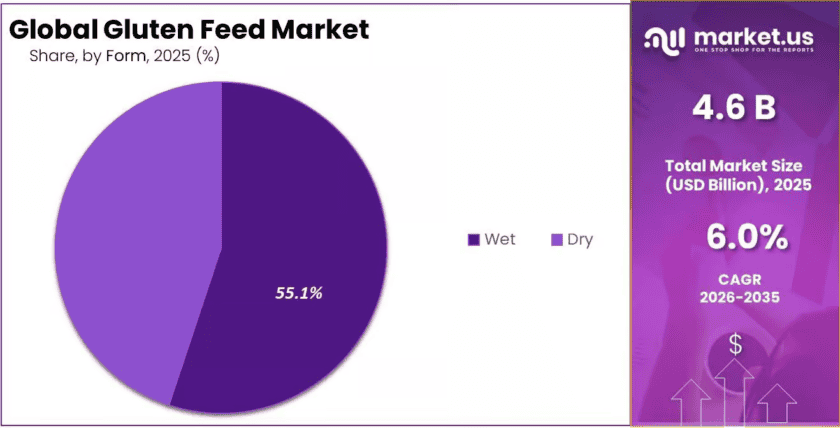
Corn remained the leading source in 2025 with more than a 59.80% share, while Wet gluten feed captured above 55.10%. Cattle represented more than 52.80% of livestock use. North America led the global market with a 32.60% share and approximately USD 1.51 billion in revenue.
The industrial base supporting gluten feed remains strong. USDA estimated global corn production at 1.33 billion metric tons in 2025/26, including 432.34 million metric tons in the United States. USDA also reported record U.S. corn production of 17.0 billion bushels in 2025.
Gluten feed also fits the growing circular-feed model because it converts grain-processing co-products into useful animal nutrition instead of waste. Demand is supported by dairy and beef feeding, higher feed requirements, grain-processing capacity, and growing interest in cost-effective alternatives to conventional grain and protein meals.
Key Takeaways
- The Gluten Feed Market was valued at USD 4.6 billion in 2025 and is forecast to reach around USD 8.3 billion by 2035, growing at a 6.0% CAGR.
- Corn dominated the source segment with more than a 59.80% share in 2025.
- Wet gluten feed held more than a 55.10% share, supported by its use in cattle operations near wet-milling facilities.
- Cattle accounted for more than a 52.80% share of livestock demand.
- North America led the market with a 32.60% share, reaching approximately USD 1.51 billion in 2025.
- USDA reported global corn production of 1.33 billion metric tons in 2025/26, strengthening the raw-material base for corn-derived feed co-products.
Regional Analysis
North America Leads with 32.60% Share and USD 1.51 Billion Market Value
North America held a dominant position in the Gluten Feed Market in 2025, capturing more than a 32.60% share and generating approximately USD 1.51 billion. The region benefits from large corn-processing capacity, a developed livestock industry, established feed distribution, and significant wet-milling activity.
USDA reported 86.2 million cattle and calves on U.S. farms as of January 1, 2026, including 27.6 million beef cows, 9.57 million milk cows, and 13.8 million cattle on feed. This large ruminant population supports steady demand for digestible fibre and protein feed ingredients.
The United States also remains a major corn-processing base. USDA reported 251,479 tons of corn gluten feed production during January 2026, along with 193,748 tons of wet corn gluten feed containing 40–60% moisture.
Asia Pacific is developing rapidly as feed demand expands alongside livestock and compound-feed production. USDA projected China’s 2026/27 corn production at 306 million metric tons, supporting a large regional feed-processing base.
Market Dynamics
Driver – Large Cattle and Dairy Feed Demand Supports Gluten Feed Consumption
Cattle feeding remains a major demand driver because gluten feed provides digestible fibre, protein, and energy that can partly replace conventional grain and protein ingredients. USDA reported 86.2 million cattle and calves in the United States in January 2026, including 9.57 million milk cows and 27.6 million beef cows. Another 13.8 million cattle were on feed. The European Commission also reports that roughly 5 million EU farmers raise food-producing animals valued at around EUR 130 billion, requiring approximately 450 million tons of feed each year. These large livestock populations support steady use of grain-processing co-products in formulated feed.
Trend – Circular Feed Ingredients Gain Importance
The feed industry is increasingly using co-products from food, starch, and biofuel processing to reduce waste and recover nutritional value. Gluten feed fits this trend because it is produced during wet milling after starch, germ, and other fractions are separated from corn. USDA defines corn gluten feed as the portion remaining after most starch, gluten, and germ are removed during wet milling. In January 2026, U.S. wet mills produced 251,479 tons of corn gluten feed and 193,748 tons of wet corn gluten feed. This large co-product stream supports circular processing while giving livestock producers an alternative source of fibre and protein.
Restraint – Competing Feed Ingredients Pressure Gluten Feed Demand
Gluten feed competes directly with corn, soybean meal, DDGS, wheat bran, and other low-cost ingredients used in least-cost feed formulation. USDA reported 1.78 million tons of distillers dried grains with solubles production in January 2026, compared with 251,479 tons of corn gluten feed. This much larger DDGS supply gives feed manufacturers another widely available protein and energy co-product. USDA also states that corn represents more than 95% of U.S. feed-grain production and use, while feed demand accounts for roughly 40% of domestic corn use. Changes in corn, soybean meal, DDGS, and freight prices can therefore quickly change gluten feed inclusion levels.
Opportunity – Growth in Feed Demand Creates Space for Value-Added Gluten Feed
Rising global feed demand creates opportunities for standardized, pelletized, preserved, and quality-certified gluten feed products. USDA projected global coarse-grain consumption at approximately 1.608 billion metric tons in 2026/27, with growth largely supported by feed and residual use. In China, USDA projected 2026/27 corn production at 306 million metric tons as feed demand continues to expand. Suppliers can improve the commercial value of gluten feed through better nutrient testing, moisture control, pelleting, storage stability, and digital certificates of analysis. These improvements can help feed manufacturers use gluten feed more confidently across dairy, beef, poultry, aquaculture, and other formulated-feed applications.
Emerging Trends
1. Greater Use of Wet Gluten Feed
Wet gluten feed is becoming more relevant for cattle operations located near wet mills. USDA reported 193,748 tons of wet corn gluten feed production in January 2026, up 3% from December 2025, highlighting steady commercial movement of this feed form.
2. Larger Corn Supply Supports Co-Product Availability
Strong corn production supports continued gluten feed supply. USDA estimated record U.S. corn output of 17.0 billion bushels in 2025, up 14% from 2024, while average yield reached a record 186.5 bushels per acre.
3. Feed Formulation Is Becoming More Cost Sensitive
Feed manufacturers increasingly compare gluten feed with corn, DDGS, and other substitutes. USDA states that feed use accounts for about 40% of domestic U.S. corn consumption, making ingredient-price relationships an important factor in ration formulation and purchasing decisions.
4. Circular Grain Processing Expands
Wet milling separates corn into starch, germ, gluten, fibre, and other products, allowing feed co-products to retain economic value. U.S. wet mills produced 251,479 tons of corn gluten feed during January 2026, demonstrating the scale of circular feed production.
5. Asian Feed Demand Remains Important
Asia is becoming increasingly important for global feed consumption. USDA projected China’s corn production at 306 million metric tons for 2026/27 and imports at 6 million metric tons, demonstrating the scale of regional grain and livestock-feed requirements.
Use Cases
1. Beef Cattle Feed
Corn gluten feed is widely used in beef rations because ruminants can efficiently utilize its digestible fibre and protein. USDA counted 27.6 million beef cows and 13.8 million cattle on feed in January 2026, supporting large feed demand.
2. Dairy Cattle Nutrition
Dairy farms use gluten feed as a fibre and protein ingredient alongside forage and grain. USDA reported 9.57 million milk cows in the United States in January 2026, giving gluten feed suppliers a large recurring commercial dairy-feed customer base.
3. Compound Feed Manufacturing
Feed mills can blend dried or pelleted gluten feed into compound rations for different livestock classes. The European Commission estimates that EU food-producing animals consume approximately 450 million tons of feed annually, illustrating the scale of industrial feed formulation.
4. Local Wet Feed Supply
Wet corn gluten feed is useful for farms located near processing facilities because it avoids the energy-intensive drying stage. USDA recorded 193,748 tons of wet corn gluten feed with 40–60% moisture in January 2026.
5. Pelletized Feed for Longer-Distance Distribution
Dry corn gluten feed can be pelletized for storage and transport to more distant livestock markets. USDA AMS identifies commercial corn gluten feed pellets at around 21% protein, supporting their use as standardized feed ingredients within bulk distribution networks.
Frequently Asked Questions on Gluten Feed Market
What is gluten feed?
Gluten feed is a grain-processing co-product, commonly produced during corn wet milling. It contains fibre, protein, residual starch, and other nutrients, making it useful as an animal-feed ingredient, particularly in beef and dairy cattle diets.
How large was the Gluten Feed Market in 2025?
The global Gluten Feed Market was valued at approximately USD 4.6 billion in 2025. It is forecast to reach around USD 8.3 billion by 2035, expanding at a 6.0% CAGR during 2026–2035.
Which source dominates the Gluten Feed Market?
Corn led the source segment in 2025 with more than a 59.80% share. Large corn wet-milling operations generate gluten feed while producing starch, sweeteners, oils, and other products, creating a steady commercial co-product stream.
Which form leads the Gluten Feed Market?
Wet gluten feed held more than a 55.10% share in 2025. It is particularly useful for cattle farms located close to processing plants because avoiding drying can lower processing costs while preserving a moist, palatable feed form.
Which livestock segment uses the most gluten feed?
Cattle held more than a 52.80% share in 2025. Ruminants can effectively use the digestible fibre and moderate protein content of gluten feed, making it suitable for both beef finishing and dairy feeding programs.
Which region dominates the Gluten Feed Market?
North America led the global market in 2025 with more than a 32.60% share and approximately USD 1.51 billion in revenue, supported by large corn crops, wet-milling capacity, cattle inventories, and established feed-distribution networks.
Why is corn gluten feed important?
Corn gluten feed provides an economic use for material remaining after wet milling. USDA reported 251,479 tons of U.S. corn gluten feed production in January 2026, showing that it represents a significant commercial grain-processing co-product.
What limits wider use of gluten feed?
Major limitations include nutrient variability, wet-product transportation costs, competition from DDGS and soybean meal, moisture management, storage requirements, and changing grain prices. Feed manufacturers normally compare these factors when building least-cost livestock rations.
What is the future opportunity for gluten feed?
Future opportunities include standardized nutrient grades, pelleted products, improved preservation of wet feed, digital quality monitoring, low-carbon feed positioning, and greater use in expanding livestock industries where processors need cost-effective fibre and protein sources.
Is gluten feed mainly used for cattle?
Cattle are the main users because their digestive systems handle fibrous co-products effectively. However, properly formulated gluten feed can also be used at controlled inclusion levels in poultry, swine, aquaculture, equine, and other animal diets.
Conclusion
The Gluten Feed Market is expected to remain an important part of the global livestock-feed and grain-processing industries. Valued at USD 4.6 billion in 2025, the market is projected to reach about USD 8.3 billion by 2035, expanding at a 6.0% CAGR. Strong corn production, large cattle populations, expanding feed consumption, and growing use of grain-processing co-products support demand. Corn, wet feed, and cattle remain the leading market categories. Future opportunities are likely to come from pelletization, nutrient standardization, preservation technologies, quality monitoring, and circular-feed strategies that improve the economic value of processing co-products.
Discuss your needs with our analyst
Please share your requirements with more details so our analyst can check if they can solve your problem(s)