Report Overview
In 2025, the Global Precision Fermentation Market was valued at USD 7.4 billion. From 2026 to 2035, the market is projected to expand at a CAGR of 21.0%, reaching approximately USD 49.4 billion by 2035. North America held the leading position in 2025, accounting for more than 41.52% of the market and generating revenue of USD 3.07 Billion.
Precision fermentation is a sophisticated bio-manufacturing technology that employs genetically programmed microorganisms, including yeast, fungi, and bacteria, to produce targeted functional ingredients such as proteins, enzymes, fats, vitamins, and flavor compounds. In contrast to conventional fermentation methods, precision fermentation allows manufacturers to produce specific high-value ingredients with greater consistency while using fewer resources. The technology is gaining adoption across applications involving dairy proteins, egg proteins, specialty enzymes, and nutritional ingredients.
According to the Good Food Institute (GFI), fermentation-related alternative protein companies received more than USD 350 million in global investment during 2025, demonstrating continued interest in developing scalable food biotechnology solutions. GFI reported an exact funding total of US$357 million, compared with USD 651 million in 2024. This investment activity reflects ongoing efforts to commercialize and scale fermentation-based technologies for food production.
Environmental sustainability is also emerging as an important factor supporting market growth. According to the United Nations Environment Programme (UNEP), food systems are responsible for nearly one-third of global greenhouse gas emissions. This environmental impact is encouraging food manufacturers to investigate ingredient production methods with potentially lower emissions. Precision fermentation offers the potential to reduce agricultural resource requirements compared with conventional livestock-based production, increasing its appeal among food companies seeking to advance sustainability commitments.
Consumer interest in sustainability also continues to influence food and beverage purchasing behavior. According to the International Food Information Council’s 2024 Food and Health Survey, released on 20 June 2024, approximately 31% of American consumers reported that environmental sustainability had a significant influence on their food and beverage purchasing decisions. This indicates that environmentally responsible food products continue to attract consumer attention, although the level of influence has moderated.
The Organisation for Economic Co-operation and Development (OECD) anticipates continued growth in global protein consumption over the coming decades. This trend is expected to create further opportunities for scalable technologies capable of producing non-animal proteins. At the same time, ongoing developments in synthetic biology, strain engineering, and bioprocess optimization are expected to enhance production efficiency and contribute to lower manufacturing costs, supporting the broader adoption of precision fermentation technologies.
Key Market Segments
- Global Precision Fermentation Market was valued at USD 7.4 billion in 2025.
- The market is projected to grow at a CAGR of 21.0% and is estimated to reach USD 49.4 billion by 2035.
- Animal-Free Proteins is the dominant product type, accounting for 42.23% of the market in 2025.
- Yeast is the dominant microorganism type accounting at 45.45% Share.
- Food and Beverages is the dominant application segment at 48.19% Share.
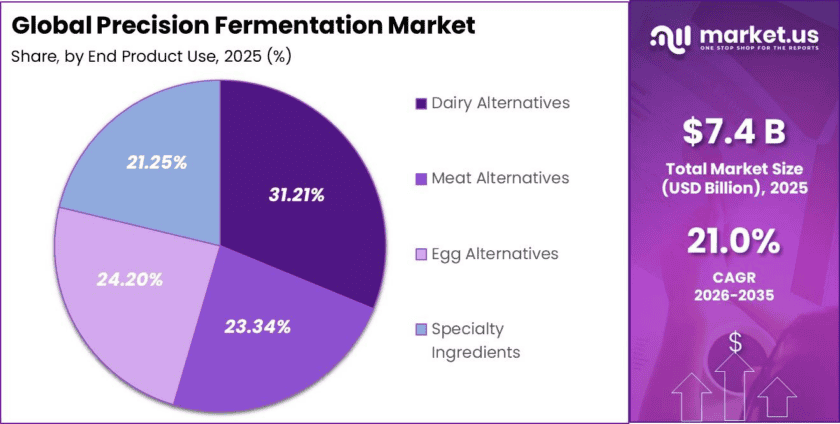
- Dairy Alternatives is the dominant end product use segment at 31.21% Share.
- B2B Industrial Sales is the dominant distribution channel at 85.31% Share.
- North America holds the largest regional share at 41.52%.
Product Type Analysis
Animal-Free Proteins dominates the Precision Fermentation Market with a 42.23% share
In 2025, Animal-Free Proteins maintained its leading position in the global precision fermentation market, accounting for more than a 42.23% share. The segment’s dominance was supported by increasing demand for fermentation-derived dairy and egg proteins used in alternative food products. Food manufacturers continued expanding the adoption of animal-free whey and casein proteins as key ingredients in dairy alternatives.
The Good Food Institute reported that more than 163 specialized companies worldwide were developing fermentation-enabled proteins and ingredients in 2025. Companies primarily focused on the fermentation ecosystem also attracted US$357 million in investment during 2025, reflecting continued commercial interest in fermentation-based protein technologies.
Enzymes represented the fastest-growing segment in the precision fermentation market during 2025 and 2026. Increasing demand from food processing, dairy production, brewing, and bakery applications supported segment growth, as enzymes help enhance production efficiency and product quality. Precision fermentation enables manufacturers to produce targeted enzymes with consistent characteristics at an industrial scale. The segment is also supported by sustainability efforts within the food industry because fermentation-derived enzymes can help lower processing time, energy consumption, and raw material waste.
Microorganism Type
Yeast leads with a 45.45% share due to broad food applications
In 2025, Yeast dominated the Precision Fermentation Market by microorganism type, accounting for more than a 45.45% share. In February 2025, the U.S. FDA completed its review of beta-lactoglobulin produced using Komagataella phaffii, with intended inclusion levels of up to 50% by weight across high-protein beverages, nutrition bars, dairy alternatives, bakery mixes, and meat, fish, and egg substitutes.
In September 2025, the FDA issued a no-questions response for Kluyveromyces marxianus yeast biomass intended for use as a protein source at levels of up to 20% in several food categories. Regulatory developments continued in 2026. A yeast-produced monellin preparation reviewed by the FDA contained at least 70% protein, with at least 85% of that protein being the functional sweet protein. Another Saccharomyces cerevisiae product reviewed in May 2026 contained at least 50% crude protein and was intended for inclusion at up to 15% of adult dog diets.
Fungi is the fastest-growing segment in the precision fermentation market during 2025 and 2026. Its growth is being supported by the expanding application of fungal microorganisms in the production of alternative proteins, functional ingredients, enzymes, and specialty food compounds. Fungi provide efficient fermentation capabilities and can transform raw materials into valuable food ingredients while requiring relatively low levels of resources.
Application
Food and Beverages dominates the Precision Fermentation Market with a 48.19% share
In 2025, Food and Beverages held the leading position in the precision fermentation market, capturing more than a 48.19% share. The segment benefited from the increasing commercialization of fermentation-derived proteins, enzymes, fats, flavors, and dairy ingredients. The Good Food Institute reported that global fermentation-enabled alternative protein companies attracted more than US$650 million in investment during 2025, highlighting growing confidence in fermentation-based food production. The U.S. Food and Drug Administration (FDA) also continued reviewing and approving novel fermentation-derived food ingredients, supporting the introduction of products across dairy alternatives, nutrition products, and specialty foods.
Pharmaceuticals is the fastest-growing segment in the precision fermentation market, driven by rising demand for biologics, recombinant proteins, vaccines, and enzyme-based therapies. In 2026, precision fermentation continued to serve as an important production technology for modern biopharmaceutical manufacturing because of its ability to provide high purity, scalability, and consistent product quality.
End Product Use
Dairy Alternatives lead with a 31.21% share as animal-free milk proteins gain wider use
In 2025, Dairy Alternatives held the dominant position in the Precision Fermentation Market by end-product use, accounting for more than a 31.21% share. Growth was supported by the expanding use of precision-fermented whey, casein, lactoferrin, and other milk proteins in yogurt, beverages, nutrition products, cheese alternatives, and frozen dairy-style foods.
In March 2026, the U.S. FDA reviewed recombinant bovine lactoferrin manufactured through precision fermentation using Komagataella phaffii. The finished ingredient contained more than 90% protein, of which over 95% was recombinant lactoferrin. Its intended applications included dairy and plant-based yogurt products at levels of up to 100 milligrams per 100 grams, nutritional beverages at up to 210 milligrams per serving, and other non-alcoholic beverages at up to 120 milligrams per serving. These applications demonstrate the ability of fermentation-derived dairy proteins to serve multiple food categories while maintaining controlled composition and functional performance. Increasing product flexibility and regulatory activity supported the continued leadership of Dairy Alternatives.
Meat Alternatives is the fastest-growing segment in the Precision Fermentation Market by end-product use. In 2025, the segment gained momentum as food producers increasingly explored fermentation-derived heme, fats, enzymes, flavour molecules, and functional proteins to enhance the taste, colour, aroma, and texture of alternative meat products.
Distribution Channel
B2B Industrial Sales dominate with an 85.31% market share
In 2025, B2B Industrial Sales held the leading position in the Precision Fermentation Market by distribution channel, capturing more than an 85.31% share. The segment remained dominant because precision-fermented proteins, enzymes, fats, vitamins, and flavour ingredients are primarily supplied in bulk to food manufacturers, nutrition companies, pharmaceutical producers, and ingredient formulators. In September 2025, the UK Food Standards Agency also introduced a dedicated business-support service for companies preparing precision-fermentation product applications.
Retail / Direct-to-Consumer is the fastest-growing segment in the precision fermentation market. Growth is being encouraged by increasing consumer awareness of animal-free dairy, alternative proteins, and sustainable food products produced through fermentation technology. During 2026, more brands expanded their online platforms and retail partnerships to make precision fermentation-based products available directly to consumers. Rising demand for clean-label foods, greater sourcing transparency, and environmentally responsible consumption patterns supported expansion across supermarkets, specialty stores, and e-commerce channels.
Emerging Trends
Precision fermentation — the use of genetically engineered microorganisms such as yeast or fungi to manufacture specific functional proteins, fats, and other molecules — is moving rapidly from pilot-scale science into commercial-grade regulatory approval and manufacturing investment. The following trends are drawn from verifiable regulatory filings, corporate announcements, and non-profit industry tracking rather than paid market forecasts.
Regulatory clearances for animal-free dairy proteins are accelerating in the United States. In October 2025, French biotechnology company Verley became the first company to receive an FDA “No Questions Letter” for dairy ingredients made via precision fermentation, covering two products: FermWhey™ Native, a whey protein composed of 95% beta-lactoglobulin, and FermWhey™ MicroStab, a functionalized stabilized protein. The clearance followed Verley’s self-affirmed GRAS designation filed in early 2025 and involved evaluation of five independent production batches across more than 10 food-safety and composition parameters.
Egg-protein fermentation is following a similar regulatory path. Finland’s Onego Bio, which produces the recombinant egg protein Bioalbumen, received its FDA “no questions” letter on September 23, 2025, roughly nine months after filing its GRAS notice with the agency, confirming the ingredient is Generally Recognized As Safe for broad food use.
Manufacturing capacity is scaling to meet anticipated demand. Onego Bio has selected Jefferson County, Wisconsin, for its flagship U.S. production facility, acquiring 25.9 acres for $777,000. The site is designed to produce egg protein equivalent to the output of 6 million laying hens and is planned to become operational by 2028, positioning fermentation-derived protein as a hedge against supply volatility linked to events such as avian influenza.
The global competitive field is widening. As of May 2025, there were 186 companies worldwide operating in the precision-fermentation space, with 88 of them based in Europe, according to the Good Food Institute Europe. Continued technological gains in microbial strain efficiency and protein yield are cited as key drivers of this expansion.
Investment activity has cooled even as the sector matures. Funding for alternative-protein fermentation startups fell from $632 million in 2024 to $357 million in 2025, according to the Good Food Institute. The pullback followed high-profile shutdowns, including Meati and Motif Foodworks, which the organization says has “tested assumptions around timelines, scale-up pathways, and downside risks” for new entrants seeking capital.
Use Cases
Precision fermentation is moving well beyond laboratory demonstrations into functional, retail-ready ingredients that replace conventional animal or plant-derived inputs across food categories. The following use cases are drawn from verified corporate disclosures and primary industry reporting rather than paid market forecasts.
Bakery, snack, and confectionery formulation is one of the most active use cases for fermentation-derived egg protein. The Every Company’s OvoPro, an ovalbumin protein made via precision fermentation, is used as a binding agent and protein-enriching ingredient across baked goods, bars, snacks, confections, and pasta. The ingredient is shelf-stable for two years and requires no cold-chain storage or transportation, giving manufacturers a logistical advantage over shell-egg-derived ingredients.
Retail-channel adoption is scaling rapidly for animal-free egg protein. In the first four months of 2026, The Every Company secured annual orders equal to 550% of its total 2025 order volume, driven by national placement in Target and Walmart alongside growing e-commerce and foodservice demand. The surge prompted the company to quadruple production capacity through its partner Huvepharma, whose Bulgaria facility operates more than 9 million liters of fermentation capacity.
Industrial food processors are now co-manufacturing fermentation-derived proteins at commercial scale. ADM is partnering with The Every Company to produce OvoPro at ADM’s Clinton, Iowa facility, marking the ingredient’s first U.S. production site. The partnership is expected to increase available OvoPro volumes fivefold starting in the second half of 2027, supporting functional applications such as binding, aeration, gelling, and protein fortification.
Pet food manufacturers are adopting precision-fermented proteins as a novel ingredient category. The FDA granted GRAS status to “Lamb Protein Yeast,” a precision-fermentation ingredient developed by Bond Pet Foods and Hill’s Pet Food, for use in dog food at inclusion levels of up to 15% of the finished food, following a six-month feeding trial. GRAS status for use in cat food remains pending.
Sugar reduction is emerging as a distinct application for precision-fermented sweet proteins. Oobli’s fermentation-derived brazzein, the first sweet protein to receive an FDA “No Questions” letter confirming GRAS status, is positioned by the company to replace 70% or more of sugar in products such as sodas, teas, and baked goods, offering CPG manufacturers a sweetening ingredient that is metabolized as protein rather than carbohydrate.
Conclusion
Precision fermentation has moved decisively from experimental science into commercial-grade food manufacturing, marked by accelerating U.S. FDA regulatory clearances, expanding production capacity, and rising retail penetration. As of May 2025, 186 companies worldwide were active in the space, with 88 based in Europe, even as sector funding cooled from $632 million in 2024 to $357 million in 2025, reflecting a maturing “prove-it” phase rather than a slowdown in adoption. Regulatory momentum remains strong: Verley secured the first FDA “No Questions Letter” for precision-fermented dairy protein in October 2025, while Onego Bio, Oobli, and others have followed with GRAS clearances for egg and sweet proteins, and Onego Bio is building a Wisconsin facility with capacity equivalent to 6 million laying hens by 2028. Commercial traction is most visible at The Every Company, whose OvoPro egg protein saw orders grow 550% in the first four months of 2026 on the back of Walmart and Target placements, prompting a fourfold capacity expansion with Huvepharma and a new ADM partnership in Iowa set to lift volumes fivefold from 2027. Collectively, these developments position precision fermentation as an increasingly investable, supply-chain-resilient category for B2B ingredient buyers across dairy, egg, sweetener, and pet-food applications, even as the industry works through a period of financial discipline following notable startup exits such as Meati and Motif Foodworks.
Frequently Asked Questions
What is precision fermentation? Precision fermentation uses genetically engineered microorganisms such as yeast or fungi to produce specific functional proteins, fats, or enzymes. Companies like Verley and Onego Bio use it to manufacture dairy and egg proteins that match conventional animal-derived ingredients without requiring livestock.
Is precision fermentation regulated by the FDA? Yes. The FDA reviews precision-fermented ingredients through its GRAS pathway, issuing “No Questions Letters” once safety data is accepted. Verley, Onego Bio, and Oobli have each received such letters for dairy, egg, and sweet-protein ingredients since 2024.
How many companies work in precision fermentation globally? As of May 2025, 186 companies worldwide were operating in the precision-fermentation space, with 88 based in Europe, according to the Good Food Institute Europe. The field continues expanding as microbial strain efficiency improves.
Is investment in precision fermentation growing? Funding actually declined, falling from $632 million in 2024 to $357 million in 2025, per the Good Food Institute. The dip followed notable shutdowns like Meati and Motif Foodworks, signaling a shift toward proven commercial viability.
What products currently use precision-fermented ingredients? Applications include The Every Company’s OvoPro egg protein in baked goods, bars, and snacks; Oobli’s brazzein sweet protein in chocolate and beverages; and Bond Pet Foods’ lamb protein yeast in dog food at up to 15% inclusion.
Are retailers stocking precision-fermented products? Yes. The Every Company’s OvoPro is sold at Walmart, Target, and Amazon, with orders growing 550% in the first four months of 2026 compared to all of 2025, prompting a fourfold production capacity expansion.
How is manufacturing capacity expanding for precision fermentation? Onego Bio is building a Wisconsin facility, operational by 2028, sized to match the output of 6 million laying hens. ADM will also produce OvoPro at its Clinton, Iowa plant starting 2027, increasing volumes fivefold.
Can precision fermentation reduce sugar content in food? Yes. Oobli’s fermentation-derived sweet protein brazzein received FDA GRAS clearance and can replace 70% or more of sugar in products like sodas, teas, and baked goods, since it is metabolized as protein rather than carbohydrate.
Discuss your needs with our analyst
Please share your requirements with more details so our analyst can check if they can solve your problem(s)