Report Overview
In 2025, the Global Electric and Hybrid Construction Equipment Market was valued at USD 13.2 billion. From 2026 to 2035, the market is projected to expand at a CAGR of 22.1%, reaching approximately USD 97.2 billion by 2035. In 2025, Asia Pacific led the market, accounting for more than a 37.78% share and generating USD 4.85 Billion in revenue.
The electric and hybrid construction equipment industry is expanding across medium- and heavy-duty excavators, loaders, haulers, and tethered equipment. In Europe, the updated emission-free machinery database added more than 170 products across 22 categories in 2025, highlighting the growing commercial availability of cleaner construction machinery.
- Construction-related non-road machinery across 12 European countries produced 56,860 tonnes of nitrogen oxides and 2,380 tonnes of fine particulate emissions in 2023, increasing pressure for the adoption of cleaner construction fleets.
- Battery cost reductions are becoming an important driver of market growth. The International Energy Agency reported that average battery prices declined by 8% in 2025. Meanwhile, lithium iron phosphate packs were more than 40% cheaper per kilowatt-hour than nickel-based alternatives and accounted for over 55% of global electric-vehicle battery deployment. These cost reductions can help lower equipment acquisition expenses, extend operating cycles, and encourage greater adoption among rental companies and contractors.
Industrial capabilities are also advancing. Government and intergovernmental assessments indicate that medium-class electric excavators can generally complete a full work shift on a single charge, depending on the duty cycle, while fast-charging systems can enable partial recharging in approximately one hour.
Looking ahead, significant opportunities are expected in fast-charging systems, battery swapping, hybrid powertrains, fleet software, and grid-connected machinery. U.S. policy also aims to achieve net-zero off-road transport emissions by 2050, while the segment currently contributes 10% of transportation emissions.
Key market
- The global Electric and Hybrid Construction Equipment market was valued at USD 13.2 billion in 2025.
- The global market is projected to grow at a CAGR of 22.1% and is estimated to reach USD 97.2 billion by 2035.
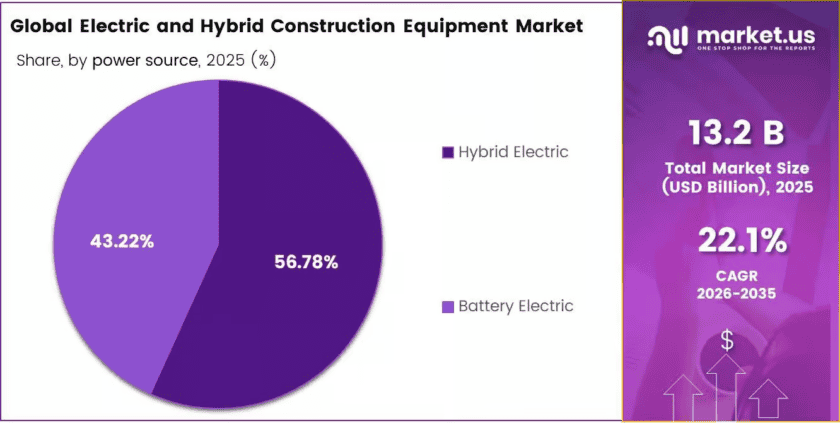
- On the basis of Power Source, the Hybrid Electric dominated the market, constituting 56.78% of the total market share.
- Based on the Product, the Excavators dominated the Electric and Hybrid Construction Equipment market, with a substantial market share of around 33.67%.
- Based on the End User, Construction Companies led the market, comprising 64.67% of the total market.
- In 2025, the Asia Pacific was the most dominant region in the Electric and Hybrid Construction Equipment market, accounting for 36.78% of the total global consumption.
Power Source Analysis
Hybrid Electric represents dominant Segment in the Market.
Hybrid Electric leads the power source segment with a 56.78% market share, driven by its ability to reduce diesel dependence while maintaining operating time at demanding construction sites. This is particularly valuable for excavators, loaders, and earthmoving equipment in remote areas where charging infrastructure remains limited. London government data show that construction and infrastructure equipment contributes 96% of the city’s non-road machinery emissions, including around 1,660 tonnes of nitrogen oxides and 440,159 tonnes of carbon dioxide annually, supporting demand for hybrid systems that offer lower fuel consumption and reliable range.
Battery Electric is the growing segment, supported by incentives that help reduce equipment and charging costs. California’s Clean Off-Road Equipment program provides construction machinery vouchers of up to USD 500,000 and infrastructure support of up to USD 30,000. The program has funded 2,350 zero-emission heavy-duty machines and expects supported deployments to avoid approximately 250,000 tons of carbon dioxide-equivalent emissions during their contracted operating periods.
Product Analysis
Excavators a significant product.
Excavators account for the largest product segment with a 33.67% share, reflecting their extensive use in earthmoving, trenching, demolition, roadwork, and major infrastructure projects. In the United States, the Department of Transportation allocated USD 62 billion across 12 highway formula programs for fiscal 2025, an increase of USD 18.8 billion from fiscal 2021. More than 60,000 infrastructure projects were already progressing under federal funding, supporting demand for cleaner excavators suitable for urban and regulated construction environments.
Dump Trucks are the growing product segment as mining and construction companies seek cleaner material-hauling solutions. In June 2026, the Government of Canada announced up to CAD 73 million for 12 sustainable mining projects, including an electric haul-truck demonstration. The initiative allocated CAD 2.4 million to replace large diesel haul trucks with electric vehicles and install charging infrastructure, supporting the testing of electric drivetrains under demanding load, distance, and terrain conditions.
End User Analysis
Electric and Hybrid Construction Equipment Are Mostly Utilized in the Construction Companies.
Construction Companies dominate the end-user segment with a 64.67% share, supported by large-scale private building and infrastructure activity where productivity, fuel savings, and compliance with urban emission regulations affect project costs. In May 2026, U.S. private construction spending reached an annualized USD 1.669 trillion, including USD 930.2 billion in private residential construction and USD 738.7 billion in non-residential projects, creating strong opportunities for electric excavators, loaders, and hybrid equipment.
Government & Municipalities represent the growing segment as public agencies increasingly focus on cleaner fleets and lower-emission construction operations. U.S. public construction spending reached USD 541.2 billion in May 2026, up 0.5% from April. Highway construction accounted for USD 150.6 billion, while educational construction reached USD 113.4 billion, creating a substantial opportunity for future electric and hybrid equipment procurement.
Emerging Trends
1. Battery-Electric Equipment Is Moving Into More Construction Applications
Battery-electric construction machinery is becoming more practical across different equipment categories. In March 2026, the European Union’s Public Buyers Community reported that battery-electric construction machinery was market-ready for most equipment categories and that supply was readily available in Europe, indicating that electrification is moving beyond pilot projects toward commercial deployment.
2. Electric Excavators and Wheel Loaders Are Being Tested in Real Construction Conditions
Real-world demonstrations are helping manufacturers and contractors understand the performance of electric equipment. A U.S. EPA-supported project demonstrated a 2.5-ton battery-electric compact excavator with a 20 kWh battery and a 5-ton battery-electric compact wheel loader equipped with a 40 kWh battery, showing the growing application of battery power in construction machinery.
3. Mobile Charging Is Becoming Important for Construction Sites
Charging flexibility is emerging as an important requirement because construction equipment frequently operates away from fixed charging locations. A London trial used mobile recharging for an electric excavator and wheel loader, with a charging van sent to construction sites according to machine charging requirements. This approach can help overcome infrastructure limitations on temporary worksites.
4. Construction Projects Are Preparing Their Sites for Electric Equipment
Infrastructure planning for electricity is becoming part of construction-site development. Westminster’s 2026 Code of Construction Practice requires projects to consider electrical power requirements early to support electric non-road mobile machinery and charging facilities. Its roadmap specifies suitable electrical supply requirements from January 2027, 2028, and 2030 for different project levels.
5. Hybrid and Zero-Emission Equipment Is Expanding on Major Infrastructure Projects
Large infrastructure projects are increasingly using lower-emission machinery alongside conventional equipment. The HS2 Air Quality Annual Report recorded 99.9% NRMM compliance across its central and northern areas in 2024, while construction sites continued trials involving electric crawler cranes, electric piling rigs, telehandlers and all-electric concrete mixers.
Use Cases
1. Excavation and Compact Construction Work
Electric excavators are well suited to applications where lower emissions and reduced noise are important. A U.S. EPA-supported demonstration used a 2.5-ton electric compact excavator with a 20 kWh battery, showing how battery-powered machinery can be applied to smaller excavation and construction activities.
2. Wheel Loading and Material Handling
Battery-electric wheel loaders can support material handling while reducing dependence on diesel fuel. The U.S. demonstration project included a 5-ton electric compact wheel loader with a 40 kWh battery and a 1 cubic meter bucket, providing a practical example of electric technology for loading and site-material operations.
3. Infrastructure and Large Construction Projects
Electric and hybrid equipment is increasingly being incorporated into major infrastructure construction. During 2024, HS2 reported the continued deployment and testing of electric crawler cranes, electric piling rigs, telehandlers and all-electric concrete mixers, demonstrating the use of lower-emission machinery across multiple construction activities.
4. Construction Sites With Limited Grid Access
Mobile battery energy storage systems are increasingly being used where construction sites have limited or temporary grid connections. In May 2026, a Liebherr mobile battery system powered a construction project near Zurich for more than five months, helping operate cranes without a diesel generator. The system saved around 10,000 litres of diesel, 27 tonnes of CO₂, and approximately CHF 17,700 in fuel costs.
5. Urban Construction and Low-Emission Projects
Electric machinery is particularly useful in urban environments where emissions and noise need to be controlled. A UK government assessment notes that battery-electric propulsion has already been deployed in smaller machines such as mini diggers and forklifts, while larger excavators face challenges from long recharge times and the need for large battery packs.
Conclusion
Electric and hybrid construction equipment is progressing from early demonstrations toward broader commercial use. Government projects and European procurement initiatives show increasing deployment of electric excavators, wheel loaders, cranes, piling equipment, telehandlers and concrete mixers. However, larger machinery still faces challenges related to battery size, charging time and electrical infrastructure, making hybrid systems and mobile charging important transition solutions.
Frequently Asked Questions
1. What is electric construction equipment?
Electric construction equipment uses batteries and electric motors instead of relying mainly on conventional diesel engines. Examples include excavators, wheel loaders, cranes and concrete mixers. These machines can reduce direct exhaust emissions and noise, making them suitable for specific construction applications.
2. What is hybrid construction equipment?
Hybrid construction equipment combines an internal combustion engine with an electric power system. This configuration can reduce fuel use while maintaining the longer operating capability of conventional machinery. It can be especially useful for demanding applications where full battery-electric operation remains difficult.
3. Which construction machines can use electric power?
Electric power can be applied to several construction machines, including compact excavators, wheel loaders, cranes, piling rigs, telehandlers and concrete mixers. Demonstration projects have already tested machines ranging from a 2.5-ton excavator to a 5-ton wheel loader.
4. Why are construction companies adopting electric equipment?
Construction companies are adopting electric equipment to reduce emissions, lower noise and comply with increasingly demanding environmental requirements. Availability is also improving, with European authorities reporting in 2026 that battery-electric construction machinery was market-ready for most equipment categories.
5. What are the main challenges of electric construction equipment?
The main challenges include battery capacity, charging time, equipment cost and access to suitable electrical infrastructure. UK government assessments note that larger excavators can require large battery packs and face longer recharge times, making full electrification more challenging for heavy-duty applications.
6. How is charging infrastructure supporting electric construction equipment?
Charging infrastructure is becoming an important part of construction-site planning. Westminster’s 2026 construction guidance requires projects to consider electrical supply for electric machinery and charging facilities, with requirements introduced progressively from 2027 through 2030.
7. Can electric equipment operate on temporary construction sites?
Yes, electric equipment can operate on temporary construction sites when suitable charging solutions are available. Mobile charging can help address locations without permanent infrastructure. A London trial used a charging van to provide mobile recharging for electric construction machinery operating at worksites.
8. Are electric excavators commercially available?
Yes, electric excavators are increasingly commercially available, particularly in compact and medium applications. The European Public Buyers Community reported in March 2026 that battery-electric construction machinery was market-ready for most equipment categories and readily available in Europe.
9. What role do mobile batteries play in construction?
Mobile batteries can supply electricity for charging equipment at locations where grid connections are limited or unavailable. In 2026, a Norwegian emission-free construction project planned to procure mobile battery banks with quick-charging capabilities, initially targeting at least 2–3 devices.
10. What is the future of electric and hybrid construction equipment?
The future is likely to include a combination of battery-electric, hybrid and other low-emission technologies. Battery-electric machines are expanding in smaller and medium applications, while hybrid and alternative power systems can address heavier equipment where battery size, charging time and operating duration remain significant limitations.
Discuss your needs with our analyst
Please share your requirements with more details so our analyst can check if they can solve your problem(s)