Overview
New York, NY – Sep 10, 2026 – The global Direct-fed Microbials (DFM) Market is gaining importance as livestock producers look for practical ways to support digestive health, feed utilization, animal performance, and antimicrobial stewardship. DFMs contain live bacteria or yeasts that are added directly to animal feed, with common applications across poultry, cattle, swine, dairy, and aquaculture. The market was valued at USD 1.6 billion in 2025 and is projected to reach approximately USD 2.7 billion by 2035, expanding at a 5.8% CAGR. North America led with a 32.0% share, equal to about USD 0.50 billion.
Commercial adoption is being supported by large livestock populations and efforts to reduce unnecessary antimicrobial dependence. FDA reported that U.S. sales of medically important antimicrobials for food-producing animals in 2024 remained 27% below their 2015 peak. Meanwhile, USDA counted 94.2 million cattle and calves on U.S. farms in July 2026. These conditions support greater interest in microbial feed products designed around gut balance, feed efficiency, and preventive animal nutrition.
Key Takeaways
- The Direct-fed Microbials Market is projected to increase from USD 1.6 billion in 2025 to approximately USD 2.7 billion by 2035 at a 5.8% CAGR.
- Lactic Acid Bacteria held the leading microbial-type position with more than a 43.0% share in 2025.
- Single-Strain products dominated product composition with more than a 58.0% share.
- Dry formulations captured more than a 68.0% share, supported by easier handling, storage, blending, and use in commercial feed.
- Poultry represented the largest livestock application with more than a 45.7% share.
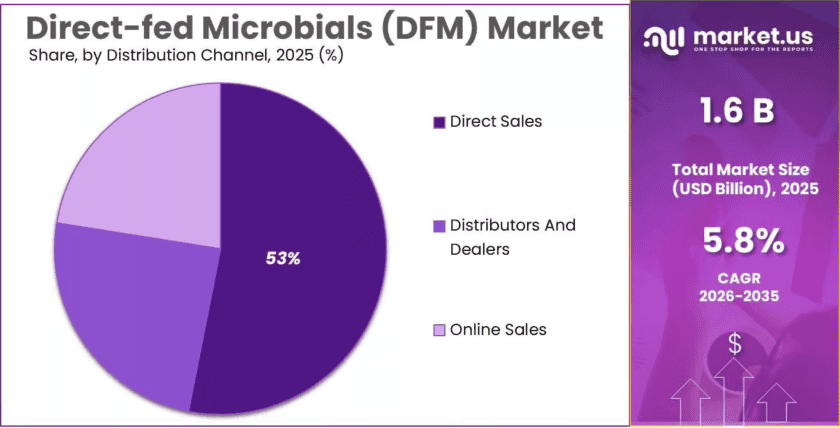
- Direct Sales led distribution channels with more than a 53.0% share.
- North America accounted for approximately 32.0% of the global market and generated about USD 0.50 billion in 2025.
Regional Analysis
North America held the dominant position in 2025, capturing more than a 32.0% share and generating approximately USD 0.50 billion. The region benefits from intensive poultry, cattle, dairy, and swine production alongside an established feed-additive industry. USDA reported 94.2 million cattle and calves on U.S. farms in July 2026, including 28.5 million beef cows, 9.65 million milk cows, and 13.2 million cattle on feed. These large commercial herds support continued demand for microbial products used in digestive-health and feed-management programs.
Asia Pacific is emerging as the fastest-growing regional market, supported by expanding livestock production and greater use of formulated feed. China produced 100.72 million tonnes of pork, beef, mutton, and poultry in 2025, increasing 4.2% from the previous year. Poultry output reached 28.37 million tonnes, up 6.7%, while 719.73 million pigs were slaughtered during the year. This production scale creates a substantial application base for probiotics and other direct-fed microbial solutions.
Market Dynamics
Driver – Pressure to Reduce Antimicrobial Dependence
Growing antimicrobial stewardship is a major driver for Direct-fed Microbials. FDA reported that U.S. sales of medically important antimicrobials for food-producing animals increased 16% between 2023 and 2024, but remained 27% below the historical peak recorded in 2015. The long-term reduction is encouraging livestock producers to examine nutrition, vaccination, biosecurity, and microbial approaches alongside responsible medication use. DFMs are increasingly studied as feed-based tools for maintaining intestinal microbial balance and animal performance. Their relevance is strongest in intensive poultry, cattle, dairy, and swine systems where feed efficiency and animal health directly influence operating margins and production consistency.
Trend – Greater Use of Validated, Strain-Specific Products
The market is moving toward strain-specific microbial products supported by clearer efficacy and safety evidence. In July 2025, the European Food Safety Authority assessed Bacillus velezensis CECT 5940 and concluded that it had potential efficacy in poultry when supplied at 1 × 10⁹ CFU per kilogram of complete feed. In May 2026, the European Commission authorized the preparation for poultry for laying. This regulatory direction favors suppliers capable of documenting strain identity, microbial concentration, safety, stability, and intended use. Feed companies are therefore moving away from broad probiotic claims toward products developed for particular animal species, production stages, and measurable nutritional functions.
Restraint – Variable Performance and Regulatory Scrutiny
Variable biological response remains an important restraint for DFM adoption. Results can differ by microbial strain, dose, animal age, diet, farm environment, and health status. A USDA-ARS study published in 2026 evaluated 650 market pigs receiving two direct-fed microbial treatments. One supplied 1.0 × 10⁶ CFU per head per day, while another supplied 3.0 × 10⁹ CFU per head per day. The study found no significant differences in overall growth performance or carcass characteristics compared with controls. Such results show why producers require stronger field evidence before committing to broad use, while suppliers face continuing costs for validation, quality control, and regulatory compliance.
Opportunity – Expanding Animal Protein Production
Increasing animal-protein production creates a clear long-term opportunity for DFM suppliers. USDA projects U.S. broiler production to rise from 47.9 billion pounds in 2026 to 53.4 billion pounds by 2034, an increase of 11.5%. Poultry consumption is expected to climb from 103.6 pounds per person to 110.4 pounds during the same period. Larger production volumes create more feed demand and increase interest in solutions that can support feed utilization, intestinal health, and consistent performance. Opportunities are particularly strong for heat-stable Bacillus products, targeted lactic-acid bacteria, multi-strain combinations, precision dosing, and microbial products integrated with enzymes and prebiotics.
Emerging Trends
1. Antimicrobial Stewardship Drives Microbial Nutrition
FDA reported that medically important antimicrobial sales for U.S. food-producing animals remained 27% below the 2015 peak in 2024. This long-term reduction is increasing interest in DFM products used alongside vaccination, nutrition, hygiene, and preventive herd-management strategies.
2. EU Reduction Targets Support Non-Antibiotic Approaches
The European Commission aims to reduce sales of antimicrobials for farmed animals and aquaculture by 50% by 2030. Monitoring showed a 28% reduction from the 2018 baseline by 2022, creating stronger incentives for preventive nutrition and microbial feed solutions.
3. Precise Microbial Dosing Gains Importance
EFSA concluded in 2025 that Bacillus velezensis CECT 5940 could be effective for poultry at 1 × 10⁹ CFU/kg of complete feed. Such evaluations are pushing the DFM industry toward precisely defined strains, guaranteed concentrations, and validated feeding rates.
4. More Species-Specific DFM Research
A 2026 USDA-ARS study tested DFMs on 650 finishing pigs, including doses of 1.0 × 10⁶ and 3.0 × 10⁹ CFU/head/day. This type of species-specific research is becoming important for separating proven applications from broad probiotic marketing claims.
5. Organic Livestock Creates Another Application Route
USDA allows nonsynthetic direct-fed microorganisms in compliant organic livestock feed. Organic livestock must receive feed composed of 100% organic agricultural ingredients, while organic ruminants generally obtain at least 30% of dry-matter intake from pasture during the grazing season.
Use Cases
1. Poultry Production
DFMs are incorporated into poultry feed to support intestinal microbial balance and feed utilization. USDA reported production of 9.40 billion broilers with a live weight of 62.2 billion pounds in 2025, creating a major commercial application base for microbial feed products.
2. Beef and Dairy Cattle
Cattle producers use DFMs within feed programs targeting rumen function, digestion, and production consistency. USDA counted 94.2 million cattle and calves in July 2026, including 28.5 million beef cows and 9.65 million milk cows, supporting substantial microbial-feed demand.
3. Swine Nutrition
Swine represents an important DFM application because modern farms closely manage feed conversion and intestinal health. USDA reported 73.7 million hogs and pigs on U.S. farms in June 2026, including 67.8 million market hogs and 5.88 million breeding animals.
4. Aquaculture Feed
DFMs can be incorporated into aquaculture feeds as producers seek better digestive and health-management tools. In 2025, NOAA identified 13 Aquaculture Opportunity Areas covering more than 21,000 acres and invested USD 11.9 million in 37 aquaculture research and extension projects.
5. Organic Livestock Systems
USDA permits qualifying direct-fed microorganisms in organic livestock feed, giving DFM suppliers access to certified production systems. Organic livestock agricultural feed must be 100% organic, while dairy animals require at least 12 months of organic management before their milk can be marketed as organic.
Frequently Asked Questions on Direct-fed Microbials (DFM) and the DFM Market
1. What are Direct-fed Microbials?
Direct-fed microbials are live microorganisms, commonly selected bacteria or yeasts, supplied directly through animal feed. They are used to support a balanced digestive microbial environment and are commercially applied across poultry, cattle, dairy, swine, and aquaculture production systems.
2. How large is the Direct-fed Microbials Market?
The global Direct-fed Microbials Market was valued at approximately USD 1.6 billion in 2025 and is projected to reach around USD 2.7 billion by 2035, expanding at a compound annual growth rate of 5.8%.
3. Which microbial type leads the DFM Market?
Lactic Acid Bacteria represented the leading microbial category in 2025, accounting for more than a 43.0% share. These microorganisms are widely incorporated into animal-feed products intended to support gut microbial balance and digestive performance across several livestock species.
4. Which product composition dominates the market?
Single-Strain formulations held the dominant position in 2025 with more than a 58.0% share. These products allow suppliers to provide clearly identified microbial strains with defined concentrations, controlled manufacturing conditions, targeted functions, and comparatively straightforward quality-assurance requirements.
5. Why do dry DFMs hold a large market share?
Dry products captured more than a 68.0% share in 2025. Their strong position reflects convenient storage, transport, dosing, and incorporation into commercial feed, particularly where producers require microbial products that remain practical during large-scale feed manufacturing and distribution.
6. Which livestock category uses the most DFMs?
Poultry led the livestock segment with more than a 45.7% share in 2025. Large commercial flock sizes, short production cycles, intensive feed management, and ongoing research into gut health and antimicrobial alternatives support strong DFM adoption in poultry.
7. Why is antimicrobial stewardship important for DFM demand?
FDA reported that U.S. medically important antimicrobial sales for food-producing animals in 2024 remained 27% below the 2015 peak. This long-term shift increases interest in nutrition, probiotics, vaccination, biosecurity, and other tools that support responsible animal-health management.
8. Are Direct-fed Microbials allowed in organic livestock feed?
USDA guidance permits nonsynthetic direct-fed microorganisms, commonly described as probiotics, in organic livestock feed when production meets applicable organic requirements. Agricultural ingredients used in formulated organic feed must comply with USDA certification and ingredient rules.
9. Which region dominates the Direct-fed Microbials Market?
North America led the global DFM market in 2025 with approximately a 32.0% share, representing around USD 0.50 billion. Large commercial poultry, beef, dairy, and swine industries provide an established customer base for microbial feed products.
10. What opportunities will shape future DFM growth?
Future opportunities include strain-specific products, heat-stable microorganisms, precision microbiome solutions, poultry and aquaculture applications, and combinations with enzymes or prebiotics. USDA projects U.S. broiler output to grow 11.5% between 2026 and 2034, expanding the feed base.
Conclusion
The Direct-fed Microbials Market is positioned for steady growth as livestock producers focus on digestive health, feed performance, antimicrobial stewardship, and efficient animal-protein production. The market is projected to rise from USD 1.6 billion in 2025 to USD 2.7 billion by 2035 at a 5.8% CAGR. North America leads with a 32.0% share, while Asia Pacific offers strong expansion potential. Regulatory support for responsible antimicrobial use, growing poultry and livestock output, and stronger scientific validation are encouraging adoption. Future competition will increasingly center on strain performance, stability, precise dosing, species-specific products, and documented safety and efficacy.