Overview
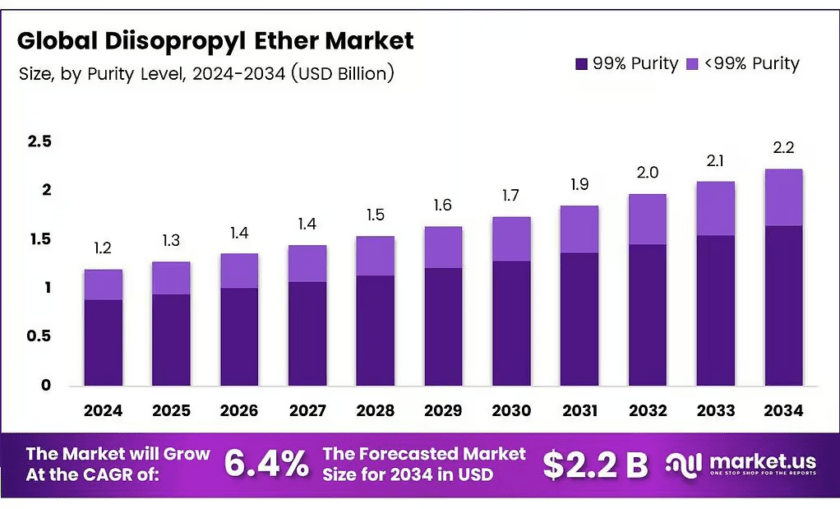
New York, NY – May 27, 2026 – The Global Diisopropyl Ether Market size is worth USD 1.2 billion in 2024 and will reach USD 2.2 billion by 2034. Market analysts project a compound annual growth rate of 6.4% from 2025 to 2034. Consequently, this growth reflects rising industrial demand across multiple sectors.
Diisopropyl ether is a clear, colorless liquid with a sharp, sweet odor and high flammability. Manufacturers value this compound for its excellent solvent properties and miscibility with organic solvents. However, the substance poses significant safety risks due to explosive peroxide formation. Regular peroxide testing is mandatory every three months for stored diisopropyl ether. This frequency is much higher than the twelve-month interval for diethyl ether. Therefore, proper storage in glass bottles with inhibitors like BHT remains critical for safe handling.
High purity standards of at least 99% assay define premium diisopropyl ether grades. The compound boils at 68-70°C and maintains a density of 0.725 g/cm³ at 20°C. Additionally, its low viscosity of 0.37 mPa·s enables efficient performance in industrial applications. Disposal requires careful peroxide testing and neutralization with reducing agents like ferrous sulfate. Only after confirming the absence of peroxides can operators safely burn the material. Thus, safety protocols directly influence market accessibility and operational costs.
Key Takeaways
- The Global Diisopropyl Ether Market will grow from USD 1.2 billion in 2024 to USD 2.2 billion by 2034 at a 6.4% CAGR.
- The 99% purity segment dominates with a 73.9% share in 2024, driving innovation in purification for sensitive applications.
- Solvent application leads with a 37.3% share in 2024, boosting productivity in extraction and industrial processes.
- Pharmaceuticals end-use holds a 34.2% share in 2024, favored for strict purity in safe drug production.
- Asia-Pacific dominates with a 43.9% share worth USD 0.5 billion in 2024, driven by expanding petrochemicals and demand for high-octane fuels and solvents.
➤ Grab the Exclusive Preview of This Premium Research Report Now – https://market.us/report/global-diisopropyl-ether-market/request-sample/
Market Segmentation
By Purity Level
In 2024, the 99% purity segment held a dominant market position with a 73.9% share. This high-grade variant excels in applications requiring minimal impurities. Manufacturers prioritize it for superior performance in sensitive processes. Thus, this segment drives innovation in purification techniques and fuels market expansion through quality focus.
The less than 99% purity segment complements the market by offering cost-effective options for less stringent uses. Producers leverage this grade for basic solvent applications and broad accessibility. Consequently, it supports diverse industrial needs by balancing affordability with functionality. This approach ensures steady demand across multiple sectors.
By Application
In 2024, the Solvent application held a dominant market position with a 37.3% share due to its versatile extraction capabilities. Industries rely on diisopropyl ether for dissolving compounds efficiently in extraction tasks. Hence, this application boosts productivity across the chemical and manufacturing sectors. Its versatility directly propels its leading status in the market.
The fuel additive application enhances combustion efficiency and reduces engine emissions significantly. Automakers adopt diisopropyl ether for cleaner fuel formulations that align with environmental regulations. Therefore, this role strengthens the compound’s growth potential in the transportation sector. The pharmaceutical intermediate application supports precise drug synthesis as a key building block. Pharma firms value its reactivity for advancing medical innovations.
By End-Use
In 2024, the pharmaceuticals end-use segment held a dominant market position with a 34.2% share due to rigorous quality standards. This application ensures safe drug production through strict purity norms. Thus, it accelerates therapeutic developments and reflects healthcare priorities. This dominance demonstrates the critical role of high-purity solvents in medicine manufacturing.
The petrochemicals segment utilizes diisopropyl ether in refining processes and polymer creation effectively. Energy sectors integrate this compound seamlessly to support fuel advancements. Consequently, this end-use drives industrial scalability and operational efficiency. The paints and coatings segment benefits from its solvent properties for improved formulation stability. Rising construction demand enhances product durability and expands aesthetic applications.
Regional Analysis
Asia-Pacific led the global diisopropyl ether market in 2024 with a dominant 43.9% share valued at approximately USD 0.5 billion. This leadership stems from the region’s expanding petrochemical industry and rising demand for high-octane fuel components. Countries like China, India, Japan, and South Korea are increasing production capacities for oxygenates and clean fuel additives. These nations align with tightening emission norms through efficient blending solutions.
North America and Europe follow as significant markets due to stringent fuel quality regulations and advanced industrial infrastructure. The U.S. Tier 3 program and Europe’s sulfur-free petrol mandates create steady demand for ether-based oxygenates. Government-backed investments in clean energy and chemical manufacturing reinforce market growth across these regions. Consequently, sustained refinery modernization will drive continued consumption of diisopropyl ether.
Drivers
Tighter fuel-quality standards worldwide push refineries to use high-octane oxygenates like diisopropyl ether. Regulators now cap gasoline sulfur at 10 ppm across major markets, including the U.S., Europe, and India. The U.S. Tier 3 program and Europe’s sulfur-free petrol mandate create long-term octane management needs. Therefore, oxygenates help reduce aromatics while maintaining engine performance and meeting emissions goals.
Biofuel mandates and oxygen content programs keep oxygenates in focus for fuel blenders globally. The U.S. oxygenated gasoline rule historically required 2.7% oxygen by weight during specific seasons. This quantification demonstrates the critical role of oxygenates in meeting air-quality targets. Consequently, diisopropyl ether benefits from regulatory frameworks that encourage cleaner, higher-efficiency fuel formulations across multiple regions.
Use Cases
In pharmaceutical manufacturing, diisopropyl ether serves as a high-purity reaction medium and extraction solvent. Drug producers rely on its excellent dissolution properties for synthesizing active pharmaceutical ingredients. The compound’s low water solubility enables efficient separation processes. Moreover, its volatility allows easy removal after reactions, ensuring final product purity.
Within industrial laboratories, researchers use diisopropyl ether as a specialized solvent for organic chemistry applications. Its unique ether functional group supports sensitive reactions that require anhydrous conditions. Additionally, the compound works effectively in chromatographic separation techniques. Consequently, research facilities value its consistent quality for reproducible experimental results across various testing protocols.
Business Opportunities
Manufacturers can capitalize on the rising demand for high-purity diisopropyl ether in emerging pharmaceutical markets. Companies that invest in advanced purification technologies will secure premium pricing for 99% purity grades. Developing stable supply chains with safety-certified storage solutions creates competitive advantages. Therefore, suppliers focusing on quality assurance will capture growing market share in regulated industries.
Expanding applications in gasoline oxygenate blending present significant revenue opportunities for producers. Refineries seeking to meet octane requirements without raising aromatics need reliable ether suppliers. Companies that establish technical partnerships with fuel blenders can secure long-term contracts. Additionally, developing stabilizer packages to address peroxide risks will differentiate providers in safety-conscious markets.
Major Challenges
High flammability and peroxide formation risks severely limit diisopropyl ether handling in industrial settings. The compound’s flash point of -28°C creates fire hazards that require explosion-proof equipment and inerting systems. These safety requirements translate into elevated operational costs for storage and transportation. Consequently, some manufacturers choose alternative solvents with lower risk profiles.
Stringent regulatory oversight of volatile organic compound emissions restricts diisopropyl ether usage in many regions. The compound readily volatilizes under ambient conditions due to the vapor pressure of approximately 227 hPa at 25°C. Governments increasingly regulate VOC emissions from solvents and industrial processes. Therefore, compliance costs and usage limitations challenge market expansion in environmentally sensitive areas.
Top Key Players in the Market
- Eastman Chemical Company
- LG Chem Ltd.
- Sasol Limited
- Dow Chemical Company
- Mitsubishi Chemical Corporation
- ExxonMobil Corporation
- LyondellBasell Industries N.V.
- Others
Conclusion
The global diisopropyl ether market demonstrates steady growth driven by solvent applications and pharmaceutical demand. Asia-Pacific leads regional markets while high-purity grades dominate segment shares. Safety concerns regarding peroxide formation and flammability remain significant operational challenges. However, emerging opportunities in gasoline oxygenate blending and clean fuel regulations support market expansion. Manufacturers that prioritize quality assurance and safety protocols will capture sustainable growth in this specialized chemical market
Discuss your needs with our analyst
Please share your requirements with more details so our analyst can check if they can solve your problem(s)