Overview
New York, NY – Oct 29, 2026 – The global Supplement Testing Market is gaining importance as manufacturers, ingredient suppliers, and distributors place greater emphasis on product safety, quality, and regulatory compliance. According to Market.us, the market was valued at USD 2.7 billion in 2025 and is projected to reach USD 7.7 billion by 2035, growing at a compound annual growth rate (CAGR) of 11.1% from 2026 to 2035.
Supplement testing covers ingredient identification, potency measurement, contaminant screening, microbiological analysis, and finished-product verification. These services help manufacturers confirm that supplements contain the specified ingredients and meet established quality requirements. The United States Food and Drug Administration (FDA) requires dietary supplement manufacturers to establish appropriate specifications and conduct relevant tests or examinations under 21 CFR Part 111.
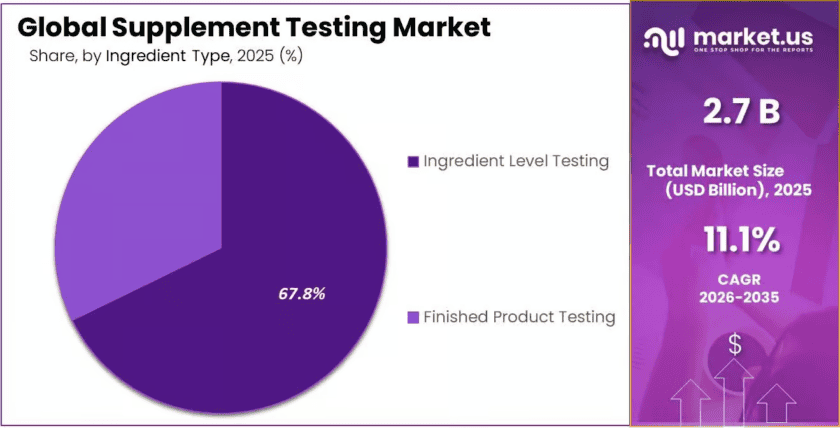
In 2025, microbiological testing accounted for 34.78% of the market by testing type, while ingredient-level testing represented 67.89% by ingredient type. North America led the market with a 32.78% share, equivalent to approximately USD 0.8 billion in revenue. Rising attention to ingredient authenticity, contamination prevention, and consistent product quality is expected to support demand for specialised laboratory testing services.
Key Takeaways
- Market value: The Supplement Testing Market reached USD 2.7 billion in 2025 and is projected to reach USD 7.7 billion by 2035.
- Growth outlook: The market is projected to grow at a CAGR of 11.1% from 2026 to 2035.
- Leading testing type: Microbiological testing held a 34.78% share in 2025, reflecting the importance of contamination control.
- Leading ingredient category: Ingredient-level testing accounted for 67.89% of the market in 2025.
- Dominant region: North America held a 32.78% share, generating approximately USD 0.8 billion in 2025.
- Regulatory focus: FDA requirements cover identity, purity, strength, composition, and applicable contaminant limits.
- Growth opportunities: Botanical authentication, advanced analytical methods, and testing of specialised supplement formulations offer opportunities for laboratory service providers.
Regional Analysis
North America: Dominant Region
North America held a leading position in the Supplement Testing Market in 2025, accounting for 32.78% of global revenue, or approximately USD 0.8 billion. The region benefits from established analytical laboratories, supplement manufacturers, quality assurance providers, and regulatory oversight.
In the United States, the National Institutes of Health’s Office of Dietary Supplements reports that approximately one-half of adults and one-third of children and adolescents use dietary supplements. This broad consumer base supports the need for reliable ingredient verification, potency analysis, and contamination screening. FDA current good manufacturing practice requirements further encourage manufacturers to maintain documented quality controls and appropriate testing procedures.
Asia-Pacific: Growth Opportunities
Asia-Pacific offers opportunities for supplement testing providers because the region includes major ingredient suppliers, supplement manufacturers, and export-oriented production facilities. International trade exposes manufacturers to different destination-market requirements, increasing the importance of identity verification, contaminant analysis, and reliable certificates of analysis.
Laboratories can benefit by expanding chemical testing, microbiological services, and botanical authentication capabilities. However, the supplied market figures do not establish a verified fastest-growing region or a specific regional growth rate. Government sources support the importance of testing and compliance, but region-specific market growth claims require separate, reliable market evidence.
Market Dynamics
Driver: Greater Focus on Product Quality and Safety
Demand for supplement testing is supported by manufacturers’ need to verify ingredient identity, purity, strength, composition, and contaminant limits. The United States FDA’s current good manufacturing practice requirements under 21 CFR Part 111 require manufacturers to establish specifications and conduct appropriate tests or examinations.
These controls help prevent incorrect ingredients, inaccurate ingredient quantities, and contamination from affecting finished products. The National Institutes of Health reports that approximately one-half of U.S. adults use dietary supplements, demonstrating the scale of consumer exposure. As manufacturers manage larger product portfolios and varied ingredient sources, reliable laboratory testing becomes an important part of production quality assurance.
Trend: Advanced Methods for Botanical Authentication
Supplement testing is increasingly focused on reliable identification of botanical ingredients and the detection of adulterants. Plant extracts can contain many chemical compounds, and their composition may vary with growing conditions, harvesting, and processing. The National Institutes of Health’s Analytical Methods and Reference Materials Program supports the development and validation of methods for dietary ingredients, including approaches for botanical classification and authentication.
These methods can help laboratories identify incorrect plant species, quantify selected compounds, and investigate contaminants. Combining chemical fingerprinting with suitable molecular or other analytical methods can improve confidence in test results, particularly when conventional methods cannot adequately distinguish closely related botanical materials.
Restraint: High Testing Costs and Method Limitations
Testing costs can be a challenge for smaller supplement manufacturers and laboratories. Advanced instruments, reference materials, skilled analysts, and validated analytical procedures require investment. Complex botanical ingredients may also lack widely accepted reference materials or validated methods, making reliable testing more difficult.
The National Institutes of Health highlights the importance of characterising supplements for identity, purity, strength, composition, and stability to support reproducible research. When suitable methods are unavailable, laboratories may need additional method development and validation before offering a test routinely.
Opportunity: Broader Testing of Complex and Specialised Formulations
The development of botanical blends, probiotics, sports nutrition products, and multi-ingredient supplements creates opportunities for laboratories with specialised analytical capabilities. Ingredient-level testing can identify quality problems before materials enter production, while finished-product testing helps confirm that selected specifications are met.
The National Institutes of Health supports analytical method development for dietary supplement ingredients, including methods addressing adulterants, natural toxins, pesticides, and toxic elements. Laboratories can use this scientific foundation to expand testing portfolios, improve turnaround times, and provide clearer quality documentation. Companies that invest in validated methods, reference materials, and robust quality systems can serve manufacturers seeking consistent testing across complex product lines.
Emerging Trends
1. Botanical Ingredient Authentication
Botanical authentication is becoming more important as supplement formulations use diverse plant extracts. The National Institutes of Health supports analytical methods that help identify botanical ingredients and detect adulterants. Laboratories increasingly use validated chemical fingerprinting and other suitable methods to distinguish related plant species and verify ingredient identity.
2. Wider Contaminant Screening
Laboratories are expanding testing for contaminants such as toxic elements, pesticides, natural toxins, and harmful microorganisms. The FDA requires manufacturers to establish appropriate specifications and controls. Testing programmes that combine risk assessment with suitable analytical methods can help identify problems before products are released for distribution.
3. Greater Attention to Ingredient-Level Testing
Ingredient-level testing remains a major service area, representing 67.89% of the market in 2025, according to Market.us. Testing raw materials before production helps manufacturers detect identity, purity, and potency issues earlier. This approach can reduce the risk of nonconforming ingredients entering finished supplements.
4. Development of Validated Analytical Methods
Validated methods help laboratories produce reliable and repeatable results. The National Institutes of Health’s Analytical Methods and Reference Materials Program supports the development of methods for measuring dietary ingredients and verifying label claims. Better reference materials and method validation can improve confidence in results across different laboratories.
5. More Structured Finished-Product Verification
Finished-product testing helps manufacturers confirm that supplements meet established specifications before release. Under FDA rules, manufacturers must verify that selected finished batches meet product specifications using appropriate tests or examinations, unless an applicable provision permits an alternative documented approach. This makes sampling plans and quality records important parts of testing programmes.
Use Cases
1. Verifying Raw Botanical Ingredients
A supplement manufacturer purchasing a botanical extract can use identity testing to confirm that the supplied plant material matches its specifications. Chemical fingerprinting and other validated methods can help distinguish related species. The National Institutes of Health identifies botanical authentication as an important part of supplement integrity.
2. Checking Vitamin and Mineral Potency
Laboratories can measure selected vitamins and minerals to check whether their amounts meet established specifications. This testing supports manufacturers producing multivitamins, mineral capsules, and fortified nutritional products. FDA manufacturing requirements address ingredient strength and finished-product composition, making suitable analytical checks important to quality assurance.
3. Detecting Microbial Contamination
Microbiological testing helps manufacturers assess whether ingredients or finished supplements contain microorganisms that could compromise product quality or safety. Laboratories can select appropriate tests based on the formulation and risk. In 2025, microbiological testing represented 34.78% of the Supplement Testing Market.
4. Screening for Toxic Elements and Other Contaminants
Testing laboratories can analyse selected ingredients and finished products for contaminants such as lead, arsenic, cadmium, and mercury where relevant to the product and its specifications. The results help manufacturers evaluate raw material quality and decide whether a batch meets established requirements before release.
5. Confirming Finished-Product Specifications
Before a supplement is released, manufacturers can use appropriate testing to verify selected specifications for identity, purity, strength, composition, and contaminants. FDA rules require documented quality controls and testing or examinations. A sound sampling plan helps companies evaluate finished batches and maintain traceable quality records.
Frequently Asked Questions
1. What is the Supplement Testing Market?
The Supplement Testing Market includes laboratory services used to verify the identity, potency, purity, composition, and quality of dietary supplement ingredients and finished products. It serves manufacturers, ingredient suppliers, distributors, and organisations requiring documented product quality checks.
2. What was the market value in 2025?
According to Market.us, the global Supplement Testing Market was valued at USD 2.7 billion in 2025. The estimate covers testing services supporting dietary supplement quality, including ingredient authentication, potency analysis, contaminant screening, and microbiological testing.
3. What is the market forecast through 2035?
Market.us projects that the Supplement Testing Market will reach USD 7.7 billion by 2035, growing at a compound annual growth rate of 11.1% from 2026 to 2035. This is a commercial market forecast, not a government estimate.
4. Why is supplement testing important?
Supplement testing helps manufacturers check that ingredients match specifications and that finished products meet relevant quality requirements. Testing can identify incorrect ingredients, inconsistent potency, or contamination. These checks support manufacturing quality systems and help companies make better-informed decisions about releasing products.
5. Which testing type led the market in 2025?
According to Market.us, microbiological testing led the market by testing type in 2025, with a 34.78% share. This category covers testing used to assess microbial contamination and support quality control for relevant supplement ingredients and finished products.
6. Which ingredient-testing category held the largest share?
Ingredient-level testing led the market by ingredient type in 2025, accounting for 67.89%, according to Market.us. It helps manufacturers assess raw materials before production, supporting checks of identity, purity, strength, and other ingredient specifications.
Conclusion
The Supplement Testing Market is becoming increasingly important as manufacturers seek reliable ways to verify ingredient quality, product composition, and contamination controls. Market.us estimates the market at USD 2.7 billion in 2025, with a projected value of USD 7.7 billion by 2035 and a CAGR of 11.1%.
Microbiological testing and ingredient-level testing held leading positions in their respective categories, while North America remained the dominant region. Regulatory requirements and ongoing scientific work on analytical methods support the need for effective testing programmes. Future opportunities will depend on reliable botanical authentication, validated methods, advanced contaminant analysis, and cost-effective laboratory services.
Discuss your needs with our analyst
Please share your requirements with more details so our analyst can check if they can solve your problem(s)