Overview
New York, NY – Sep 03, 2026 – The global Battery Passport Market is expanding rapidly as battery manufacturers, automotive companies, energy-storage operators, recyclers, and regulators move toward digital battery identification and lifecycle tracking. In 2025, the market was valued at USD 139.6 billion and is projected to reach approximately USD 1,587.0 billion by 2035, growing at a 27.5% CAGR between 2026 and 2035.
Battery passports create a digital record containing information about battery identity, chemistry, production origin, performance, environmental characteristics, ownership, repair history, and end-of-life treatment. Their importance is increasing alongside global battery deployment, which reached approximately 1.2 TWh in 2025, nearly 30% higher than the previous year.
Electric vehicles represented more than 70% of total battery deployment, while global electric-car sales exceeded 20 million units in 2025. Lithium-ion battery manufacturing capacity also surpassed 4 TWh, increasing the volume of battery information that must be managed across global supply chains.
Regulation is becoming another major adoption factor. Relevant batteries sold in the European Union will require an electronic battery passport from 18 February 2027, creating strong demand for identification hardware, software platforms, data integration, verification, and lifecycle-management services.
Key Takeaways
- The global Battery Passport Market reached USD 139.6 billion in 2025 and is projected to reach approximately USD 1,587.0 billion by 2035, supported by a 27.5% CAGR.
- Hardware held the leading component position with a 67.23% share, supported by requirements for identifiers, QR codes, tags, and supporting access infrastructure.
- Lithium-ion batteries led the battery-type segment with a 43.45% share, reflecting their widespread use across electric vehicles and energy-storage applications.
- Energy Storage Systems accounted for the largest application share at 42.0%, supported by growing requirements for lifecycle, health, ownership, and residual-value information.
- Battery Manufacturers led the end-user segment with a 37.89% share, reflecting their central role in recording production, chemistry, material, and carbon information.
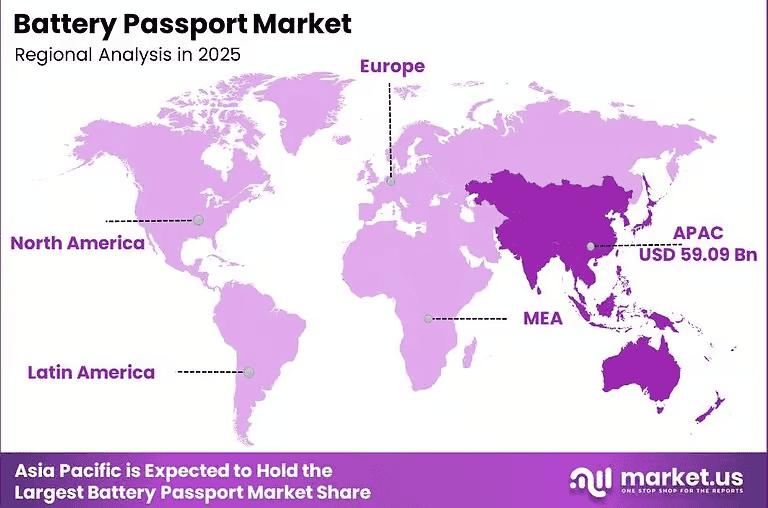
- Asia Pacific dominated geographically with a 42.0% share, representing approximately USD 59.09 billion in market value.
Regional Analysis
Asia Pacific Leads with a 42.0% Share
Asia Pacific held the dominant position in the Battery Passport Market, accounting for approximately 42.0% of the global market and generating about USD 59.09 billion in revenue. The region benefits from its large battery manufacturing base and strong participation in electric-vehicle supply chains. High production volumes create significant requirements for digital identification, manufacturing records, carbon information, material traceability, and lifecycle data.
Europe Emerges as the Fastest-Growing Region
Europe is developing as the fastest-growing Battery Passport region because regulatory requirements are establishing clear rules for battery information, digital access, and lifecycle transparency. From 18 February 2027, relevant EV, light-means-of-transport, and industrial batteries above 2 kWh will require electronic passports. The Digital Product Passport Registry became operational on 20 July 2026, creating supporting infrastructure for standardized digital records.
Market Dynamics
Driver – Mandatory Battery Regulations Accelerate Passport Adoption
Regulation is one of the strongest drivers of Battery Passport adoption. From 18 February 2027, electric-vehicle batteries, light-means-of-transport batteries, and industrial batteries above 2 kWh entering the EU market will require electronic passports. The requirement is becoming increasingly important as EV battery deployment reached approximately 1.2 TWh in 2025, rising almost 30% in one year. Electric vehicles accounted for more than 70% of total battery deployment. These rules are pushing battery manufacturers and automotive companies to establish reliable digital systems for product identification, chemistry records, carbon information, lifecycle tracking, and regulatory access.
Trend – Live Battery Data is Replacing Static Digital Records
Battery passports are gradually moving from simple digital identification toward connected lifecycle-data platforms. Modern systems are being designed to record battery condition, performance, chemistry, ownership, repair, reuse, and recycling information over time. The Digital Product Passport Registry became operational on 20 July 2026, while 6 of 8 harmonised Digital Product Passport standards had been published by that point. Global EV battery deployment of around 1.2 TWh in 2025 also highlights the growing volume of information that must be handled. This trend is encouraging closer integration between battery management systems, manufacturing databases, cloud platforms, and compliance systems.
Restraint – Complex Data Integration Creates Implementation Pressure
Battery passport adoption requires manufacturers to connect information from production, material sourcing, battery management systems, ownership records, repair activities, and end-of-life processes. This becomes challenging when companies operate across different plants, suppliers, vehicle platforms, and software systems. The approaching 18 February 2027 compliance deadline increases pressure on companies to standardize information quickly. Technical interoperability also remains important, as only 6 of 8 harmonised Digital Product Passport standards had been published by July 2026. Companies therefore face integration, validation, access-control, and data-management requirements while preparing systems that must remain useful throughout a battery’s complete operating life.
Opportunity – Circular Battery Economy Expands Passport Services
Battery reuse, repurposing, and recycling provide major opportunities for Battery Passport providers. EU requirements call for lithium-based battery recycling efficiency of at least 65% by the end of 2025 and 70% by the end of 2030. By the end of 2027, recovery requirements reach 90% for cobalt, copper, lead, and nickel and 50% for lithium. Battery passports can document chemistry, condition, ownership, material composition, and recycling history, helping companies decide whether batteries should be repaired, reused, repurposed, or recycled. This creates opportunities for software providers, verification firms, recyclers, and lifecycle-data specialists.
Emerging Trends
1. Connected Battery Lifecycle Platforms
Battery passports are moving toward live lifecycle platforms rather than static digital labels. With EV battery deployment reaching 1.2 TWh in 2025, manufacturers increasingly need systems that connect production, battery health, ownership, repair, reuse, and recycling information.
2. QR-Based Digital Battery Identification
From 18 February 2027, qualifying batteries entering the EU market will require electronic passports accessible through digital identification. QR-based access can help manufacturers, regulators, service providers, recyclers, and customers retrieve standardized battery information throughout the product lifecycle.
3. Standardized Digital Product Passport Systems
Technical standardization is progressing as battery data becomes more interoperable. By July 2026, 6 of 8 harmonised Digital Product Passport standards had been published, covering areas such as identifiers, APIs, storage, and standardized data exchange between participants.
4. Recycling and Recovered-Material Verification
Battery passports are becoming important for documenting recycled materials. From August 2031, relevant EU batteries must contain at least 16% recycled cobalt, 6% recycled lithium, 6% recycled nickel, and 85% recycled lead.
5. Growing Battery Health Data Integration
Battery health data is becoming increasingly valuable for used EVs, warranties, leasing, repair, and resale. Global lithium-ion manufacturing capacity exceeded 4 TWh in 2025, increasing the future number of batteries requiring verified condition and performance information.
Use Cases
1. Regulatory Compliance and Battery Identification
Battery passports provide verified digital identities for regulated batteries. From 18 February 2027, relevant EV, light-means-of-transport, and industrial batteries above 2 kWh require passports, helping manufacturers organize compliance information through standardized digital records and identifiers.
2. Electric Vehicle Battery Lifecycle Monitoring
Battery passports can record EV battery condition from production through vehicle operation and retirement. With global EV battery deployment reaching 1.2 TWh in 2025, monitoring health, charging history, temperature, and significant operating events is becoming increasingly important.
3. Used Battery and Residual-Value Assessment
Verified battery records can improve used-EV valuation, warranty decisions, and leasing processes. Lithium-ion manufacturing capacity exceeded 4 TWh in 2025, making reliable state-of-health and historical usage information increasingly valuable for buyers, sellers, financial companies, and service providers.
4. Second-Life Battery Selection
Battery passports can help determine whether retired EV batteries are suitable for stationary energy storage. EV battery deployment is expected to approach 3 TWh by 2030, creating a growing pool of batteries requiring reuse, repurposing, repair, or recycling decisions.
Frequently Asked Questions on Battery Passport and Battery Passport Market
What is a Battery Passport?
A Battery Passport is a digital record linked to an individual battery. It can contain information about identity, chemistry, manufacturing origin, performance, ownership, environmental characteristics, repair history, reuse, and recycling throughout the battery lifecycle.
How large was the Battery Passport Market in 2025?
The global Battery Passport Market was valued at approximately USD 139.6 billion in 2025. It is expected to expand strongly as regulatory compliance, battery manufacturing, EV deployment, recycling, and lifecycle-data requirements increase worldwide.
How large could the Battery Passport Market become by 2035?
The market is projected to reach approximately USD 1,587.0 billion by 2035, expanding at a 27.5% CAGR from 2026 onward as battery identification, traceability, compliance, recycling, and lifecycle-management systems become more widely adopted.
How can Battery Passports support recycling?
Battery passports can record chemistry, material composition, ownership, and recycling history. These records become useful as lithium-battery recycling efficiency requirements rise from at least 65% in 2025 to 70% by 2030.
Conclusion
The Battery Passport Market is entering a strong growth phase as battery production, electric vehicles, energy storage, recycling, and digital compliance become more closely connected. Valued at USD 139.6 billion in 2025, the market is projected to reach approximately USD 1,587.0 billion by 2035, supported by a 27.5% CAGR. Regulatory requirements beginning in 2027 are expected to accelerate adoption of digital identification and lifecycle-data platforms. With EV battery deployment already reaching 1.2 TWh, battery passports are becoming increasingly important for manufacturers, automakers, recyclers, storage operators, certification providers, and companies managing battery health, traceability, reuse, and material recovery.
Discuss your needs with our analyst
Please share your requirements with more details so our analyst can check if they can solve your problem(s)