Report Overview
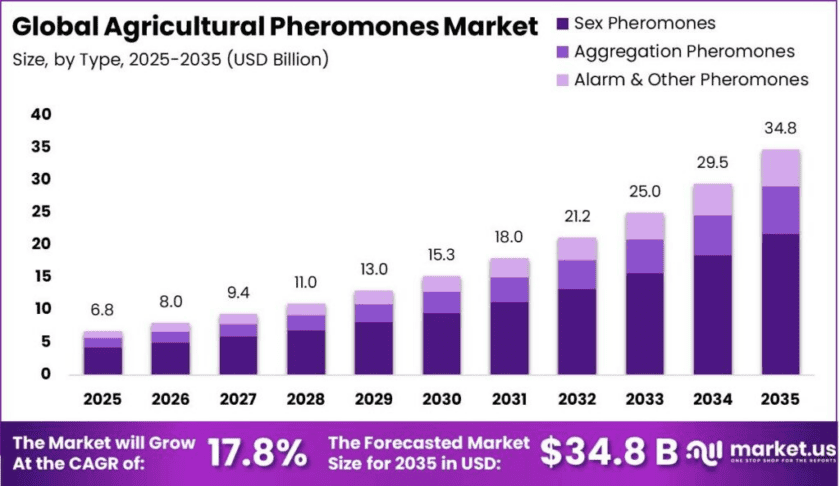
In 2025, the Global Agricultural Pheromones Market was valued at USD 6.8 billion. From 2026 to 2035, the market is projected to expand at a CAGR of 17.8%, reaching approximately USD 34.8 billion by 2035. Europe held the leading position in 2025, accounting for more than a 38.3% market share, with revenue of USD 2.60 billion.
Agricultural pheromones are biologically active chemical compounds that modify insect behavior and are used in crop production for pest monitoring, mating disruption, mass trapping, and attract-and-kill applications. These semiochemicals have become an increasingly important element of integrated pest management (IPM) programs as agricultural producers look for environmentally sustainable alternatives to conventional chemical pesticides. Market growth is being supported by increasing concerns over pesticide resistance, tighter regulations governing synthetic crop protection products, and rising demand for agricultural products with minimal pesticide residues.
In December 2025, the Food and Agriculture Organization of the United Nations reported that global agriculture would need to produce approximately 50% more food, feed, and fibre by 2050 compared with 2012 levels, as the world population approaches 7 billion. This outlook is increasing pressure on farmers and agricultural suppliers to enhance crop protection efficiency, improve yields, and minimize environmental impacts through more sustainable agricultural practices.
The increasing scale of crop losses associated with insect pests worldwide represents a major growth driver for agricultural pheromones. At the same time, the Organisation for Economic Co-operation and Development (OECD) has highlighted growing regulatory scrutiny of conventional pesticides, strengthening the case for sustainable pest-management alternatives, including pheromone-based solutions.
According to FiBL and IFOAM, global organic farmland reached approximately 9 million hectares in 2023, creating favorable conditions for biological pest-control solutions, including agricultural pheromones. Technological advancements are also supporting market development, with innovations in controlled-release dispensers, aerosol technologies, and smart trapping systems improving the efficiency and cost-effectiveness of pheromone applications across large-scale farming operations.
In July 2025, the European Commission reported that the risk of chemical pesticides had declined by 58% in 2023 compared with the 2015–2017 baseline. This meant that the Farm to Fork Strategy’s 50% reduction target for 2030 had already been achieved under the Commission’s indicator.
Together, these regulatory shifts, technological developments, and increasing sustainability expectations across global food supply chains are expected to support the continued expansion of the agricultural pheromones industry. The growing emphasis on integrated pest management, reduced chemical pesticide use, and environmentally responsible crop protection is likely to create additional opportunities for pheromone-based pest-control technologies over the long term.
Key Market Segments
- The Global Agricultural Pheromones Market was valued at USD 6.8 billion in 2025.
- The global agricultural pheromones market is projected to grow at a CAGR of 17.8% and is estimated to reach USD 34.8 billion by 2035.
- Sex Pheromones is the dominant type segment, accounting for 62.5% of the market in 2025.
- Dispensers / Traps is the dominant formulation segment at 54.2% Share.
- Crop Protection is the dominant application segment at 67.1% Share.
- Fruits & Vegetables is the dominant crop type segment at 46.2% Share.
- Direct/B2B Sales is the dominant distribution channel at 71.5% Share.
- Europe holds the largest regional share at 38.3%.
Type Analysis
Sex Pheromones lead the Agricultural Pheromones Market with a 62.5% share, supported by their effectiveness in targeted pest management
In 2025, Sex Pheromones maintained a leading position in the Agricultural Pheromones Market, accounting for more than a 62.5% share. Their dominance is primarily attributed to their extensive application in mating disruption and insect monitoring programs across commercial agricultural operations. Sex pheromones provide highly targeted pest control, enabling growers to manage specific pest populations while limiting effects on beneficial insects. Their adoption has continued to increase as farmers seek effective alternatives to conventional pesticides in response to increasingly stringent environmental regulations.
In May 2026, the Food and Agriculture Organization reported that plant pests and diseases can cause losses of up to 40% of global food crops each year, generating more than US$220 billion in crop losses. Since plants account for around 80% of human diets, these losses are increasing the importance of early pest detection, integrated pest management, and targeted biological crop-protection technologies.
Alarm & Other Pheromones represents the fastest-growing segment in the agricultural pheromones market. Expansion of this segment is being supported by increasing research into behavioral pest-control technologies designed to protect crops while reducing dependence on chemical pesticides. These pheromones are being investigated for applications including pest repellence, movement disruption, and strengthening integrated pest management programs. Ongoing developments in precision agriculture and sustainable farming practices are expected to encourage greater adoption of alarm and specialty pheromones through 2026.
Formulation Analysis
Dispensers / Traps lead the Agricultural Pheromones Market with a 54.2% share, supported by reliable performance in large-scale pest monitoring
In 2025, Dispensers / Traps held the leading market position, representing more than a 54.2% share. This formulation type remained widely preferred because it enables consistent pheromone release over prolonged periods, supporting effective insect monitoring and mating disruption programs. Its extensive application across fruit orchards, vineyards, and specialty crops has been further supported by the growing implementation of integrated pest management practices.
The European Commission’s Farm to Fork Strategy has set a goal of reducing the use and risk of chemical pesticides by 50% by 2030. This objective is encouraging agricultural producers to adopt biological pest-control technologies, including pheromone-based traps and dispensers, as alternatives or complements to conventional chemical treatments.
Spray / Liquid formulations represent the fastest-growing segment in the agricultural pheromones market. Growth is being supported by the development of sprayable pheromone technologies that allow broader field coverage while utilizing existing agricultural spraying infrastructure. Commercial growers are increasingly seeking scalable and cost-efficient pest management solutions, supporting demand for these formulations. Expansion of organic agriculture worldwide is also contributing to segment growth.
Application Analysis
Crop Protection leads the Agricultural Pheromones Market with a 67.1% share, driven by increasing demand for sustainable pest management
In 2025, Crop Protection held the dominant market position, capturing more than a 67.1% share. The segment maintained its leadership as agricultural pheromones are increasingly utilized to protect crops from insect infestations while reducing reliance on conventional chemical pesticides. Farmers and commercial growers are incorporating pheromone-based solutions into integrated pest management programs to enhance crop protection, maintain quality, and reduce environmental impacts. The growing scale of global food production is further increasing the importance of effective crop protection strategies.
In June 2025, the Food and Agriculture Organization forecast that global cereal production would reach a record 911 billion tonnes in 2025, representing a 2.1% increase from 2024. This substantial production volume underscores the importance of effective pest monitoring and crop-protection measures for safeguarding cereal yields.
Mass Trapping is the fastest-growing segment in the agricultural pheromones market. Adoption is increasing as growers use pheromone-baited traps to directly suppress pest populations instead of depending exclusively on chemical treatments. Mass trapping provides an environmentally friendly pest-control approach that supports residue-free crop production and aligns with increasingly stringent agricultural sustainability requirements. The technique is being applied across fruit, vegetable, and plantation crops, where early pest identification and population suppression are essential.
Crop Type Analysis
Fruits & Vegetables lead the Agricultural Pheromones Market with a 46.2% share, driven by high pest susceptibility and strict quality requirements
In 2025, Fruits & Vegetables represented the dominant crop type, accounting for more than a 46.2% share. The segment held the largest position because fruit and vegetable production requires intensive pest management to preserve yields, visual quality, and export standards. Agricultural pheromones are widely deployed in fruit orchards and vegetable cultivation to monitor pest activity and support mating disruption programs while helping reduce pesticide residues. Demand remains particularly strong for high-value crops, where even limited pest damage can generate substantial economic losses.
In December 2024, the Food and Agriculture Organization reported that global fruit and vegetable production reached approximately 1 billion tonnes in 2023. This significant production base emphasizes the importance of protecting high-value crops against insect pests and diseases.
Field Crops is the fastest-growing segment in the agricultural pheromones market. Growth is being supported by increasing implementation of integrated pest management practices across large-scale cultivation of crops including corn, soybean, wheat, cotton, and rice. Farmers are progressively incorporating pheromone-based monitoring and trapping technologies to improve pest detection and reduce their dependence on broad-spectrum insecticides.
Distribution Channel Analysis
Direct/B2B Sales lead the Agricultural Pheromones Market with a 71.5% share, supported by strong manufacturer-to-grower relationships
In 2025, Direct/B2B Sales held the leading distribution position, capturing more than a 71.5% share. This channel maintained its dominance because agricultural pheromones are specialized crop-protection products that frequently require technical assistance, field-level support, and customized pest management solutions. Large agricultural enterprises, cooperatives, distributors, and agricultural service providers commonly purchase these products directly from manufacturers or authorized suppliers to support product performance and regulatory compliance. The extensive scale of commercial agriculture worldwide further reinforces the importance of direct and business-to-business sales.
Online Channels represent the fastest-growing distribution segment in the agricultural pheromones market. Expansion is being driven by the increasing digitalization of agricultural input procurement and the growth of e-commerce platforms focused on farming products. Growers are increasingly turning to online channels to compare products, obtain technical information, and place orders more conveniently. Digital advisory services and direct online product availability are also improving purchasing accessibility, particularly for small and medium-sized farms.
Emerging Trends
California’s regulatory pipeline shows a steady influx of new biopesticide active ingredients, a category that includes many pheromone-based formulations. In 2025, the California Department of Pesticide Regulation (DPR) registered 23 pesticide products containing 19 different new active ingredients, including biopesticide entries such as a nucleopolyhedrovirus strain approved for diamondback moth larvae control on brassica crops. DPR’s active database now tracks approximately 11,514 products built from 1,019 different active ingredients, giving California one of the largest state-level biopesticide registries in the U.S.
The EU’s low-risk active substance framework has carved out a defined space for pheromones since its expansion in the early 2020s. As of the most recent count, 19 actives have been designated low-risk substances under Annex I of the EU Biocidal Product Regulation (BPR), a list that explicitly includes pheromones such as Oct-1-en-3-ol. A further seven additional active substances were added as repellent or attractant actives effective 1 June 2021, expanding the regulatory lane through which pheromone-based attractants reach the European market.
Field-level economics from Southeast Asia illustrate the financial upside of pheromone-integrated farming systems. In Vietnam’s Thanh Quoi commune, a project combining pheromone traps with duck-based pest control and drone-applied biopesticides produced a 30 percent jump in net profit per hectare, alongside a nearly one-third (29 percent) cut in material costs, including a 50 percent reduction in seed costs and a 23 percent reduction in fertilizer costs.
Pheromone-based mating disruption has been a documented, successful component of a completed U.S. eradication program. APHIS confirms that in 2018, the agency and industry partners successfully eradicated pink bollworm from commercial cotton production in the United States, a pest that had persisted in the country since first entering from Mexico in 1917. This closes out a program in which pheromone application for mating disruption was one of four core control technologies deployed.
The scale of the sterile-insect and pheromone-based campaign behind that eradication was substantial. Over the life of the pink bollworm program, more than 11 billion sterile moths were released by aircraft to overwhelm wild populations, run continuously across 24 years in some regions, with growers covering roughly 80 percent of the program’s costs.
Use Cases
Tree fruit orchards represent one of the most mature commercial applications of pheromone technology. In Washington State, mating disruption is now a standard control practice applied to roughly 90% of apple acres, where synthetic pheromone dispensers interfere with the ability of male codling moth to locate females, reducing the number of viable offspring and cutting the volume of insecticides growers need to apply each season.
Vineyards have used pheromone-based eradication as a direct financial alternative to broad-spectrum spraying. During California’s fight against the European grapevine moth, the acreage requiring treatment fell from 22,000 acres in 2010 to just 1,900 acres by the program’s later stage, the result of a six-year, $59 million cooperative effort in which Napa County spent $9.8 million, the wine industry contributed $49 million, and the USDA added $46.5 million toward pheromone-based detection, trapping, and mating disruption.
Stored-product and warehouse facilities rely on pheromone trapping to pinpoint infestations across enormous storage footprints. Pest management professionals are often tasked with locating a single infested pallet inside distribution centers capable of holding nearly 10,000 pallets, a challenge made urgent by USDA-National Institute of Food and Agriculture findings, reported in 2023, that between 20% and 40% of global crop production is lost to pests annually.
Government entomology research continues to validate pheromone trap sensitivity for food-storage insect monitoring. In controlled USDA Agricultural Research Service testing on stored products, pheromone-baited traps captured an average of approximately 100 insects per trap per week, sustained consistently across a 17-week test period, confirming the traps’ reliability for pinpointing infestation hot spots within a single storage building.
Conclusion
Agricultural pheromones have moved from a niche pest-control tool to a core pillar of modern, low-risk crop protection, backed by expanding regulatory approval, proven field economics, and measurable environmental gains. In the United States, the EPA has registered fifteen new biopesticide active ingredients since January 2025, while California’s DPR added 19 new active ingredients across 23 products in the same year, reflecting steady regulatory momentum for pheromone-based formulations. In Europe, the EU renewed Straight Chain Lepidopteran Pheromones (acetates) as low-risk active substances under Regulation (EU) 2025/973 on 23 May 2025, while the IBMA reports that biocontrol, including semiochemicals, now represents €1.6 billion, or nearly 10%, of Europe’s crop protection market. On-the-ground results reinforce this trajectory: mating disruption now covers roughly 90% of Washington State’s apple acres, the USDA Forest Service’s Slow the Spread program has treated 10 million acres of forest while cutting spongy moth spread by 83%, and California’s European grapevine moth campaign shrank treated vineyard acreage from 22,000 to 1,900 through a $59 million cooperative effort. Together, these regulatory, commercial, and field-level data points confirm that pheromone-based pest management is scaling steadily across orchards, vineyards, forestry, stored-product facilities, and row crops, positioning the category for continued adoption as growers and regulators prioritize reduced-risk alternatives to conventional insecticide
FAQ
What are agricultural pheromones?
Agricultural pheromones are synthetic versions of natural insect chemical signals used to influence pest behavior. They attract, confuse, or disrupt mating in target insects, offering a species-specific, low-toxicity alternative to conventional broad-spectrum insecticides across orchards, vineyards, row crops, and forestry.
How does pheromone mating disruption work?
Mating disruption saturates an area with synthetic female pheromone, preventing males from locating mates. This reduces successful reproduction and lowers pest populations over time, without directly killing insects, making it a non-toxic complement to integrated pest management programs.
Are agricultural pheromones safe for the environment?
Yes, regulators including the EPA classify pheromones as inherently lower risk than conventional pesticides because they target only the pest species or closely related organisms, avoiding harm to birds, mammals, pollinators, and other non-target organisms in treated fields.
Which crops commonly use pheromone-based pest control?
Pheromones are widely used in apples, pears, grapes, cotton, walnuts, and stored grain. Orchard and vineyard growers rely on mating disruption for moths like codling moth and grapevine moth, while warehouses use pheromone traps for stored-product insect monitoring.
What is driving growth in the agricultural pheromones market?
Growth is driven by tightening pesticide regulations, rising consumer demand for residue-free produce, and expanding low-risk substance approvals in the EU and U.S. Regulatory bodies continue registering new pheromone active ingredients, supporting broader commercial adoption.
How is the agricultural pheromones market regulated?
Pheromones fall under biopesticide or low-risk active substance categories overseen by agencies like the EPA and European Commission. These frameworks require safety and efficacy data but generally offer faster approval pathways than conventional synthetic pesticides.
Do pheromone traps only monitor pests, or can they control them too?
Pheromone traps serve both purposes. Low-density traps monitor pest activity to guide spray timing, while mass trapping and mating disruption formulations, applied at higher pheromone concentrations, actively suppress reproduction and reduce overall pest populations in treated areas.
What challenges limit wider adoption of agricultural pheromones?
Effectiveness depends on large, contiguous treatment areas, since small or isolated fields allow mated pests to migrate in. Cost, grower awareness, and the need for consistent multi-year application also remain barriers to broader smallholder and regional adoption.
Discuss your needs with our analyst
Please share your requirements with more details so our analyst can check if they can solve your problem(s)