Overview
In 2025, the Global Sustainable Agriculture Market was valued at USD 17.8 billion. From 2026 to 2035, the market is projected to grow at a CAGR of 10.4%, reaching approximately USD 47.8 billion by 2035. In 2025, North America dominated the market, accounting for more than 36.8% of the share and generating USD 6.6 billion in revenue.
Sustainable agriculture focuses on farming practices that protect soil, water, biodiversity and the climate while supporting food production and farm income. Its importance is increasing as global food security continues to face pressure.
- FAO estimated that 8.2% of the global population experienced hunger in 2024, representing between 638 million and 720 million people. At the same time, 28% of the population experienced moderate or severe food insecurity.
- The environmental impact of agrifood systems is also influencing the market. FAO reported that global agrifood emissions reached 16.5 billion tonnes of carbon dioxide equivalent in 2023, accounting for 32% of total human-caused emissions. Farm-gate crop and livestock activities contributed 8.1 billion tonnes, or 49% of total agrifood emissions, highlighting the growing importance of low-emission farming practices.
- According to FAO’s 2025 AQUASTAT data, agriculture accounts for approximately 72% of global freshwater withdrawals, while renewable freshwater availability per person decreased by 7% over the previous decade. FAO also estimates that nearly 1.2 billion people live in agricultural areas experiencing severe water constraints.
Land restoration is becoming an increasingly important policy and investment priority. FAO found that 1.7 billion people live in regions where crop yields are at least 10% lower due to human-induced land degradation. It also estimates that reversing 10% of degradation on existing cropland could restore sufficient agricultural output to feed an additional 154 million people annually. This is creating opportunities for regenerative farming, cover crops, crop rotation, agroforestry and soil-carbon improvement.
- The World Bank reports that agrifood systems receive only 4.3% of global climate finance. However, its annual climate-smart agriculture investment increased nearly eightfold to approximately USD 3 billion by fiscal year 2023. In fiscal year 2024, climate finance accounted for 62% of its agriculture and food lending, while active projects supported 4.7 million farmers in adopting improved technologies.
Government programs are also opening new commercial opportunities. The European Union has approximately 17 million hectares of land under organic farming, representing 11% of agricultural land, while organic retail sales exceed EUR 45 billion. EU policy aims to increase organic farmland to at least 25% by 2030, together with a 50% reduction in pesticide use and risk and a 20% reduction in fertiliser use. These targets are supporting investment in biological inputs, certification, traceability and low-chemical farming systems.
Future opportunities are expected to grow across precision agriculture, biological crop protection, renewable-powered irrigation, climate-resilient seeds, carbon measurement, farm analytics and circular food systems. UNEP estimated that 1.05 billion tonnes of food were wasted in 2022, equivalent to 132 kilograms per person and 19% of food available to consumers. Since food waste contributes 8–10% of global emissions, reducing waste can create additional opportunities in storage, cold chains, composting, by-product recovery and digital supply-chain management.
Key market segment
- The Global Sustainable Agriculture Market was valued at USD 17.8 billion in 2025.
- The market is projected to grow at a CAGR of 10.4% and is estimated to reach USD 47.8 billion by 2035.
- On the basis of product, seeds and traits dominated the market, constituting 43.5% of the total market share.
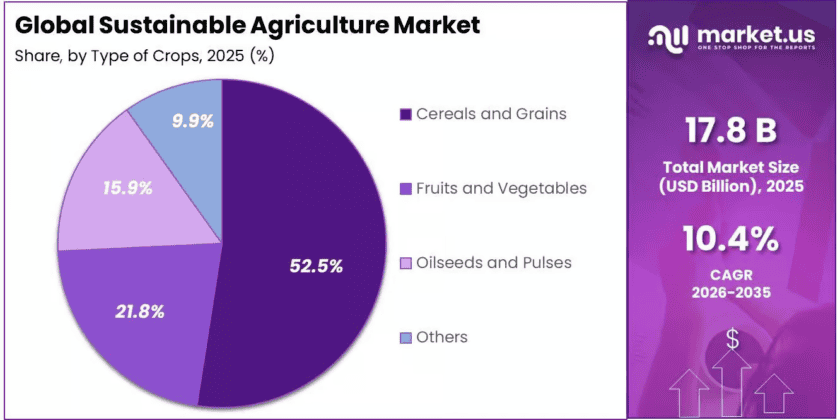
- Based on the type of crops, cereals and grains dominated the market, with a substantial market share of around 52.5%.
- Based on the farming system, organic farming led the market, comprising 34.2% of the total market.
- On the basis of application, food production dominated the market, constituting 32.1% of the total market share.
- In 2025, North America was the most dominant region in the market, accounting for 36.8% of the total global consumption.
Product Analysis
Seeds and Traits Dominates the Sustainable Agriculture Market with a 43.5% Share
In 2025, Seeds and Traits dominated the market with more than a 43.5% share, supported by the role of improved seeds in sustainable crop production and their ability to help farmers manage weeds, insects, diseases, drought, and changing growing conditions. USDA data showed that over 90% of U.S. corn, upland cotton, and soybean acreage used genetically engineered varieties in 2025. Herbicide-tolerant soybean seeds covered 96% of planted acreage, while stacked-trait seeds accounted for 84% of corn acreage and 87% of cotton acreage.
Biopesticides is the fastest-growing segment, driven by rising adoption of microbial pesticides, biochemical substances, plant-incorporated protectants, and naturally derived pest-control products. In 2025, the U.S. Environmental Protection Agency reported registering 15 new biopesticide active ingredients since January. During 2026, it also reviewed new biological products for vegetables, cereal grains, corn, cotton, oilseeds, peanuts, soybeans, fruits, and other crops, expanding their agricultural applications.
Type of Crops Analysis
Cereals and Grains Dominate with a 52.5% Share, Supported by Large Wheat Output.
In 2025, Cereals and Grains dominated with more than a 52.5% share, supported by large-scale production of staple crops for food, animal feed, and industrial processing. In September 2025, USDA reported U.S. wheat production of 1.98 billion bushels, including 1.40 billion bushels of winter wheat, with an average yield of 53.3 bushels per acre. This production base supports the use of crop rotation, precision nutrient application, reduced tillage, and soil-conservation practices.
Fruits and Vegetables is the fastest-growing segment, supported by higher returns per cultivated area and increasing investment in biological pest control, drip irrigation, protected cultivation, organic fertilizers, and soil-health monitoring. In the 2025/26 season, USDA forecast global fresh table grape production at 30.0 million tonnes, an increase of 545,000 tonnes, while global exports were projected at 4.2 million tonnes, encouraging more efficient and environmentally responsible cultivation practices.
Farming System Analysis
Organic Farming Dominates with a 34.2% Share as Certified Agricultural Land Expands
In 2025, Organic Farming held the leading position with more than a 34.2% share, supported by strict production standards, reduced dependence on synthetic inputs, and growing availability of certified organic products. According to the UK Department for Environment, Food & Rural Affairs, organically farmed land in the UK reached 540,000 hectares in 2025, representing an annual increase of 7.3%, strengthening demand for organic seeds, biological crop protection, and natural soil-management practices.
Conservation Agriculture is the fastest-growing segment by farming system, as farmers increasingly adopt minimum tillage, permanent soil cover, and crop rotation to control erosion, retain moisture, and reduce cultivation costs. In June 2026, the Food and Agriculture Organization reported that a conservation agriculture programme in southern Iraq supported 1,600 farmers. Farms using these methods recorded a 25% increase in crop yields, while irrigation cycles declined by nearly 30%.
Application Analysis
Food Production dominates with a 32.1% market share
Food Production dominated the market with more than a 32.1% share, as sustainable farming practices help maintain stable supplies of grains, fruits, vegetables, and other essential foods. Farmers are increasingly applying crop rotation, efficient irrigation, soil conservation, and responsible input management to maintain productivity while reducing environmental pressure.
Bioenergy is the fastest-growing segment, supported by greater use of crop residues, animal waste, and other agricultural materials for renewable energy production. Farmers are adopting bioenergy to improve waste management, reduce reliance on conventional fuels, and create additional income opportunities, while the growing focus on circular farming and cleaner energy is strengthening its role in sustainable agriculture.
Emerging Trends
1. Climate-Smart and Low-Emission Farming Is Expanding
Climate-smart agriculture is becoming a major trend as farmers seek to improve productivity while reducing environmental impacts. The World Bank increased annual climate-smart agriculture investment nearly eightfold to almost USD 3 billion by FY2023. By FY2024, climate finance represented 62% of its agriculture and food lending, while projects supported 4.7 million farmers in adopting improved technologies.
2. Water-Efficient Agriculture Is Gaining Importance
Efficient water management is becoming essential because agriculture accounts for more than 70% of global freshwater withdrawals. FAO highlights growing pressure from water scarcity and climate change, increasing demand for drip irrigation, precision irrigation, drought-tolerant crops, water monitoring and other resource-efficient farming technologies.
3. Regenerative and Soil-Focused Farming Is Growing
Soil health is becoming a stronger priority as more than 1.6 billion hectares of land are already degraded by unsustainable management. About 60% of this human-induced degradation occurs on agricultural land, supporting greater adoption of crop rotation, reduced tillage, cover crops, agroforestry and other soil-restoration practices.
4. Organic Farming Continues to Expand
Organic farming is gaining commercial importance as consumers and policymakers seek lower-input production systems. In the EU, organically farmed land has reached around 17 million hectares, representing 11% of total agricultural land, while organic retail sales have exceeded EUR 45 billion.
5. Digital and Data-Driven Farming Is Becoming More Important
Digital tools are increasingly being integrated into sustainable farming to improve resource efficiency and farm productivity. Precision agriculture, farm analytics, remote monitoring and improved agricultural technologies can help farmers make better decisions about irrigation, fertilizers, crops and other inputs while supporting climate resilience. The World Bank reports that its active agriculture and food projects had helped 4.7 million farmers adopt improved technologies by FY2024.
6. Circular Agriculture and Food-Waste Reduction Are Creating New Opportunities
Circular farming is gaining attention through composting, crop-residue recovery, by-product utilization and improved supply chains. UNEP estimates that 1.05 billion tonnes of food were wasted in 2022, equal to 19% of food available to consumers and 132 kg per person. Food loss and waste generate 8–10% of global greenhouse-gas emissions.
Use Cases of Sustainable Agriculture
1. Sustainable Crop Production
Sustainable agriculture is used to maintain crop productivity while reducing pressure on soil, water and ecosystems. Practices such as crop rotation, conservation farming, efficient irrigation and responsible fertilizer management help improve resource efficiency. FAO reports that agriculture accounts for more than 70% of global freshwater withdrawals.
2. Soil Restoration and Land Management
Farmers use sustainable agriculture for restoring degraded soils through cover crops, reduced tillage, crop rotation, organic inputs and agroforestry. More than 1.6 billion hectares of land are already degraded by unsustainable management, with about 60% of human-induced degradation occurring on agricultural land.
3. Water-Efficient Farming
Sustainable agriculture supports water conservation through drip irrigation, precision irrigation, soil-moisture monitoring and drought-resilient farming methods. This use case is particularly important because agriculture represents more than 70% of global freshwater withdrawals, making efficient water use critical for long-term food production.
4. Organic Food Production
Organic farming applies sustainable practices by limiting reliance on synthetic agricultural inputs and emphasizing soil fertility, biodiversity and responsible resource management. The EU currently has around 17 million hectares under organic farming, equal to 11% of agricultural land, while organic retail sales exceed EUR 45 billion.
5. Climate-Resilient Farming
Sustainable agriculture is increasingly used to help farmers manage climate-related risks while maintaining production. Climate-smart farming combines productivity, resilience and emissions reduction. World Bank projects approved during FY22–24 are expected to avoid 174.5 million tonnes of CO₂-equivalent emissions over their lifetime.
6. Food Waste and Circular Resource Management
Sustainable agriculture supports circular food systems by converting crop residues and organic waste into compost, animal feed, bioenergy and other useful products. In 2022, the world generated 1.05 billion tonnes of food waste, while food loss and waste accounted for 8–10% of global greenhouse-gas emissions.
7. Low-Emission Agricultural Production
Sustainable agriculture is increasingly used to reduce emissions from crop and livestock production through improved nutrient management, soil practices, energy efficiency and better production systems. FAO reported that agrifood systems produced 16.5 billion tonnes of CO₂ equivalent in 2023, representing 32% of total human-caused emissions.
Conclusion
Sustainable agriculture is becoming an important approach for balancing food production with environmental protection and resource efficiency. Rising pressure on land, water and climate is encouraging farmers and governments to adopt climate-smart farming, organic production, soil restoration, efficient irrigation and digital technologies. With agriculture responsible for more than 70% of global freshwater withdrawals and agrifood systems generating 16.5 billion tonnes of CO₂ equivalent in 2023, sustainable production methods are expected to remain a major priority for future food security and agricultural development.
Frequently Asked Questions
1. What is sustainable agriculture?
Sustainable agriculture is a farming approach that produces food while protecting soil, water, biodiversity and natural resources. It combines efficient resource use, responsible input management and climate-resilient practices to maintain productivity and farm income over the long term.
2. Why is sustainable agriculture important?
Sustainable agriculture is important because farming faces increasing pressure from water scarcity, land degradation and climate change. Agriculture accounts for more than 70% of global freshwater withdrawals, making efficient resource management essential for future food production.
3. What are the main practices used in sustainable agriculture?
Major sustainable agriculture practices include crop rotation, conservation tillage, cover cropping, organic farming, precision irrigation, integrated pest management, agroforestry, soil restoration and responsible fertilizer use. These methods help improve productivity while reducing pressure on natural resources and ecosystems.
4. What is the Sustainable Agriculture Market?
The Sustainable Agriculture Market includes products, technologies and farming practices that support environmentally responsible and resource-efficient agricultural production. Key areas include sustainable seeds and traits, biopesticides, organic farming, conservation agriculture, precision technologies, efficient irrigation and biological agricultural inputs.
5. How does sustainable agriculture help reduce climate change?
Sustainable agriculture can reduce climate impacts by improving soil management, lowering unnecessary fertilizer use, increasing resource efficiency and supporting low-emission production. Agrifood systems generated 16.5 billion tonnes of CO₂ equivalent in 2023, showing the importance of reducing agricultural emissions.
6. How does sustainable agriculture conserve water?
Sustainable agriculture conserves water through drip irrigation, precision irrigation, soil-moisture monitoring, drought-resistant crops and improved farm management. Since agriculture accounts for more than 70% of global freshwater withdrawals, these practices can significantly improve water-use efficiency.
7. How does organic farming support sustainable agriculture?
Organic farming supports sustainable agriculture by emphasizing soil fertility, biodiversity and responsible use of natural resources. In the EU, organic farming covers around 17 million hectares, equal to 11% of agricultural land, with organic retail sales exceeding EUR 45 billion.
8. What role does technology play in sustainable agriculture?
Technology helps farmers improve decisions about crops, irrigation, fertilizers and other inputs. Precision agriculture, digital monitoring and data-based farming can improve efficiency and resilience. By FY2024, World Bank-supported projects had helped 4.7 million farmers adopt improved agricultural technologies.
9. How does sustainable agriculture reduce food waste?
Sustainable agriculture supports better harvesting, storage, transportation, processing and circular resource management. UNEP estimates that 1.05 billion tonnes of food were wasted in 2022, representing 19% of food available to consumers and 132 kg per person.
10. What are the major opportunities in the Sustainable Agriculture Market?
Major opportunities include precision farming, biological crop protection, organic production, renewable-powered irrigation, climate-resilient seeds, soil restoration, carbon measurement, farm analytics and circular food systems. These areas can improve resource efficiency while supporting productivity and long-term agricultural resilience.
Discuss your needs with our analyst
Please share your requirements with more details so our analyst can check if they can solve your problem(s)