Overview
New York, NY – October 28, 2026- The global shrink plastic film market is gaining attention as food and beverage manufacturers, retailers, and industrial companies seek packaging that protects products, supports transportation, and improves shelf presentation. Shrink plastic film tightens around products when exposed to heat, helping secure individual items, multipacks, and larger shipments. Printed films also provide branding space and product information, while unprinted films are widely used for bundling and protective packaging.
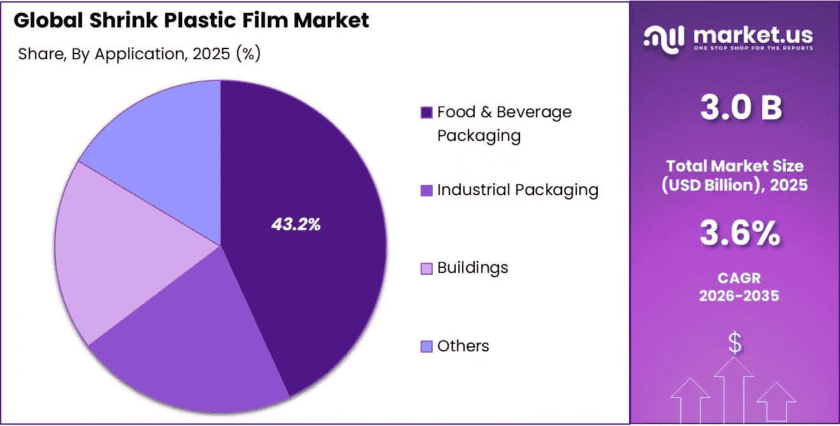
According to Market.us, the global shrink plastic film market was valued at USD 3.0 billion in 2025 and is projected to reach USD 4.3 billion by 2035, representing a compound annual growth rate (CAGR) of 3.6%. Printed film accounted for 62.34% of the market, center-folded film represented 56.34%, and food and beverage packaging captured 43.23%, according to the report.
Environmental requirements are also changing product development. The European Union’s Packaging and Packaging Waste Regulation began applying in phases from August 2026, with a broader objective of making packaging recyclable by 2030. These requirements are encouraging manufacturers to evaluate recyclable film structures, recycled content, material efficiency, and improved waste collection.
Key Takeaways
- Market value in 2025: USD 3.0 billion.
- Projected market value by 2035: USD 4.3 billion.
- Forecast CAGR: 3.6% for 2026–2035, according to Market.us.
- Leading product type: Printed shrink plastic film, with a reported 62.34% share in 2025.
- Leading film form: Center-folded film, with a reported 56.34% share.
- Leading application: Food and beverage packaging, with a reported 43.23% share.
- Regional position: Market.us identifies Asia-Pacific as the leading region in its report overview, with a 36.78% share in 2025.
Regional Analysis
Asia-Pacific: Market.us identifies Asia-Pacific as the leading region, reporting a 36.78% share in 2025 and regional revenue of approximately USD 1.1 billion. Demand is supported by large manufacturing industries, expanding retail distribution, food processing, and beverage production. China, Japan, South Korea, and other regional manufacturing centers offer applications for printed films, multipack packaging, and industrial wrapping.
North America: The region benefits from established consumer-goods supply chains, food and beverage manufacturing, and automated packaging facilities. The United States Environmental Protection Agency (EPA) estimated that plastic containers and packaging generated 14.5 million tons of waste in 2018, equal to approximately 5.0% of municipal solid waste generation. This figure covers plastic packaging broadly, not shrink film alone. It highlights the scale of the packaging-waste management challenge.
Europe: European demand is increasingly shaped by packaging recyclability, waste reduction, and recycled-content requirements. The European Union’s Packaging and Packaging Waste Regulation establishes a policy direction toward recyclable packaging by 2030. This is encouraging converters to assess mono-material film designs, improve packaging efficiency, and strengthen material traceability.
Market Dynamics
1. Driver: Growing Demand for Food and Beverage Packaging
Food and beverage manufacturers use shrink plastic film to bundle bottles, cans, cartons, and packaged products for retail display and transportation. Printed film also supports branding and product identification, while tightly fitted packaging helps keep multipacks together during handling. Market.us reports that food and beverage packaging accounted for 43.23% of the market in 2025.
The broader packaging industry provides a substantial base for continued film demand. However, growth depends on product requirements, packaging alternatives, and consumer purchasing patterns. Manufacturers that combine efficient packaging lines with consistent film quality can respond more effectively to high-volume orders.
2. Trend: Recyclable Film Structures and Recycled Content
Packaging producers are increasingly evaluating film structures that simplify sorting and recycling while retaining strength, clarity, and shrink performance. The European Union’s Packaging and Packaging Waste Regulation sets a target for packaging to be recyclable by 2030, alongside measures to increase recycled plastic use.
The United Kingdom also applies a Plastic Packaging Tax to qualifying finished plastic packaging containing less than 30% recycled plastic, subject to the applicable rules and exemptions. These policies are encouraging manufacturers to review resin selection, recycled-content verification, and packaging design. The practical challenge is maintaining reliable sealing, appearance, and mechanical performance.
3. Restraint: Raw Material Price Volatility
Shrink plastic film producers depend on polymers such as polyethylene and polyvinyl chloride, making manufacturing costs sensitive to resin prices, energy expenses, and transportation charges. Sudden increases in raw material costs can reduce converter margins or force price adjustments for packaging customers.
Smaller producers may have less purchasing power and fewer options for securing long-term supply. At the same time, customers may resist price increases or consider alternative packaging formats. Manufacturers can reduce exposure through supplier diversification, production efficiency, material-use optimization, and carefully structured supply agreements. However, these measures cannot completely eliminate market-wide price volatility or supply disruptions.
4. Opportunity: Lightweight Packaging and Circular Material Systems
Film converters have opportunities to develop thinner packaging that uses less material while preserving required strength, seal integrity, and product protection. They can also explore recyclable mono-material designs, qualified recycled resin, and collection arrangements with large commercial customers.
The European Union aims to make packaging recyclable by 2030, creating a regulatory incentive for improved design and material recovery. The United Kingdom’s 30% recycled-content threshold for qualifying plastic packaging under its tax framework provides another commercial consideration. Successful products will require performance testing, reliable recycled-material supplies, and clear documentation. These capabilities can help converters serve customers seeking lower material use and better packaging compliance.
Emerging Trends
1. Mono-material shrink films
Producers are exploring polyethylene-based film structures that can simplify recycling compared with mixed-material designs. The European Union aims to make packaging recyclable by 2030, encouraging converters to improve material compatibility while preserving shrink performance.
2. Increased recycled-content use
Manufacturers are testing recycled polymers for suitable packaging applications. In the United Kingdom, qualifying plastic packaging containing at least 30% recycled plastic is generally outside the Plastic Packaging Tax charge, subject to the rules and exclusions.
3. Lightweight film development
Converters are working to reduce film thickness without compromising load stability or sealing. Lower material use can reduce packaging weight and resin consumption per unit, although each film specification requires testing on the customer’s packaging line.
4. Automated packaging operations
Automated wrapping and heat-shrink systems help high-volume manufacturers package products consistently. Film selection must match line speed, pack dimensions, and temperature settings. Performance testing across 3 areas, sealing, shrinking, and handling, can help identify production problems before commercial rollout.
5. Better printing and product identification
Printed films help brands display logos, product information, and promotional graphics on packs. Market.us reports that printed film held a 62.34% share in 2025. Converters are balancing print quality with ink compatibility and end-of-life recycling needs.
Use Cases
1. Beverage multipack bundling
Beverage producers wrap bottles and cans into multipacks for retail distribution. Shrink film keeps units grouped during transport and display. A 6-pack or 12-pack format can be designed around the product dimensions and the packaging line’s requirements.
2. Packaged food protection
Food manufacturers use shrink film to group trays, cartons, and selected packaged products. The film supports handling and product presentation, but it must be appropriate for the intended use. Food-contact applications require compliance with applicable material-safety rules.
3. Industrial product bundling
Manufacturers use shrink film to group smaller goods, components, and cartons before shipment. A single film bundle may hold multiple items together, simplifying warehouse handling and reducing the risk of products separating during routine movement.
4. Distribution and transport
Shrink film can secure grouped products and selected loads during storage and distribution. Businesses choose film thickness and shrink characteristics according to package size, load stability, and handling conditions. Pallet wrapping requirements should be assessed separately from individual-product shrink wrapping.
Frequently Asked Questions on Shrink Plastic Film
1. What is shrink plastic film?
Shrink plastic film is a polymer-based packaging material that contracts when exposed to suitable heat. It fits closely around products, helping bundle items, improve presentation, and support protection during storage, handling, and transportation.
2. What is the global shrink plastic film market size?
According to Market.us, the global shrink plastic film market was valued at USD 3.0 billion in 2025. The report projects growth to USD 4.3 billion by 2035, with a stated CAGR of 3.6%.
3. Which segment leads the shrink plastic film market?
Market.us reports that printed shrink plastic film held a 62.34% share in 2025. Printed film supports product branding, identification, and promotional communication across food, beverage, and consumer-goods packaging applications.
4. What is the largest application of shrink plastic film?
Food and beverage packaging is a major application, accounting for a reported 43.23% share in 2025. Manufacturers use shrink film to bundle bottles, cans, cartons, and other packaged products for distribution and retail display.
5. What materials are used to manufacture shrink plastic film?
Common materials include polyethylene (PE), polyvinyl chloride (PVC), and polyolefin films. The choice depends on shrink performance, clarity, strength, sealing requirements, cost, and the intended packaging application. Not every material is suitable for every product or recycling system.
6. What factors are driving market growth?
Demand for packaged food, beverage multipacks, retail-ready products, and industrial packaging supports market growth. Automated packaging lines and demand for printed branding also contribute. However, resin-price volatility and environmental requirements influence purchasing and material-selection decisions.
7. What are the major challenges facing manufacturers?
Manufacturers face fluctuating polymer prices, pressure to reduce packaging waste, recycled-material quality limitations, and changing packaging regulations. They must maintain product protection and production efficiency while adapting film formulations and packaging designs to customer and regulatory requirements.
Conclusion
The shrink plastic film market is positioned for steady development as food and beverage manufacturers, retailers, and industrial businesses continue to require efficient packaging solutions. Market.us estimates that the market will increase from USD 3.0 billion in 2025 to USD 4.3 billion by 2035, at a CAGR of 3.6%. Printed film, center-folded film, and food and beverage packaging represent important market segments.
At the same time, material costs, recycling limitations, and environmental regulations will influence future competition. Investment in lightweight designs, recyclable structures, and efficient production processes can help manufacturers respond to changing customer requirements and regulatory expectations.
Discuss your needs with our analyst
Please share your requirements with more details so our analyst can check if they can solve your problem(s)