Overview
New York, NY – Sep 28, 2026 – The global Starch Recovery Systems Market is expected to expand from USD 390.6 million in 2025 to USD 704.9 million by 2035, registering a 6.1% CAGR during 2026–2035. Starch recovery systems help food processors capture usable starch from process water through hydrocyclones, centrifuges, refining sieves, filters, conveyors, and related separation equipment.
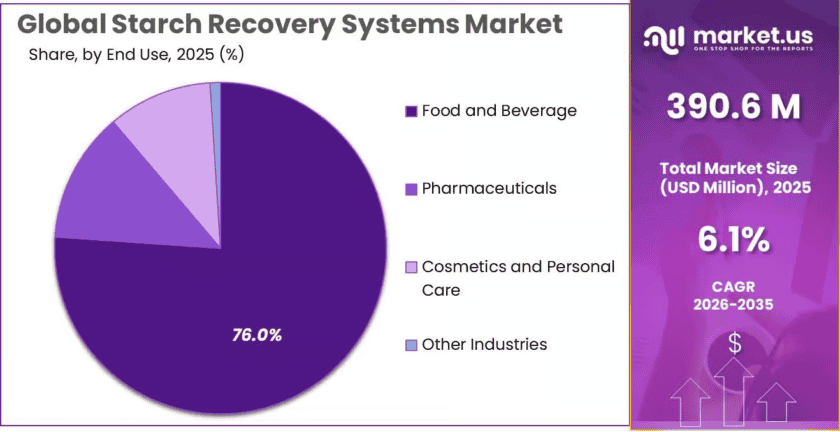
Demand is being supported by increasing potato, corn, wheat, frozen-food, and snack processing volumes. Recovery systems help plants improve raw-material utilization while reducing starch solids entering wastewater treatment. In 2025, Hydrocyclones and Centrifuges accounted for 34.00%, while Large-Scale Plants held 45.00% of the market. Frozen Products represented 41.2%, and Food and Beverage applications accounted for 76.00%.
The industry is also benefiting from stricter waste and water-management policies. The EU’s revised Waste Framework Directive requires a 10% reduction in food waste from processing and manufacturing by 2030. This encourages processors to recover useful solids rather than treating them only as waste.
Long-term opportunities are developing around water reuse, automated solids monitoring, circular by-product utilization, energy-efficient centrifuges, and modular recovery systems. These technologies can improve plant economics by turning previously lost starch into usable food, feed, fermentation, or industrial material streams.
Key Takeaways
- The Starch Recovery Systems Market was valued at USD 390.6 million in 2025 and is projected to reach USD 704.9 million by 2035, expanding at a 6.1% CAGR.
- Hydrocyclones and Centrifuges led the component segment with more than 34.00% share in 2025.
- Large-Scale Plants dominated by plant size with more than 45.00% share.
- Frozen Products remained the leading application with more than 41.2% share.
- Food and Beverage accounted for more than 76.00% of market demand by end use.
- Asia Pacific led the regional market with more than 33.50% share in 2025.
Regional Analysis
Asia Pacific Leads with 33.50% Share as Large Starch-Crop Processing Volumes Support Equipment Demand
Asia Pacific held a dominant Starch Recovery Systems Market position in 2025, capturing more than a 33.50% share. Large corn, potato, wheat, and processed-food industries support demand for hydrocyclones, centrifuges, refining sieves, and water-recovery equipment. Market.us reports a regional value of approximately USD 130.86 million, consistent with the reported global market size and regional share.
China provides a major raw-material base. USDA data cited in the report placed Chinese corn production at approximately 301.24 million metric tons in 2025/26, equivalent to 22.6% of global production. East Asian corn imports were estimated at 39.58 million metric tons, while Southeast Asian imports reached approximately 22.66 million metric tons.
North America also presents strong expansion potential. U.S. corn production reached approximately 432.34 million metric tons in 2025/26, while potato processors across eight surveyed states used about 192 million cwt through June 2026. These large processing volumes strengthen the need for efficient starch separation, wastewater-load reduction, and process-water reuse technologies.
Market Dynamics
Driver – Wastewater Reduction and Resource Recovery
Wastewater compliance is becoming a major driver for starch recovery systems because starch-rich solids increase organic loading when they enter treatment streams. European Best Available Techniques guidance for food, drink, and milk industries includes requirements covering energy efficiency, resource efficiency, water consumption, and wastewater discharge, with starch production included within its scope. Recovery systems remove starch before wastewater treatment while creating a reusable product stream. The EU’s 2025 Waste Framework Directive amendment also requires processing and manufacturing food waste to decline by 10% by 2030, strengthening investment in technologies that improve raw-material recovery.
Trend – Water Recycling Becomes Part of Starch Recovery
Starch processors are increasingly combining solids recovery with process-water recycling. European Commission technical guidance states that the starch industry has achieved significant fresh-water savings through internal recycling, process integration, and improved cooling-water systems. Specific water use across starch plants can range from below 1 m³ to around 13 m³ per tonne of raw material, depending on plant configuration and products. This wide variation creates room for modern hydrocyclones, centrifuges, membranes, and water-management controls. Plants increasingly view starch recovery as part of broader water-efficiency projects rather than as a stand-alone separation operation.
Restraint – High Equipment and Integration Costs
High upfront investment remains an important restraint, particularly for smaller processors. A complete recovery installation may require screens, pumps, hydrocyclones, centrifuges, tanks, dewatering equipment, cleaning systems, controls, and wastewater interfaces rather than a single machine. The need for several separation stages makes projects more complex and can extend the payback period. European Commission technical guidance also shows that starch-processing water requirements vary considerably between production sites and raw materials, which means systems often require site-specific engineering. Smaller plants may therefore delay full-scale installations or begin with modular systems focused on recovering the highest-value starch streams.
Opportunity – Circular Processing and By-Product Valorization
Circular processing offers a major opportunity for starch recovery equipment suppliers. The European Commission reported that 19% of EU food waste is generated by food and beverage manufacturing, equal to approximately 25 kg per person based on Eurostat’s latest monitoring. The revised Waste Framework Directive requires a 10% reduction in processing and manufacturing food waste by 2030. Starch recovery supports this objective by converting process-side material into usable starch, feed ingredients, fermentation substrates, or industrial inputs. Equipment suppliers can benefit by offering integrated recovery, water reuse, monitoring, and by-product handling solutions.
Emerging Trends
1. Water-Reuse Integration: Starch recovery is increasingly being connected with internal water recycling. European Commission data show starch-plant water consumption can range from below 1 m³ to around 13 m³ per tonne, creating strong incentives for separation and reuse technologies.
2. Food-Waste Reduction: The EU’s amended Waste Framework Directive requires food-processing and manufacturing waste to fall by 10% by 2030. Recovery systems support this target by capturing starch-rich material before it becomes a wastewater or disposal burden.
3. Higher Potato Processing Volumes: U.S. potato processors used around 192 million cwt during the 2025/26 season through June 2026. Higher plant throughput increases starch-rich process water, supporting demand for continuous hydrocyclones, centrifuges, and screening equipment.
4. Frozen-Product Processing: Frozen French fry inventories reached about 1.06 billion pounds in March 2026, while overall frozen potato inventories approached 1.30 billion pounds. High-volume frozen processing creates strong opportunities for recovering free starch released during cutting and washing.
5. Circular By-Product Use: EPA supports reducing food loss and improving organics recycling under a national goal to cut food loss and waste by 50% by 2030. Recovering useful starch can help processors move material toward productive reuse rather than disposal.
Use Cases
1. Frozen French Fry Plants: Frozen-product manufacturers use recovery systems to capture starch released during peeling, slicing, rinsing, and blanching. With frozen French fry inventories reaching 1.06 billion pounds in March 2026, large facilities can generate substantial starch-bearing water streams.
2. Potato Chip Processing: Chip plants can recover starch from water used for washing and rinsing sliced potatoes. U.S. potato production reached approximately 413 million cwt in 2025, creating a large raw-material base for starch-recovery applications across potato-processing operations.
3. Wastewater Load Reduction: Recovery equipment can remove suspended starch before water reaches biological treatment. An EPA-supported process demonstrated recovery and recycling approaches in which 73.8 kg of water per 100 kg of potatoes could be produced through reverse osmosis.
4. Water Recycling: Processors can combine centrifuges, hydrocyclones, and filtration with recycled-water loops. European Commission data show starch-production water use can vary up to approximately 13 m³ per tonne, highlighting the savings potential of efficient internal water management.
5. By-Product Recovery: Potato processing residues can contain commercially useful starch. FAO-hosted research found potato peel material contained around 50% starch on a dry-weight basis, demonstrating opportunities to recover valuable material from streams that would otherwise have limited economic value.
Frequently Asked Questions on Starch Recovery Systems Market
What is the Starch Recovery Systems Market size?
The global Starch Recovery Systems Market was valued at USD 390.6 million in 2025 and is projected to reach approximately USD 704.9 million by 2035, expanding at a 6.1% CAGR during the forecast period.
Which component dominates the Starch Recovery Systems Market?
Hydrocyclones and Centrifuges dominated the component category in 2025 with more than 34.00% share. These systems efficiently separate, wash, concentrate, and dewater starch while removing fibre and other impurities from processing streams.
Which plant size leads the market?
Large-Scale Plants held more than 45.00% share in 2025. Their high processing volumes require continuous starch separation, water management, solids handling, and wastewater-load reduction, creating strong demand for high-capacity recovery equipment.
Which application holds the largest share?
Frozen Products led the application segment with more than 41.2% share in 2025. Frozen potato operations generate starch-rich water during washing, cutting, rinsing, and preparation, making recovery systems valuable for large processing plants.
Which end-use sector dominates the market?
Food and Beverage held more than 76.00% share in 2025. Potato, corn, wheat, snack, and frozen-food facilities generate significant starch-containing process streams, supporting demand for recovery, separation, and water-treatment equipment.
Which region leads the Starch Recovery Systems Market?
Asia Pacific held the leading position in 2025 with more than 33.50% share. Its large starch-crop processing base, particularly across corn, potato, wheat, and food manufacturing, supports substantial demand for recovery technologies.
Why are starch recovery systems important for processors?
These systems recover useful starch before it is lost into wastewater. They can improve raw-material utilization, lower solids entering treatment facilities, support process-water reuse, and create additional by-product streams for food, feed, fermentation, or industrial applications.
Conclusion
The Starch Recovery Systems Market is developing as food processors place greater emphasis on raw-material efficiency, wastewater management, and circular manufacturing. The market is projected to rise from USD 390.6 million in 2025 to USD 704.9 million by 2035, at a 6.1% CAGR. Hydrocyclones and Centrifuges remain central to high-efficiency separation, while large processing plants and frozen-food manufacturers create substantial equipment demand.
Asia Pacific continues to lead regional activity. Future investment is expected to focus increasingly on water recycling, automated process control, energy-efficient separation, modular equipment, and by-product valorization as manufacturers seek higher starch yields and lower environmental impact.
Discuss your needs with our analyst
Please share your requirements with more details so our analyst can check if they can solve your problem(s)