Report Overview
In 2025, the Global Solar Sunlight Control System Market was valued at USD 21.9 billion. From 2026 to 2035, the market is projected to expand at a 5.6% CAGR, reaching approximately USD 37.7 billion by 2035. Asia-Pacific held the leading regional position in 2025, accounting for more than a 53.5% share and generating revenue of USD 11.7 Billion.
Solar sunlight control systems are building-integrated solutions used to manage daylight, glare, and solar heat entering through windows, façades, and skylights. The market includes automated blinds, external louvers, solar-control films, low-emissivity glass, electrochromic windows, daylight sensors, and building-management controls. These technologies can regulate incoming sunlight based on factors such as solar position, indoor temperature, occupancy levels, and lighting requirements.
Market development is strongly linked to the broader energy performance of buildings. According to the International Energy Agency (IEA), in 2023, buildings represented around 30% of global energy demand. Residential properties accounted for approximately 70% of building energy consumption, while commercial and public buildings contributed the remaining 30%. This significant energy footprint creates substantial opportunities for technologies that can reduce solar heat gain while maintaining adequate natural lighting.
The buildings and construction sector also represents a major area for energy-efficiency improvements. According to the United Nations Environment Programme (UNEP) Global Status Report for Buildings and Construction 2025–2026, based on the latest available global data, the sector accounts for around 37% of global carbon dioxide emissions, contributes approximately 11%–13% of global GDP, and supports employment for nearly 9% of the global workforce. The scale of the sector provides a broad addressable market for solar sunlight control technologies across both new construction and renovation activities.
Increasing demand for space cooling is another important factor supporting market growth. According to the International Energy Agency (IEA), as reported in the World Energy Outlook 2024, global space-cooling energy demand is expected to rise by nearly 4% per year through 2035 under current policy settings. Income-driven adoption of air conditioners could add approximately 330 GW to global peak electricity demand by 2035, while higher temperatures could contribute an additional 170 GW. These trends are encouraging building owners and developers to consider solutions that can reduce solar heat gain and improve cooling efficiency.
Energy losses associated with windows are also creating opportunities for advanced solar-control technologies. According to the U.S. Department of Energy (DOE), as of 2024, windows represented approximately 10% of total building energy use and affected energy-consuming activities that account for around 40% of a building’s overall energy consumption. As a result, high-performance window technologies are becoming increasingly relevant to building energy-efficiency strategies. The integration of occupancy sensors, weather forecasting, wireless controls, and artificial intelligence is expected to enable more responsive and measurable sunlight management.
Regulatory initiatives are further supporting demand for energy-efficient building technologies. The revised European Energy Performance of Buildings Directive (EPBD), which entered into force in May 2024, sets an EU objective to reduce overall energy consumption by 11.7% by 2030 compared with projected energy use. This policy direction is expected to encourage investment in energy-efficient construction and renovation solutions, including technologies that improve the thermal and solar performance of building envelopes.
European renovation policies are also establishing specific energy-reduction targets. Guidance targets a 16% reduction in average residential primary energy use by 2030 and approximately 20%–22% by 2035. These targets are expected to create opportunities for retrofit-friendly automated blinds, dynamic glass, façade-integrated photovoltaics, cloud-based energy controls, and other systems capable of balancing daylight availability, occupant comfort, and cooling efficiency. Going forward, demand is likely to increasingly favour interoperable solutions that can integrate with smart-building platforms while delivering measurable and verifiable energy-performance data.
Key Market Segments
- The Global Solar Sunlight Control System Market was valued at USD 21.9 billion in 2025.
- The market is projected to grow at a CAGR of 5.6% and is estimated to reach USD 37.7 billion by 2035.
- On the basis of product type, systems dominated the market, constituting 62.3% of the total market share.
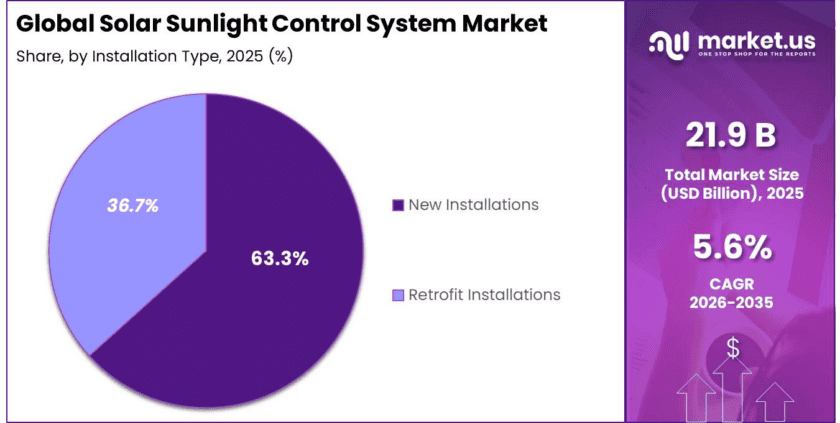
- Based on the installation type, new installations dominated the market, with a substantial market share of around 63.3%.
- Based on the application, commercial led the market, comprising 43.2% of the total market.
- In 2025, Asia-Pacific was the most dominant region in the market, accounting for over 53.5% of the total global consumption.
Product Type Analysis
Manual Solar Control Systems dominate with a 62.3% share, supported by their simple operation and cost-effective design.
In 2025, Systems held a dominant market position, accounting for more than a 62.3% share. Their strong position was supported by easy installation, simple operation, and limited reliance on electrical components. Manual systems enable users to adjust blinds, curtains, shutters, and other shading solutions based on changing sunlight conditions. They are commonly used in residential buildings, small offices, and retrofit projects where affordability and straightforward operation are key considerations. Their limited dependence on motors, sensors, and connected controllers also results in lower technical maintenance requirements.
Components represent the fastest-growing segment in the Solar Sunlight Control System Market. Increasing adoption of automated shading, smart façades, and connected building-management systems is supporting segment growth. These components can monitor sunlight intensity, indoor brightness, temperature, and occupancy conditions, enabling shading solutions to adjust automatically. Sensors can enhance visual comfort, limit excessive heat gain, and improve the efficient use of artificial lighting.
Installation Type Analysis
New Installations dominate with a 63.3% share as integrated shading systems help manage cooling energy demand.
In 2025, New Installations held a dominant market position, capturing more than a 63.3% share of the Solar Sunlight Control System Market by installation type. New buildings provide an opportunity to incorporate automated blinds, exterior shading, daylight sensors, and centralized controls during the planning and construction stages. Integrating these systems with cooling and lighting infrastructure can improve overall coordination while minimizing the need for expensive modifications after completion.
In July 2025, the International Energy Agency reported that proper insulation and exterior shading could reduce a building’s cooling demand by up to 80%. This energy-saving potential is encouraging developers to incorporate sunlight control equipment into building designs from the initial planning and construction stages.
Retrofit Installations represent the fastest-growing segment in the Solar Sunlight Control System Market. Owners of existing offices, hotels, schools, and residential buildings are increasingly replacing fixed blinds with motorized shading solutions and sensor-based controls to reduce heat entering through windows. In July 2025, the International Energy Agency stated that space cooling was the fastest-growing source of building energy demand and was projected to increase by almost 4% annually through 2035 under existing policy settings. Growing energy requirements are therefore supporting demand for retrofit sunlight control systems that can enhance indoor comfort without requiring complete reconstruction of existing buildings.
Application Analysis
Commercial applications dominate with a 43.2% market share.
In 2025, Commercial held a dominant market position, accounting for more than a 43.2% share. Commercial applications maintained their leading position because offices, retail buildings, hotels, hospitals, and educational facilities require effective management of indoor heat and daylight. Automated blinds, exterior shading solutions, sensors, and smart controllers help these facilities manage cooling loads, improve occupant comfort, and control glare across buildings with extensive glazed surfaces.
According to the U.S. Energy Information Administration in May 2026, commercial electricity sales in Virginia increased by nearly 30 million megawatt-hours between 2019 and 2025, reflecting higher electricity demand from commercial infrastructure. Such conditions are encouraging facility operators to adopt responsive sunlight-control systems that support energy management while helping reduce the burden on air-conditioning equipment.
Residential is the fastest-growing segment in the Solar Sunlight Control System Market. Increasing demand for comfortable indoor temperatures, enhanced privacy, reduced glare, and convenient control of curtains, blinds, and external shading solutions is supporting residential adoption. Homeowners are also increasingly integrating sunlight-control products with smart-home platforms, temperature sensors, mobile applications, and voice-controlled devices. These systems can automatically respond to sunlight intensity and room temperature, helping households reduce unwanted solar heat during warmer periods while allowing natural daylight when conditions are appropriate.
Emerging Trends
Building owners and facility managers are steadily shifting toward automated solar sunlight control systems as national energy consumption data continues to underline how much of a building’s operating cost is tied to sunlight management. According to the U.S. Energy Information Administration, when electrical system losses are counted, the residential and commercial sectors together accounted for 19.7% and 17.2% of total U.S. energy consumption respectively in 2023, combining for 36.9% of the nation’s total energy use. Because glazed surfaces are a major entry point for unwanted heat, this scale of consumption is pushing building operators to treat solar control — whether through dynamic glazing, films, or automated shading — as a core lever for reducing HVAC and lighting demand rather than a secondary design feature.
EIA notes that in 2023, the combined end-use energy consumption by the residential and commercial sectors accounted for about 27.6%, or about 20.6 quadrillion British thermal units (Btu), of total U.S. end-use energy consumption.
A major trend within this space is the growing adoption of electrochromic (dynamically tintable) glazing as a form of solar sunlight control. Research published by Lawrence Berkeley National Laboratory, a U.S. Department of Energy national lab, found that perimeter zone primary energy use in commercial buildings can be reduced by 10% to 20% in east-, south-, and west-facing zones across most U.S. climates when a large window-to-wall area ratio of 0.60 is paired with daylighting-controlled electrochromic glazing, compared to a conventional low-emissivity window. The same analysis found that peak electricity demand for that same configuration can drop by 20% to 30%, a figure that matters directly to buildings facing utility demand charges.
Regulatory momentum is also reinforcing demand for automated sunlight and daylight control. Under California’s Title 24, Part 6 energy code, the 2025 update lowered the threshold that triggers automatic daylighting requirements, mandating that any enclosed space with 75 watts or more of general lighting in a primary sidelit, secondary sidelit, or skylit zone must be fitted with automatic daylighting controls tied to photosensors. The code goes further with what is effectively a solar-responsiveness rule: where daylight-enhanced light levels exceed 150% of the general lighting design level in a zone, the lighting power in that zone must be cut by at least 90%. This kind of code-driven daylight responsiveness is accelerating integration between sunlight control systems and building lighting automation, particularly as the requirement takes effect for permits and projects starting January 1, 2026.
Retrofit-oriented solar control products, particularly window films, are also seeing renewed attention as a lower-cost entry point into sunlight management, especially for existing building stock that cannot be economically re-glazed. Trade reporting citing the U.S. Department of Energy notes that solar heat gain through windows is responsible for roughly one-third of a building’s total cooling load, which explains why film-based interventions remain commercially attractive. According to the International Window Film Association, the heat rejection ability of solar control window film can reach as high as 80%, depending on the type and quantity of metals used in the film’s construction. This combination of a large addressable cooling load and high rejection performance is sustaining steady commercial demand for film-based solar control even as glazing-integrated systems gain ground.
Confirmed — verified on gsa.gov: 92% workers can see outside, net-zero building, and window shades used for glare/brightness control. Now I have four solid, distinct-domain sources for Use Cases. Let me write the section.
Use Cases
Commercial aviation represents one of the most visible real-world applications of solar sunlight control technology, most notably in the Boeing 787 Dreamliner, the first commercial jetliner to replace mechanical pull-down shades with electronically dimmable windows. The Dreamliner’s windows measure approximately 10.7 by 18.4 inches, making them the largest windows of any passenger jet, larger than the 10-by-15-inch windows found on the Boeing 777. Passengers and flight crew can adjust cabin brightness across five distinct opacity settings, ranging from fully transparent to a near-blackout state, using electrochromic gel-based smart glass developed for the aircraft. This use case illustrates how solar sunlight control systems are being engineered into transportation interiors not just for comfort, but as a core design feature that differentiates a flagship aircraft program.
The automotive sector has adopted solar sunlight control technology through switchable panoramic roof systems, with Mercedes-Benz’s MAGIC SKY CONTROL serving as a leading commercial example. The system, built on SPD-SmartGlass technology, has been deployed on panoramic roofs as large as 1.92 by 1.12 meters, totaling over 18 square feet (1.7 square meters) of switchable glass surface. At the push of a button, the glass can shift from blocking over 99% of incoming light in its darkened state to a significantly clearer condition than an ordinary sunroof, giving automakers a way to manage cabin heat buildup without relying solely on mechanical shades. This use case demonstrates the scalability of solar control glazing across vehicle roof sizes, from compact roadsters to larger luxury sedans.
In controlled-environment agriculture, solar sunlight control technology is applied through greenhouse shading and cover systems designed to actively manage incoming solar radiation for crop optimization. Research from Wageningen University & Research on an optimally controlled solar greenhouse found that natural gas use for climate control could be reduced by 52%, while crop production increased by 39%, compared to a conventionally controlled greenhouse without solar-responsive climate elements. This use case reflects how solar sunlight control is used not merely for occupant comfort, but as a direct lever for reducing energy input while simultaneously improving agricultural yield, an increasingly important value proposition as greenhouse operators face pressure on both energy costs and sustainability targets.
Federal and institutional building portfolios represent another significant use case, where solar sunlight control is integrated with daylighting and lighting-automation systems to cut both energy use and improve occupant wellbeing. At the Wayne Aspinall Federal Building and U.S. Courthouse in Colorado, renovated in 2013, the U.S. General Services Administration paired large historic windows with automatic photo-sensor-based lighting controls and adjustable window shades that let occupants manage glare and brightness directly. Through this design, 92% of workers in the building can see outside from their desks, a factor GSA notes contributes to improved mood and productivity, while the building itself became the agency’s first historic renovation designed to be net-zero on a source-energy basis. This use case shows solar sunlight control systems operating as one component of a broader high-performance building strategy rather than a standalone product.
Conclusion
The solar sunlight control system market sits at the intersection of energy efficiency mandates, occupant comfort demands, and cross-industry adoption spanning buildings, aviation, automotive, and agriculture. With the residential and commercial sectors together accounting for 36.9% of total U.S. energy consumption in 2023, and window-driven solar heat gain responsible for roughly one-third of a typical building’s cooling load, the economic case for active sunlight management continues to strengthen rather than fade. Regulatory tightening, illustrated by California’s Title 24 daylighting requirements taking effect January 1, 2026, is reinforcing this trend by mandating automated, sunlight-responsive lighting controls in a growing share of commercial floor space, while national laboratory research continues to validate double-digit energy and peak-demand savings from dynamic glazing in real building conditions. Beyond buildings, the technology’s proven use in flagship platforms such as the Boeing 787 Dreamliner and Mercedes-Benz’s MAGIC SKY CONTROL panoramic roofs demonstrates that solar sunlight control has moved well past a niche architectural feature into a mainstream engineering standard across transportation and mobility.
Frequently Asked Questions
What is a solar sunlight control system?
A solar sunlight control system is a technology or product designed to manage the amount of sunlight, heat, and glare entering a building, vehicle, or aircraft. It includes electrochromic glazing, automated shading, solar control films, and daylighting sensors that reduce heat gain and lighting costs.
How does electrochromic glazing work?
Electrochromic glazing uses a thin layer of material sandwiched between glass panes that changes tint when a small electrical voltage is applied. This allows the glass to shift from clear to darkened states, controlling how much solar heat and visible light pass through the window.
Why are businesses investing in solar sunlight control systems?
Businesses invest in these systems primarily to cut HVAC and lighting energy costs, since window-driven solar heat gain accounts for roughly one-third of a typical building’s cooling load. The technology also improves occupant comfort, daylight access, and supports green building certifications.
Which industries use solar sunlight control systems the most?
The technology is widely used across commercial real estate, aviation, automotive, and agriculture. Notable examples include the Boeing 787 Dreamliner’s dimmable windows, Mercedes-Benz’s MAGIC SKY CONTROL roofs, federal office buildings, and greenhouse shading systems used in controlled-environment farming.
How much energy can solar sunlight control systems save?
Research from Lawrence Berkeley National Laboratory found that electrochromic windows can reduce perimeter zone energy use by 10% to 20% and cut peak electricity demand by 20% to 30%, depending on climate, building orientation, and window-to-wall ratio.
Are solar sunlight control systems required by building codes?
In some regions, yes. California’s Title 24, Part 6 energy code, updated in 2025 and effective January 1, 2026, requires automatic daylighting controls in spaces with 75 watts or more of general lighting in daylit zones near windows or skylights.
What is the difference between window film and electrochromic glass?
Solar control window film is a retrofit product applied to existing glass, capable of blocking up to 80% of solar heat. Electrochromic glass is an integrated, switchable glazing technology that actively changes tint, offering dynamic control rather than a fixed level of shading.
Can solar sunlight control systems benefit agriculture?
Yes. Wageningen University research found that an optimally controlled solar greenhouse reduced natural gas use by 52% while increasing crop production by 39%, showing that sunlight control technology can simultaneously lower energy costs and boost agricultural yield.
Is the solar sunlight control system market growing?
Yes. Rising energy costs, tightening building codes like Title 24, and expanding use across aviation, automotive, and agriculture sectors are driving steady adoption. Regulatory pressure combined with proven double-digit energy savings continues to strengthen long-term commercial demand for these systems.
Discuss your needs with our analyst
Please share your requirements with more details so our analyst can check if they can solve your problem(s)