Overview
New York, NY – Oct 08, 2026 – The global Offshore Decommissioning Market is entering a period of steady expansion as aging offshore oil and gas infrastructure reaches the end of its productive life. The market was valued at USD 7.0 billion in 2025 and is projected to reach approximately USD 14.3 billion by 2035, expanding at a 7.4% CAGR from 2026 to 2035.
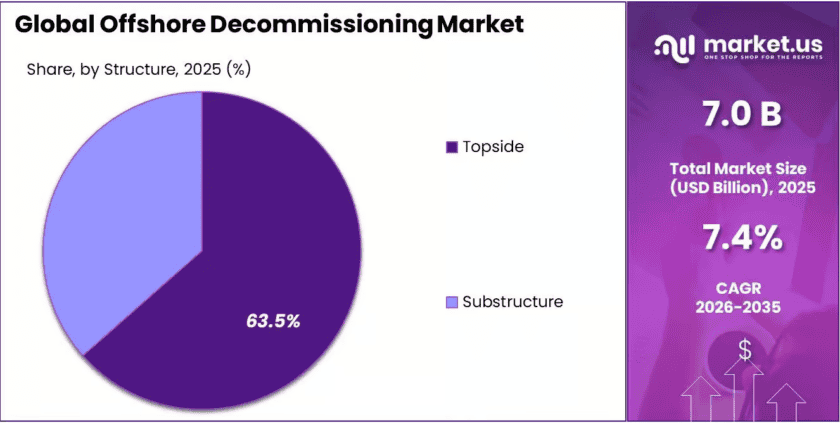
Decommissioning involves permanently plugging offshore wells, removing platforms and subsea structures, cleaning pipelines, managing hazardous materials, and restoring offshore sites. Shallow Water represented the largest type segment in 2025 with a 76.23% share, while Well Plugging and Abandonment accounted for 42.21% of service demand. Topsides dominated the structure category with a 63.56% share.
Activity is increasing as regulators require operators to safely retire inactive infrastructure. The UK’s North Sea Transition Authority reported record decommissioning spending of £2.6 billion in 2025, including around £1.3 billion on wells. More than 250 wells underwent decommissioning work during the year.
Growing use of remotely operated vehicles, advanced cutting equipment, data analytics, subsea robotics, heavy-lift vessels, and collaborative contracting models is expected to improve efficiency. These developments are creating opportunities for offshore engineering companies, vessel operators, recycling yards, subsea specialists, and environmental-service providers.
Key Takeaways
- The global Offshore Decommissioning Market reached USD 7.0 billion in 2025 and is forecast to reach USD 14.3 billion by 2035, growing at a 7.4% CAGR.
- Shallow Water dominated the type category in 2025 with more than a 76.23% share.
- Well Plugging and Abandonment led the service category with more than a 42.21% share.
- Topside structures accounted for more than 63.56% of market activity in 2025.
- Asia-Pacific led globally with more than a 38.21% share, generating approximately USD 2.6 billion in 2025.
- Aging offshore wells and platforms are creating sustained demand for plugging, removal, subsea intervention and site-restoration services.
Regional Analysis
Asia-Pacific Leads with 38.21% Share and USD 2.6 Billion
Asia-Pacific held the leading position in the Offshore Decommissioning Market in 2025, capturing more than a 38.21% share and generating around USD 2.6 billion. The region’s position is supported by aging offshore infrastructure across Australia and Southeast Asia, where mature fields increasingly require well abandonment, pipeline isolation, platform removal and subsea clearance.
Government-led environmental requirements and operator obligations are also encouraging structured retirement programmes. Decommissioning opportunities are expanding as offshore assets installed during earlier production cycles reach technical and economic maturity. Large projects increasingly require heavy-lift vessels, engineering contractors, subsea inspection systems and specialist waste-management capabilities.
Market Dynamics
Driver – Aging Offshore Assets Accelerate Retirement Activity
Aging offshore infrastructure is the strongest driver for decommissioning demand. The UK’s North Sea Transition Authority reported that operators spent a record £2.6 billion on decommissioning during 2025, compared with £2.4 billion in 2024. Around £1.3 billion was directed toward well decommissioning, with work undertaken on more than 250 wells and over 100 wells reaching final abandonment.
The remaining UK Continental Shelf programme is estimated at £43.4 billion. As fields stop producing economically, operators are legally required to secure wells, remove equipment and manage environmental liabilities, creating sustained demand for engineering, vessels and specialist contractors.
Trend – Collaborative Campaigns Reduce Vessel and Wellhead Costs
Collaboration between operators is becoming a major industry trend as companies seek to reduce vessel mobilisation and well-removal costs. In 2026, the North Sea Transition Authority and 17 operators signed a charter supporting shared data, resources and coordinated wellhead-removal campaigns.
Industry estimates suggest that replacing rig-based removal with suitable vessels could lower remaining subsea wellhead-removal costs by around 30%, potentially saving approximately £200 million. Nearly 1,000 subsea wells still require decommissioning across the UK Continental Shelf. Shared campaigns can improve vessel utilisation, strengthen supply-chain visibility and reduce duplicated mobilisation costs while maintaining required safety and regulatory standards.
Restraint – Rising Costs and Limited Specialist Capacity
Cost inflation and competition for offshore equipment remain major restraints. The NSTA estimated the remaining UK Continental Shelf decommissioning programme at £43.4 billion in 2026 despite record activity. The regulator stated that inflation, market uncertainty, competition for specialist offshore resources and demand from other energy sectors have limited cost reductions.
Around 500 wells were still awaiting final abandonment, while more than 1,000 additional wells are expected to enter decommissioning over the next five years. Limited rig, vessel and skilled-worker availability can therefore delay projects and increase day rates, weakening operators’ ability to execute work at the lowest possible cost.
Opportunity – Well Abandonment Creates Long-Term Service Pipeline
Well plugging and abandonment provides one of the clearest long-term opportunities. The NSTA states that well P&A accounts for around 50% of offshore decommissioning costs, making it the largest individual cost area and an important target for technical innovation. The regulator is developing planning models, data tools and multi-operator campaigns to improve sequencing and supply-chain efficiency.
In the U.S. Pacific region, BSEE reported in January 2026 that 46 wells associated with three platforms had already been abandoned and tested, while abandonment work had begun on another 20 shut-in wells. These programmes support opportunities for cementing, cutting, monitoring and subsea intervention providers.
Emerging Trends
1. Shared Vessel Campaigns Lower Removal Costs
Operators are increasingly sharing offshore vessels for decommissioning campaigns. The NSTA estimates vessel-based subsea wellhead removals could reduce costs by roughly 30%, potentially saving around £200 million across the remaining UK programme while freeing valuable rig capacity.
2. Well Decommissioning Activity Is Accelerating
UK operators spent approximately £1.3 billion on well decommissioning in 2025. Work covered more than 250 wells, with over 100 reaching final abandonment, showing that plugging and abandonment is moving from planning into large-scale execution.
3. Digital Benchmarking Improves Project Planning
Regulators are expanding digital performance tools. The NSTA’s 2026 benchmarking programme contains more than 1,000 validated well-decommissioning data points, helping operators compare actual costs, schedules and technical approaches before selecting methods for future offshore abandonment campaigns.
4. Local Supply Chains Capture More Work
Domestic capability is becoming increasingly important. UK-based organisations secured 71% of the value of decommissioning contracts awarded in 2025, exceeding the North Sea Transition Deal’s voluntary local-content ambition and supporting domestic engineering, marine and recycling capabilities.
5. Pacific Decommissioning Activity Expands
BSEE reported 8 offshore production platforms at different stages of decommissioning in the U.S. Pacific region in January 2026. These structures were originally installed between 1967 and 1987, highlighting the growing requirement to retire aging offshore infrastructure.
Use Cases
1. Permanent Well Plugging and Abandonment
Decommissioning contractors permanently isolate offshore reservoirs after production ends. UK operators worked on more than 250 wells in 2025, while over 100 achieved final abandonment, creating demand for cementing, casing cutting, intervention tools and well-integrity verification services.
2. Offshore Platform Removal
Contractors dismantle topsides, jackets and production facilities using heavy-lift vessels and specialist cutting systems. BSEE recorded 8 Pacific offshore facilities undergoing different stages of decommissioning in January 2026, demonstrating continuing structural-removal requirements.
3. Subsea Wellhead Removal
Subsea wellheads must be severed and recovered after wells are permanently abandoned. Approximately 1,000 subsea wells remain for decommissioning in the UKCS, while the average wellhead removal cost over recent years was around £700,000.
4. Pipeline Decommissioning
Pipelines are cleaned, disconnected, removed or safely left in place following regulatory assessment. BSEE previously awarded work covering 8 orphaned pipelines in the Matagorda Island area, demonstrating the environmental and navigational importance of retiring unused offshore pipeline infrastructure.
5. Offshore Site Clearance and Environmental Protection
Decommissioning removes equipment that could threaten navigation or marine ecosystems. BSEE’s Pacific programme includes abandoned wells, conductors and platform infrastructure, including 46 wells already abandoned and tested across the Harvest, Hidalgo and Hermosa facilities.
Frequently Asked Questions on Offshore Decommissioning
What is offshore decommissioning?
Offshore decommissioning is the controlled retirement of oil and gas infrastructure after production ends. It normally includes plugging wells, cleaning pipelines, removing platforms and subsea equipment, managing waste and restoring the offshore site to regulatory requirements.
How large is the Offshore Decommissioning Market?
The global Offshore Decommissioning Market was valued at USD 7.0 billion in 2025 and is projected to reach approximately USD 14.3 billion by 2035, expanding at a 7.4% CAGR during 2026–2035.
Which region leads the Offshore Decommissioning Market?
Asia-Pacific led the global market in 2025 with more than a 38.21% share, representing around USD 2.6 billion. Mature offshore assets across Australia and Southeast Asia are creating increasing retirement requirements.
Which type dominates offshore decommissioning?
Shallow Water held the dominant market position in 2025, accounting for more than a 76.23% share. Mature shallow-water fields contain significant numbers of older fixed platforms, wells and pipelines approaching retirement.
Which service has the largest market share?
Well Plugging and Abandonment represented the leading service segment in 2025, capturing more than a 42.21% share. Every permanently retired offshore well requires secure isolation to prevent future leakage and environmental problems.
Why is offshore decommissioning demand increasing?
Demand is increasing because many offshore assets are aging and becoming uneconomic. The NSTA estimated that the remaining UK Continental Shelf decommissioning programme alone would require approximately £43.4 billion, showing the scale of future retirement work.
What technologies are used in offshore decommissioning?
Operators use heavy-lift vessels, remotely operated vehicles, subsea cutting systems, well-intervention equipment, cementing systems, digital inspection tools and data platforms. These technologies help reduce offshore exposure while improving planning, safety and project execution.
What are the main challenges in offshore decommissioning?
Major challenges include high project costs, limited specialist vessel capacity, inflation, aging infrastructure and complex regulations. Around 500 UKCS wells were awaiting final abandonment in 2026, illustrating the execution backlog facing operators and contractors.
Conclusion
The Offshore Decommissioning Market is developing into an important long-term offshore-services industry as mature oil and gas infrastructure reaches retirement. Valued at USD 7.0 billion in 2025, the market is projected to reach USD 14.3 billion by 2035, supported by a 7.4% CAGR. Well plugging, platform removal, subsea clearance and environmental restoration will remain central activities.
Asia-Pacific’s 38.21% share highlights strong retirement needs outside traditional North Sea markets. At the same time, rising costs are encouraging shared vessels, digital planning, robotics and collaborative contracting. These changes should improve execution efficiency while creating opportunities for engineering, marine and environmental-service providers.
Discuss your needs with our analyst
Please share your requirements with more details so our analyst can check if they can solve your problem(s)