Overview
New York, NY – Sep 28, 2026 – The global Smart Transformers Market is expected to grow from USD 3.6 billion in 2025 to around USD 14.0 billion by 2035, expanding at a 14.5% CAGR during 2026–2035. Smart transformers combine conventional voltage transformation with sensors, communication systems, automated voltage control, condition monitoring, and digital asset-management tools. These capabilities are becoming important as utilities modernize aging grids and connect renewable generation, battery storage, electric vehicles, and data centers.
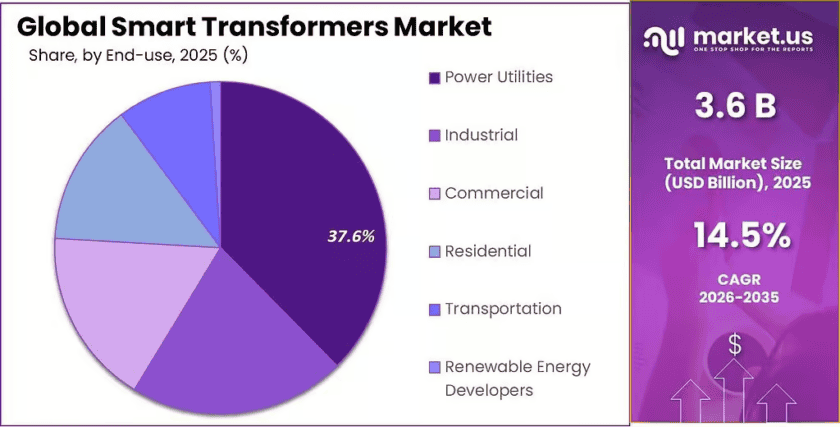
In 2025, Distribution Transformers captured more than 50.60% of the market by type. Transformers accounted for 41.00% by component, Smart Grids held 35.00% by application, and Power Utilities represented 37.00% by end user.
Grid investment provides a strong long-term foundation. The IEA reported that around USD 400 billion is currently invested in grids each year, but spending needs to increase by about 50% by 2030. More than 2,500 GW of generation, storage, and large-load projects are waiting for grid connections globally. Smart transformers can help utilities manage these increasingly complex, decentralized, and digitally controlled power networks.
Key Takeaways
- The Smart Transformers Market was valued at USD 3.6 billion in 2025 and is projected to reach USD 14.0 billion by 2035, growing at a 14.5% CAGR.
- Distribution Transformers led by type with more than 50.60% share in 2025.
- Transformers dominated the component category with more than 41.00% share.
- Smart Grids accounted for more than 35.00% share by application.
- Power Utilities held more than 37.00% share among end users.
- Europe led the regional market with more than 42.50% share, generating approximately USD 1.54 billion in 2025.
Regional Analysis
Europe Leads with 42.50% Share and USD 1.54 Billion as Aging Grids Require Digital Modernization
Europe held a dominant Smart Transformers Market position in 2025, capturing more than a 42.50% share and generating approximately USD 1.54 billion. The region is benefiting from large grid replacement and digitalization requirements. The European Commission estimated in June 2025 that approximately EUR 730 billion would be required for distribution-grid development and another EUR 477 billion for transmission networks by 2040.
Around 40% of European distribution grids are more than 40 years old, creating a strong need for digitally monitored transformers, automatic voltage regulation, condition-based maintenance, and smarter power distribution. Renewable electricity is also increasing grid complexity. Eurostat reported that renewables accounted for 49.9% of EU gross electricity consumption in 2025, compared with 47.5% in 2024.
Asia Pacific is emerging as the fastest-growing regional market as electricity demand, renewable capacity, urban infrastructure, and grid spending increase. The region’s expansion creates opportunities for digitally monitored distribution transformers, smart substations, solid-state transformers, and automated grid-control systems.
Market Dynamics
Driver – Grid Modernization and Rising Electricity Demand
Rapid electricity-demand growth is a major driver for smart transformers. The IEA reported that global electricity consumption reached about 28,200 TWh in 2025 and is expected to increase to 33,600 TWh by 2030. Annual grid investment currently stands near USD 400 billion, but needs to increase by roughly 50% by 2030. Utilities therefore need transformers capable of voltage regulation, remote monitoring, load management, and predictive diagnostics. Smart transformers help distribution networks handle changing demand from electric vehicles, data centers, renewable generation, heat pumps, storage systems, and electrified industrial processes while improving visibility across increasingly complex power networks.
Trend – Digitalization, AI, and Predictive Transformer Monitoring
Smart transformers are increasingly becoming connected digital assets rather than passive electrical equipment. The European Commission’s 2026 Strategic Roadmap for Digitalisation and AI in Energy promotes AI for electricity-grid optimization, energy efficiency, and demand flexibility. The EU has allocated around EUR 1 billion through Horizon Europe for research into energy systems, grids, and storage, with approximately EUR 100 million planned for advanced smart-grid solutions and EUR 75 million for AI energy applications under the 2026–2027 programme. This trend supports transformers equipped with sensors, digital twins, real-time diagnostics, automated control, and predictive-maintenance software.
Restraint – Transformer Supply Chains and Higher Grid Component Costs
Transformer supply constraints remain a major restraint because smart-grid projects depend on specialized electrical steel, copper, semiconductor devices, sensors, and manufacturing capacity. The IEA reported that prices for key grid components have nearly doubled over the past five years, while transformer and cable delivery times have also lengthened. The U.S. Department of Energy identified more than 80,000 different distribution-transformer varieties used nationwide, showing how specification fragmentation can complicate manufacturing and inventories. High equipment costs and long procurement cycles can therefore delay utility modernization projects, particularly when digital controls and communications increase system complexity.
Opportunity – Renewable Energy and Flexible Distribution Networks
Renewable integration creates a major opportunity for smart-transformer suppliers because variable generation requires more flexible voltage management and two-way electricity flows. Eurostat reported that renewable sources supplied 49.9% of EU gross electricity consumption in 2025, while the EU’s overall renewable-energy target reaches 42.5% by 2030. At the global level, solar and wind are expected to increase from around 17% of electricity generation today to 27% by 2030. Smart transformers can support renewable-heavy networks by monitoring loading, controlling voltage, detecting faults, and coordinating distributed energy resources, batteries, and demand-response systems.
Emerging Trends
1. AI-Based Grid Optimization: The European Commission’s 2026 digital-energy roadmap supports AI deployment across electricity grids. Horizon Europe has earmarked around EUR 75 million for AI energy applications, encouraging transformers with predictive diagnostics, intelligent voltage control, and automated asset management.
2. Higher Renewable Penetration: Renewable sources accounted for 49.9% of EU gross electricity consumption in 2025. Greater renewable penetration increases voltage variability and bidirectional power flows, supporting demand for transformers with advanced monitoring, communications, and automated control.
3. Grid Investment Acceleration: Global annual grid investment is around USD 400 billion and needs to rise by roughly 50% by 2030. This investment cycle supports replacement of conventional transformers with digitally connected and higher-efficiency units.
4. Transformer Standardization: The U.S. Department of Energy identified more than 80,000 transformer varieties nationwide. Standardization efforts are increasingly focused on reducing production complexity and improving interchangeability, helping utilities shorten procurement cycles for modern distribution transformers.
5. Digital Energy Infrastructure: Digitalization of EU energy systems could create around EUR 71 billion annually in direct consumer savings and more than EUR 300 billion in wider system benefits, strengthening investment interest in smart grid and connected transformer technologies.
Use Cases
1. Renewable Integration: Smart transformers manage voltage fluctuations created by solar and wind generation. In 2025, renewables supplied 49.9% of EU gross electricity consumption, making automated voltage control and real-time monitoring increasingly important across distribution networks.
2. Data Center Connections: More than 2,500 GW of renewables, storage, and large-load projects are currently waiting in global grid connection queues. Smart transformers can improve capacity management and monitoring where rapidly growing data-center loads place pressure on local substations.
3. EV Charging Networks: Electricity demand from transport is expected to account for more than 10% of global demand growth through 2030, double its contribution during the previous five years. Smart transformers can manage charging peaks and localized voltage stress.
4. Aging Distribution Networks: Around 40% of European distribution grids are more than 40 years old. Smart transformers can support replacement programs by adding digital diagnostics, remote monitoring, automated voltage management, and condition-based maintenance to aging network infrastructure.
5. Grid Resilience: The U.S. Department of Energy manages a USD 10.5 billion Grid Resilience and Innovation Partnerships Program and announced approximately USD 1.9 billion through SPARK in March 2026, creating opportunities for modern grid equipment and advanced control technologies.
Frequently Asked Questions on Smart Transformers Market
What is the Smart Transformers Market size?
The global Smart Transformers Market was valued at approximately USD 3.6 billion in 2025 and is projected to reach around USD 14.0 billion by 2035, expanding at a 14.5% CAGR.
Which type dominates the Smart Transformers Market?
Distribution Transformers held the leading position in 2025 with more than 50.60% share. Their large installed base across local electricity networks makes them central to grid monitoring, voltage management, renewable integration, and modernization projects.
Which component dominates the market?
Transformers accounted for more than 41.00% of the Smart Transformers Market by component in 2025. They form the central electrical conversion equipment around which sensors, monitoring hardware, digital controllers, switches, and communications systems are integrated.
Which application leads the Smart Transformers Market?
Smart Grids held more than 35.00% share in 2025. Smart transformers support grid automation through voltage regulation, fault detection, condition monitoring, bidirectional electricity flow management, and communications with utility control platforms.
Which end user holds the largest share?
Power Utilities accounted for more than 37.00% share in 2025. Utilities are investing in transformer monitoring and digital grid equipment to improve reliability, integrate renewable resources, manage peak demand, and reduce maintenance downtime.
Which region leads the Smart Transformers Market?
Europe held the dominant regional position in 2025 with more than 42.50% share, generating approximately USD 1.54 billion. Aging distribution assets and major grid investment requirements continue to support regional modernization.
Why are smart transformers important for future power grids?
Smart transformers provide real-time monitoring, automated voltage management, communication, and diagnostic functions. These capabilities help utilities operate networks with higher renewable penetration, distributed energy resources, electric vehicles, batteries, and rapidly changing electricity demand.
Conclusion
The Smart Transformers Market is entering a strong expansion phase as utilities modernize aging electricity networks and prepare for higher renewable generation, electric vehicles, storage, and data-center demand. The market is expected to increase from USD 3.6 billion in 2025 to USD 14.0 billion by 2035, growing at a 14.5% CAGR. Distribution transformers remain the leading type, while smart-grid applications and power utilities provide a major demand base. Europe continues to lead regional activity. Future opportunities will increasingly center on digital monitoring, AI-driven diagnostics, automated voltage control, solid-state technologies, cybersecurity, and flexible transformer designs that improve grid reliability and efficiency.
Discuss your needs with our analyst
Please share your requirements with more details so our analyst can check if they can solve your problem(s)