Overview
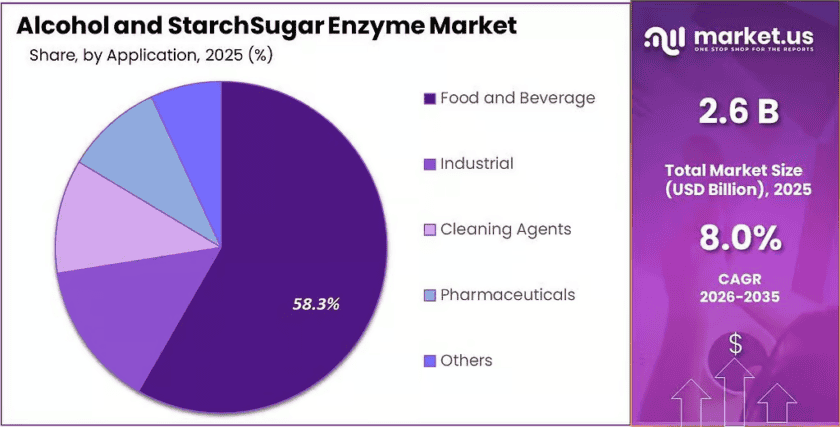
New York, NY – Oct 23, 2026 – The global Alcohol and StarchSugar Enzyme Market is gaining attention as food manufacturers, starch processors, and biofuel producers seek efficient ways to convert starch into fermentable sugars and improve production yields. According to the supplied Market.us report, the market was valued at approximately USD 0.8 billion, with Asia-Pacific accounting for 34.56% of the market. Amylase represented 47.21% of the market by enzyme type, while liquid formulations accounted for 62.34%. Microbial enzymes held a 76.34% share, and food and beverage applications represented 58.34%.
Alcohol and starch-sugar enzymes support important industrial processes, including starch liquefaction, saccharification, fermentation, and the production of glucose syrups. Amylases break down starch into smaller carbohydrate molecules, while other enzymes help convert these products into sugars used in food processing and alcohol production. These processes are important in brewing, distilling, sweetener manufacturing, and fuel ethanol production.
Demand is supported by efforts to improve raw-material utilization, reduce processing time, and maintain consistent product quality. Advances in microbial fermentation and enzyme formulation are also creating opportunities for industrial users. However, production costs, temperature and pH sensitivity, raw-material quality, and the need for process-specific enzyme performance remain important considerations for manufacturers.
Key Takeaways
- Market size in 2025: USD 2.6 billion.
- Projected market size by 2035: USD 5.6 billion.
- Forecast CAGR: 8.0% during 2026–2035.
- Leading region: Asia-Pacific, with a 34.56% share, valued at USD 0.8 billion in 2025.
- Leading enzyme type: Amylase, accounting for 47.21%.
- Leading formulation: Liquid enzymes, holding a 62.34% share.
- Leading source: Microbial enzymes, representing 76.34%.
- Leading application: Food and beverage, accounting for 58.34%.
Regional Analysis
Asia-Pacific
Asia-Pacific led the Alcohol and StarchSugar Enzyme Market in 2025, capturing 34.56% of global revenue, equivalent to USD 0.8 billion. Its position is supported by food processing, starch-based ingredients, brewing, and industrial fermentation.
The region’s manufacturing base creates demand for amylase and glucoamylase, which help convert starch into fermentable sugars. The International Energy Agency reported in January 2026 that biofuel consumption in India had increased from less than 2 billion litres annually in 2018 to more than 11 billion litres by 2025, illustrating how policy-supported biofuel development can increase demand for fermentation inputs
Market Dynamics
1. Driver: Growing Demand for Bioethanol and Starch Conversion
Demand for alcohol and starch-sugar enzymes is supported by ethanol production and the need to convert starch into fermentable sugars. Amylase breaks down starch during liquefaction, while glucoamylase releases glucose for fermentation.
The US Department of Energy reports that nearly 90% of US ethanol plants use dry-mill processing, where corn is ground and fermented to produce ethanol and coproducts. The International Energy Agency also reported that biofuel demand is expected to grow through 2030 under existing policies. These developments support enzyme use in fermentation, although actual demand depends on plant output and operating economics.
2. Trend: Development of More Efficient Enzyme Formulations
Manufacturers are developing enzyme formulations designed to work under specific processing conditions, including different temperatures, pH levels, and starch concentrations. Better enzyme performance can improve sugar release and help reduce processing time or energy requirements.
The US Food and Drug Administration lists alpha-amylase preparations used to hydrolyze edible starch into maltodextrin and carbohydrate sweeteners, demonstrating the established role of these enzymes in food manufacturing. Increasing attention to process efficiency is encouraging the use of tailored microbial enzymes, controlled dosing, and performance testing. Adoption depends on the formulation’s ability to deliver consistent results at a commercially viable cost.
3. Restraint: High Production Costs and Process Sensitivity
Alcohol and starch-sugar enzymes must operate under suitable temperature, pH, and processing conditions to deliver consistent results. Enzyme production, formulation, storage, and quality testing can increase operating costs. Food and beverage manufacturers must also evaluate safety, permitted uses, and the suitability of enzyme preparations for each application.
The US Food and Drug Administration explains that food enzyme preparations may contain stabilizers, diluents, and other formulation ingredients, and their regulatory status depends on the intended use and applicable requirements. Smaller processors may face additional costs when adjusting equipment or validating a new formulation, limiting adoption where expected savings are low.
4. Opportunity: Advanced Biofuels and Industrial Biotechnology
Advanced biofuels create opportunities for enzymes that help convert starch, sugars, and biomass into useful products. The International Energy Agency reported that global biofuel demand could reach 310 billion litres annually by 2030 in its accelerated scenario, approximately 30% above its main case.
Enzymes can contribute to feedstock conversion, although advanced pathways may require different enzyme systems from conventional grain-based ethanol production. Suppliers can develop specialized formulations, work with biofuel producers, and support process optimization. Commercial growth will depend on sustainable feedstock availability, plant investment, fuel policies, and the ability to compete on total production cost.
Emerging Trends in Alcohol and StarchSugar Enzymes
1. Advanced Microbial Enzyme Production
Microbial enzymes accounted for 76.34% of the market in 2025, according to Market.us. Manufacturers are improving microbial strains and fermentation processes to produce enzymes with consistent activity for starch conversion, food processing, and industrial alcohol production.
2. Growth in Liquid Enzyme Formulations
Liquid formulations held a 62.34% market share in 2025. Their suitability for automated dosing and direct mixing makes them useful in large-scale processing. Producers continue to improve formulation stability and handling for industrial fermentation and starch conversion.
3. Improved Starch-to-Sugar Conversion
Amylase represented 47.21% of the market in 2025. New formulations aim to improve starch breakdown and sugar release under specific processing conditions. These improvements can help food, sweetener, brewing, and ethanol manufacturers maintain consistent production quality.
4. Expansion of Biofuel Applications
The International Energy Agency estimates that global biofuel demand could reach 310 billion litres per year by 2030 in its accelerated scenario. This creates opportunities for enzymes that improve starch and biomass conversion into fermentable sugars.
5. Stronger Focus on Food Enzyme Compliance
Food manufacturers must assess enzyme safety and permitted applications. The US Food and Drug Administration identifies alpha-amylase preparations used to hydrolyze starch into maltodextrin and carbohydrate sweeteners. This supports demand for documented, application-specific enzyme preparations.
Use Cases of Alcohol and StarchSugar Enzymes
1. Fuel Ethanol Production
Amylase and glucoamylase convert corn starch into fermentable sugars before yeast produces ethanol. Nearly 90% of US ethanol plants use dry-mill processing, making enzyme performance important for starch conversion, production efficiency, and consistent fermentation.
2. Brewing and Distilling
Breweries and distilleries use starch-degrading enzymes to release fermentable sugars from grains. The enzymes support fermentation consistency and help processors work with different grain inputs. The exact enzyme combination depends on the recipe, grain characteristics, and desired beverage.
3. Glucose Syrup and Sweetener Manufacturing
Manufacturers use alpha-amylase and other carbohydrate-processing enzymes to break starch into smaller sugars. The US Food and Drug Administration lists enzyme preparations used in starch hydrolysis and dextrose production, demonstrating their role in commercial sweetener manufacturing.
4. Food Ingredient Processing
Food processors use starch-degrading enzymes to produce maltodextrins and other carbohydrate ingredients. These ingredients can support formulation, texture, and processing requirements across food applications. The enzyme selection depends on the starch source, target product, and applicable food-safety requirements.
5. Industrial Biotechnology
Industrial biotechnology uses enzymes to convert carbohydrate-rich raw materials into sugars for fermentation and further processing. The International Energy Agency identifies biofuels as an important low-emissions fuel pathway, creating opportunities for enzyme-assisted conversion where feedstock, cost, and process conditions are suitable.
Frequently Asked Questions
1. What are alcohol and starch-sugar enzymes?
Alcohol and starch-sugar enzymes are biological catalysts used to break starch into smaller carbohydrates and fermentable sugars. Amylase and glucoamylase are common examples, supporting ethanol production, brewing, distilling, and the manufacture of starch-based sweeteners.
2. What is the market size in 2025?
According to Market.us, the global Alcohol and StarchSugar Enzyme Market reached USD 2.6 billion in 2025. The report projects revenue of USD 5.6 billion by 2035, representing a compound annual growth rate of 8.0%.
3. Which enzyme type leads the market?
Amylase led the market in 2025, accounting for 47.21% of the total, according to Market.us. It is widely used to break down starch during industrial processing, creating smaller carbohydrates for subsequent sugar production and fermentation.
4. Which region dominates the market?
Asia-Pacific led the market in 2025, accounting for 34.56% of global revenue, valued at USD 0.8 billion. Demand is supported by food manufacturing, starch processing, brewing, and industrial fermentation activities.
5. Why are microbial enzymes widely used?
Microbial enzymes accounted for 76.34% of the market in 2025. They can be produced through controlled fermentation and tailored for specific processing conditions, making them suitable for large-scale starch conversion, food manufacturing, and alcohol production.
6. What are the major applications of these enzymes?
Major applications include fuel ethanol production, brewing, distilling, glucose syrup manufacturing, food processing, and industrial biotechnology. The enzymes help convert starch into fermentable sugars or other carbohydrates, with the selected preparation depending on the process and final product.
7. What is driving market growth?
Growth is supported by bioethanol production, demand for processed foods, starch-based ingredients, and the need for efficient fermentation. The International Energy Agency expects biofuel demand to continue growing through 2030, subject to policy implementation and market conditions.
Conclusion
The Alcohol and StarchSugar Enzyme Market is positioned for continued growth as food manufacturers, starch processors, and bioethanol producers seek better conversion efficiency and consistent product quality. According to Market.us, the market is projected to increase from USD 2.6 billion in 2025 to USD 5.6 billion by 2035, at a CAGR of 8.0%.
Asia-Pacific remains the leading region, while microbial enzymes, liquid formulations, and amylase represent important market segments. Advances in enzyme formulation and industrial biotechnology may create further opportunities. However, production costs, process sensitivity, feedstock variation, and regulatory requirements will influence future adoption across applications.
Discuss your needs with our analyst
Please share your requirements with more details so our analyst can check if they can solve your problem(s)