Overview
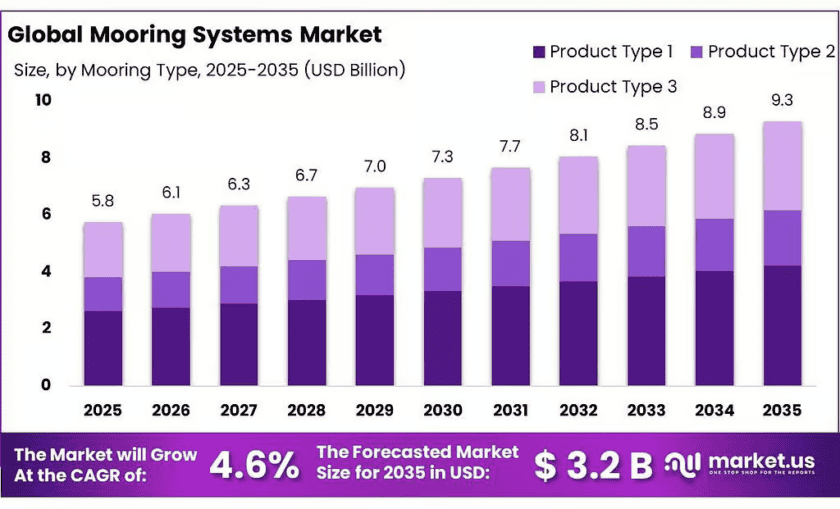
New York, NY – Oct 23, 2026 – The global Mooring Systems Market is gaining importance as offshore oil and gas operations, maritime transportation, floating production facilities, and offshore renewable energy projects require reliable station-keeping equipment. According to the supplied Market.us report, the market was valued at USD 2.1 billion in 2025 and is projected to reach USD 3.2 billion by 2035, registering a compound annual growth rate (CAGR) of 4.6% from 2026 to 2035. Asia-Pacific led the market in 2025 with a 37.89% share, valued at approximately USD 0.7 billion.
Mooring systems use anchors, chains, steel wires, synthetic ropes, connectors, and tension-control equipment to hold floating vessels and offshore structures in position under changing wind, wave, and current conditions. They are essential for floating production, storage, and offloading (FPSO) vessels, offshore platforms, floating wind turbines, and marine terminals.
Demand is supported by deepwater energy development, offshore infrastructure investment, and the need for dependable station-keeping equipment. In 2025, deep and ultra-deepwater systems accounted for 62.67% of the market, while FPSO applications represented 46.21%. Single Point Mooring systems held 42.90%, and vertical load anchors accounted for 34.78%.
Advances in mooring materials, reliability-based design, and digital condition monitoring are creating opportunities for equipment manufacturers and offshore engineering providers. However, installation complexity, harsh marine conditions, project delays, and high maintenance costs continue to influence purchasing decisions.
Key Takeaways
- Market value in 2025: USD 2.1 billion.
- Projected market value by 2035: USD 3.2 billion.
- Forecast CAGR: 4.6% during 2026–2035.
- Leading region: Asia-Pacific, with a 37.89% share, valued at USD 0.7 billion in 2025.
- Leading depth segment: Deep/ultra-deepwater, with a 62.67% share.
- Leading application: FPSO systems, accounting for 46.21%.
- Leading mooring type: Single Point Mooring, with a 42.90% share.
- Leading anchorage segment: Vertical load anchors, representing 34.78%.
Regional Analysis
Asia-Pacific
Asia-Pacific led the Mooring Systems Market in 2025, accounting for 37.89% of global revenue, equivalent to approximately USD 0.7 billion. Demand is supported by offshore oil and gas development, shipbuilding, port infrastructure, and offshore wind investment.
China, Japan, and South Korea have established maritime manufacturing capabilities and offshore engineering industries. UN Trade and Development reported that developing economies in Asia handled 60% of global container port traffic in 2024, highlighting the region’s importance in maritime trade. These activities support demand for vessel mooring equipment, offshore anchors, chains, and synthetic ropes.
North America
North America benefits from offshore oil and gas production in the Gulf of Mexico, marine terminals, and emerging floating offshore wind projects. Mooring systems are essential for FPSO vessels, offshore drilling units, and floating renewable energy structures operating in challenging marine environments.
The US Department of Energy identified approximately 2.8 terawatts of technical floating offshore wind resource potential across eight geographic areas in the contiguous United States, subject to environmental, technical, and other development constraints. This potential creates a long-term opportunity for mooring lines, anchors, installation services, and inspection technologies.
Market Dynamics
1. Driver: Expansion of Deepwater Oil and Gas Operations
Deepwater oil and gas development is a major driver of demand for mooring systems. Floating production, storage, and offloading vessels and offshore platforms depend on anchors, chains, and mooring lines to remain safely positioned in challenging marine conditions.
The US Bureau of Ocean Energy Management maintains offshore leasing and water-depth data covering thousands of leases and tens of thousands of wells, reflecting the scale of offshore activity requiring reliable infrastructure. As projects move into deeper waters, operators need engineered station-keeping systems that account for waves, currents, fatigue, and seabed conditions.
2. Trend: Reliability-Based Mooring Design
Mooring design is moving toward more consistent reliability assessment, improved fatigue analysis, and better evaluation of extreme environmental loads. In October 2026, DNV announced that findings from its NorMoor joint industry project had been incorporated into the third edition of ISO 19901-7, an international standard for station-keeping systems on floating offshore structures and mobile offshore units.
The updated framework addresses ultimate, accidental, and fatigue limit states. This development supports more consistent engineering assessments and can help operators evaluate safety and long-term equipment performance when designing or upgrading mooring systems.
3. Restraint: High Installation and Maintenance Costs
Mooring systems can be expensive to install and maintain because they require specialized vessels, heavy anchors, high-strength chains or ropes, and skilled offshore personnel. Installation becomes more complex as water depth increases and seabed conditions become harder to assess.
The US Department of Energy notes that floating wind systems generally target water depths of approximately 60 to 1,000 metres, where longer mooring lines and more complex anchoring arrangements may be needed. Inspection, corrosion management, fatigue assessment, and component replacement add further costs. These requirements can delay projects when budgets or installation resources are limited.
4. Opportunity: Floating Offshore Wind and Shared Mooring Systems
Floating offshore wind creates opportunities for specialized mooring lines, anchors, connectors, and installation services. The US Department of Energy identified approximately 2.8 terawatts of technical floating offshore wind resource potential across eight geographic areas in the contiguous United States.
Although this is a technical resource estimate rather than a construction forecast, it indicates a substantial potential development base. Research published through the National Renewable Energy Laboratory also identifies shared mooring and anchor arrangements as possible ways to reduce line lengths and anchor numbers in floating wind farms. Commercial adoption will depend on project economics, seabed conditions, and engineering validation.
Emerging Trends in Mooring Systems
1. Advanced Mooring Materials
Manufacturers are improving chain strength, corrosion resistance, and synthetic rope performance for demanding marine conditions. The Department of Energy identifies floating wind applications in water depths of approximately 60 to 1,000 metres, where line length, weight, and anchor design strongly influence system performance.
2. Shared Anchors and Mooring Lines
Floating wind developers are studying shared mooring arrangements to reduce the number of seabed anchors and total line length. National Renewable Energy Laboratory research identifies potential cost savings from shared systems, particularly in deeper waters where installation and station-keeping costs can increase.
3. Reliability-Based Engineering Standards
Updated engineering standards are improving the assessment of mooring strength, fatigue, and accidental loads. In October 2026, DNV reported that its NorMoor research had contributed to the third edition of ISO 19901-7, supporting more consistent station-keeping design for floating offshore structures.
4. Floating Offshore Wind Expansion
Floating wind projects require mooring systems to hold turbines in position where fixed foundations may not be suitable. The US Department of Energy estimated 2.8 terawatts of technical floating offshore wind potential in US waters, creating a long-term opportunity for anchors, ropes, and installation services.
5. Digital Inspection and Condition Monitoring
Operators are increasingly interested in digital inspection, load monitoring, and predictive maintenance to identify wear before failure. These systems can track changes in mooring loads and component condition. Their value is particularly high for long-life offshore assets exposed to continuous waves, currents, corrosion, and fatigue.
Use Cases of Mooring Systems
1. Floating Production, Storage, and Offloading Vessels
FPSO vessels use mooring systems to remain positioned above offshore oil and gas fields while processing and storing production. The FPSO segment accounted for 46.21% of the Mooring Systems Market in 2025, according to Market.us.
2. Floating Offshore Wind Turbines
Floating wind turbines use anchors and mooring lines to maintain position while allowing controlled movement under wind and waves. The US Department of Energy identifies floating wind applications in waters approximately 60 to 1,000 metres deep, depending on project and technology requirements.
3. Offshore Oil Loading Terminals
Single Point Mooring systems allow tankers to connect to offshore loading points and align with changing wind, waves, and currents. The mooring type accounted for 42.90% of the market in 2025, according to Market.us.
4. Deepwater Floating Platforms
Deepwater platforms use mooring lines and specialized anchors to limit unwanted movement during offshore operations. Deep and ultra-deepwater systems represented 62.67% of the market in 2025, reflecting the importance of station-keeping in challenging offshore environments.
5. Commercial Ports and Floating Marine Facilities
Ports use mooring arrangements to secure ships at berths, terminals, and floating facilities. UN Trade and Development reported that developing economies in Asia handled 60% of global container port traffic in 2024, demonstrating the scale of maritime activity requiring safe vessel positioning.
Frequently Asked Questions on Mooring Systems
1. What are mooring systems?
Mooring systems are combinations of anchors, chains, ropes, connectors, and related equipment that keep vessels or floating structures in a designated position. They are used in offshore energy, marine terminals, floating wind farms, and port operations.
2. What is the global Mooring Systems Market size?
According to Market.us, the global Mooring Systems Market was valued at USD 2.1 billion in 2025. The report projects the market to reach USD 3.2 billion by 2035, at a CAGR of 4.6%.
3. Which region leads the Mooring Systems Market?
Asia-Pacific led the market in 2025, accounting for 37.89% of global revenue, valued at approximately USD 0.7 billion. Offshore energy development, shipbuilding, port activity, and marine engineering support regional demand.
4. What are the main types of mooring systems?
Common types include spread mooring, Single Point Mooring, taut-leg mooring, catenary mooring, and tension-based systems. Selection depends on vessel design, water depth, environmental loads, seabed conditions, and the operating requirements of the floating structure.
5. Why are mooring systems important for offshore oil and gas?
Mooring systems keep floating production vessels and offshore platforms positioned during production, storage, and transfer operations. Proper design helps manage environmental forces, maintain safe operating limits, and reduce the risk of unwanted movement or station-keeping failure.
6. What is driving market growth?
Growth is supported by deepwater oil and gas projects, floating offshore wind, offshore infrastructure investment, and demand for dependable marine equipment. Maintenance, inspection, and replacement of mooring components also create demand throughout the operating life of offshore assets.
Conclusion
The Mooring Systems Market is supported by demand from offshore oil and gas production, maritime infrastructure, and floating renewable energy projects. According to Market.us, the market is expected to grow from USD 2.1 billion in 2025 to USD 3.2 billion by 2035, at a CAGR of 4.6%.
Asia-Pacific remains the leading regional market, while deepwater applications, FPSO vessels, and Single Point Mooring systems represent important market segments. Advances in mooring materials, reliability-based design, and shared-anchor technology may create new opportunities. However, installation costs, challenging marine conditions, and project delays will continue to influence industry growth.
Discuss your needs with our analyst
Please share your requirements with more details so our analyst can check if they can solve your problem(s)