Overview
New York, NY – Nov 16, 2026 – The global Power Grid System market is witnessing strong development as electricity consumption increases across residential, commercial, and industrial sectors. Growing renewable energy installations, electric vehicle adoption, data centre expansion, and industrial electrification are increasing the need for reliable transmission and distribution infrastructure.
According to the referenced market assessment, the global Power Grid System market was valued at USD 13.8 billion in 2025 and is projected to reach USD 47.5 billion by 2035, registering a compound annual growth rate (CAGR) of 13.1% during 2026–2035. Power transformers, transmission lines, substations, switchgear, and distribution equipment remain essential components of grid development.
Utilities are also investing in smart monitoring, automation, and grid modernisation to improve electricity delivery and reduce system losses. Asia-Pacific represented the leading regional market in 2025, accounting for 35.11%, equivalent to USD 4.8 billion. Government-backed infrastructure programmes and rising demand for dependable electricity are expected to create further opportunities for grid equipment manufacturers and technology providers.
Key Takeaways
- Market valuation: The Power Grid System market was valued at USD 13.8 billion in 2025 and is projected to reach USD 47.5 billion by 2035.
- Growth outlook: The market is expected to register a 13.1% CAGR during 2026–2035.
- Leading component: Power Transformers dominated the component segment with a 34.21% share in 2025.
- Leading grid type: Transmission Grid accounted for the largest share at 61.22% in 2025.
- Leading voltage category: Low Voltage held a dominant position with a 40.21% share.
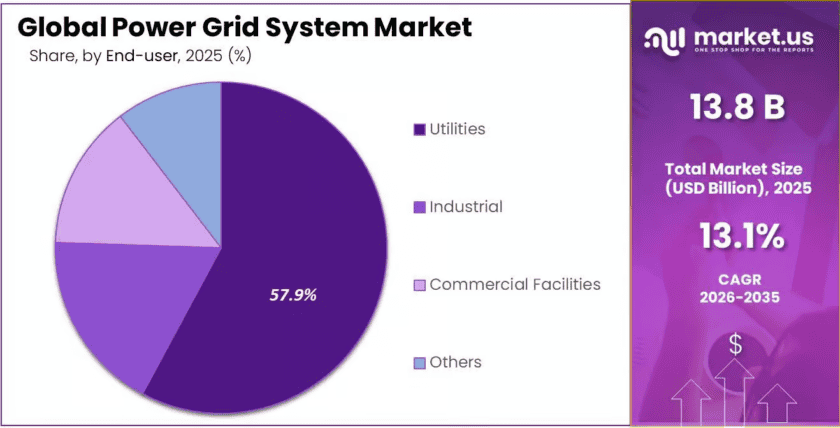
- Leading end user: Utilities accounted for 56.78% of the market in 2025.
- Dominating region: Asia-Pacific led the global market with a 35.11% share, valued at USD 4.8 billion.
Regional Analysis
Asia-Pacific dominated the Power Grid System market in 2025, accounting for 35.11% of global revenue, equivalent to USD 4.8 billion. Its position is supported by electricity demand growth, industrial expansion, renewable energy integration, and investment in high-voltage transmission and distribution networks. China, Japan, South Korea, and Southeast Asian economies are strengthening grid infrastructure to improve power reliability and connect new generation capacity.
According to the International Energy Agency (IEA), electricity demand in Asia-Pacific increased by 4.1% in 2025, contributing approximately two-thirds of the global increase. The region’s demand is expected to grow by an average of 4.7% annually during 2026–2030. North America and Europe also offer important opportunities through grid replacement, transmission expansion, digital monitoring, and renewable energy connections.
Market Dynamics
1. Driver: Rising Electricity Consumption and Electrification
Growing electricity consumption across manufacturing, transportation, commercial buildings, and residential applications is a major driver of the Power Grid System market. The increasing use of electric vehicles, artificial intelligence infrastructure, data centres, and electric heating is creating additional pressure on existing transmission and distribution networks.
According to the IEA’s Electricity 2026 report, global electricity demand is expected to grow by an average of 3.6% annually during 2026–2030. The agency also estimates that annual grid investment must increase by approximately 50% from the current USD 400 billion level by 2030. This requirement is encouraging utilities to expand substations, transformers, cables, and transmission capacity.
2. Trend: Digitalisation and Smart Grid Technology Adoption
Digitalisation is becoming an important trend as utilities move towards automated and intelligent electricity networks. Smart grids use sensors, digital meters, communication systems, and automated controls to monitor electricity flow and identify network problems. These technologies help utilities manage changing electricity demand, detect faults, and improve power distribution.
The U.S. Department of Energy identifies sensing, communication, control, computing, and data management as important features of smart grid infrastructure. In addition, the IEA estimates that dynamic line rating technology can increase transmission capacity by approximately 20–30% on suitable lines. These developments are encouraging investment in digital substations and advanced grid management systems.
3. Restraint: High Equipment Costs and Supply Chain Delays
High equipment prices and long delivery periods remain important challenges for power grid development. Large power transformers, high-voltage cables, copper, aluminium, and other specialised materials require significant manufacturing capacity and technical expertise.
According to the IEA’s February 2025 transmission grid assessment, procurement of power cables generally takes 2–3 years, while large power transformers can require up to 4 years. Specialised direct-current cables can have waiting periods exceeding 5 years. The IEA also reported that cable prices had nearly doubled since 2019, while power transformer prices had increased by approximately 75%. These conditions can delay grid projects, increase capital expenditure, and affect project completion schedules.
4. Opportunity: Expansion of Existing Transmission Capacity
Modernising existing transmission infrastructure creates an important opportunity for equipment manufacturers and grid technology providers. Utilities can increase electricity transfer capacity by replacing conventional conductors with advanced conductors, improving voltage control, and installing dynamic monitoring systems.
According to the U.S. Department of Energy, advanced conductors can help increase transmission capacity without requiring entirely new transmission corridors. The IEA’s 2026 assessment indicates that reconductoring can increase line capacity by approximately 50–100%, depending on the technology and operating conditions. These improvements can help connect renewable energy projects, reduce network congestion, and support growing electricity demand.
Emerging Trends in the Power Grid System Market
1. Artificial Intelligence in Grid Management
Artificial intelligence is helping utilities analyse electricity consumption, identify equipment faults, and improve network planning. The U.S. Energy Information Administration projects data centre server electricity consumption could reach 446–818 billion kWh by 2050, increasing the importance of intelligent grid management.
2. Advanced Transmission Conductors
Advanced conductors are gaining attention because they can increase electricity transfer capacity through existing transmission corridors. The IEA estimates that reconductoring can increase line capacity by 50–100%, depending on project conditions, reducing the need for some new transmission construction.
3. Renewable Energy Grid Integration
Solar and wind installations are increasing the need for flexible transmission networks and improved grid balancing. The IEA expects solar and wind to increase their combined share of global electricity generation from 17% to 27% by 2030, creating additional requirements for grid connections and system flexibility.
4. Battery Storage Integration
Battery energy storage is becoming an important part of grid infrastructure because it helps balance electricity supply and demand. According to the IEA, approximately 600 GW of utility-scale batteries were awaiting grid connection in 2025, highlighting the need for improved connection infrastructure and storage management.
5. Flexible Grid Capacity Technologies
Dynamic line rating, advanced power-flow control, and network optimisation are gaining attention as alternatives to immediate large-scale grid construction. The IEA estimates that dynamic line rating can increase transmission capacity by 20–30% on suitable lines, helping utilities use existing infrastructure more effectively.
Use Cases of Power Grid Systems
1. Electricity Transmission and Distribution
Power grid systems transport electricity from generation facilities to consumers through transmission lines, substations, and distribution networks. The U.S. Department of Energy reports that the national grid includes more than 600,000 miles of transmission lines, demonstrating its importance in large-scale electricity delivery.
2. Renewable Energy Connection
Grid infrastructure connects solar and wind farms with electricity networks, allowing renewable power to reach residential and industrial consumers. The IEA identifies more than 2,500 GW of renewable, storage, and large-load projects waiting in global grid connection queues, highlighting the need for additional network capacity.
3. Industrial Power Supply
Manufacturing plants, chemical facilities, steel producers, and processing industries depend on reliable grid infrastructure to operate machinery and production equipment. In the United States, industrial electricity consumption reached approximately 1.05 trillion kWh in 2025, supporting the need for dependable substations, transformers, and distribution networks.
4. Electric Vehicle Charging Networks
Power grids support public charging stations, commercial charging facilities, and residential electric vehicle charging. U.S. light-duty electric vehicles consumed approximately 23.5 billion kWh of electricity in 2025, creating additional requirements for distribution transformers, charging connections, and local network upgrades.
5. Data Centre and Digital Infrastructure
Data centres require stable electricity supply to operate servers, cooling systems, and networking equipment. According to the EIA, data centre servers accounted for approximately 7% of U.S. commercial electricity consumption in 2025. This is encouraging investment in dedicated substations, backup power, and high-capacity grid connections.
Frequently Asked Questions on Power Grid System Market
1. What is the Power Grid System market?
The Power Grid System market includes equipment and technologies used to generate, transmit, distribute, and manage electricity. It covers power transformers, switchgear, circuit breakers, cables, substations, and smart grid solutions.
2. What was the global Power Grid System market size in 2025?
According to the referenced market assessment, the global Power Grid System market was valued at approximately USD 13.8 billion in 2025, supported by infrastructure modernisation and increasing electricity requirements.
3. What is the expected market value by 2035?
The global Power Grid System market is projected to reach USD 47.5 billion by 2035, registering a CAGR of 13.1% during the forecast period of 2026–2035.
4. Which region dominates the Power Grid System market?
Asia-Pacific dominated the market in 2025 with a 35.11% share, representing approximately USD 4.8 billion. Increasing electricity demand, industrial development, and transmission infrastructure investments support its leading position.
5. Which component holds the largest market share?
Power Transformers dominated the component segment in 2025, accounting for 34.21% of the market. Their importance in voltage conversion, electricity transmission, and distribution supports their leading position.
Conclusion
The Power Grid System market is entering an important growth phase as electricity consumption, renewable energy integration, and digital infrastructure requirements continue to increase. The market is projected to grow from USD 13.8 billion in 2025 to USD 47.5 billion by 2035, supported by a 13.1% CAGR.
Asia-Pacific remains the leading regional market, while power transformers and transmission networks represent important industry segments. However, equipment shortages, high installation costs, and project delays remain challenges. Growing investment in smart grids, advanced conductors, energy storage, and transmission modernisation is expected to create long-term opportunities for manufacturers and technology providers.
Discuss your needs with our analyst
Please share your requirements with more details so our analyst can check if they can solve your problem(s)