Overview
New York, NY – Sep 29, 2026 – The global Potato Processing Market continues to expand as food manufacturers, restaurants, retailers, and institutional kitchens increase their use of frozen, ready-to-cook, dehydrated, and snack-based potato products. The market is projected to grow from USD 42.3 billion in 2025 to around USD 73.4 billion by 2035, representing a 5.6% CAGR during 2026–2035.
Large raw-material availability supports industrial processing. USDA data show that U.S. processors used about 150.48 million cwt of potatoes for frozen French fries in 2024, along with 55.76 million cwt for chips and shoestring potatoes and 42.57 million cwt for dehydrated products including starch and flour.
Consumer preferences are also shifting toward processed formats. USDA reported that frozen potato products represented about 50% of U.S. potato availability, equivalent to approximately 58 pounds per person, during the recent 2022–2024 period. Total potato availability averaged around 115 pounds per person.
Foodservice remains an important demand channel. U.S. food-away-from-home spending reached USD 1.41 trillion in 2025, accounting for 56.3% of total food expenditure and supporting continued demand for convenient frozen fries and other prepared potato products.
Key Takeaways
- The global Potato Processing Market was valued at USD 42.3 billion in 2025 and is projected to reach approximately USD 73.4 billion by 2035, expanding at a 5.6% CAGR.
- In 2025, Frozen Potatoes held the leading product position with more than a 42.30% share, supported by strong demand for fries, wedges, hash browns, and other frozen formats.
- Ready-to-Cook Products dominated the application category in 2025, accounting for more than a 46.90% share, reflecting growing preference for convenient and time-saving food preparation.
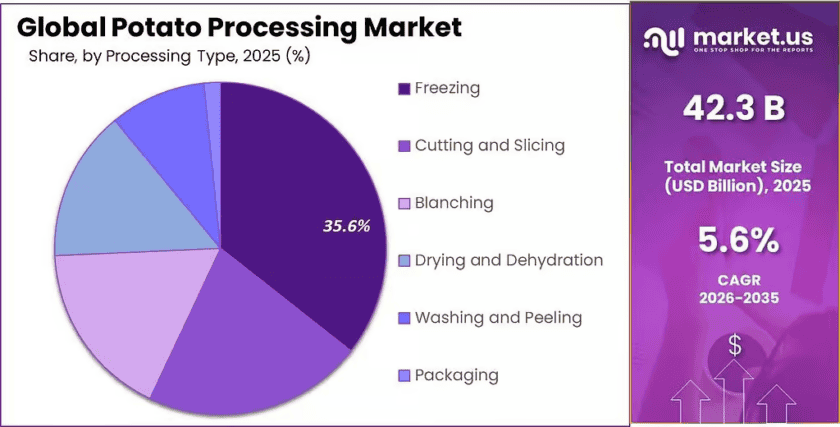
- By processing type, Freezing captured more than a 35.60% share in 2025 as frozen potato products remained widely used across foodservice and retail operations.
- Foodservice led the distribution channel category with more than a 56.20% share in 2025, supported by restaurants, quick-service outlets, hotels, cafeterias, and institutional kitchens.
- North America dominated the market with more than a 31.50% share, generating approximately USD 13.34 billion in 2025.
Regional Analysis
North America Maintains Leading Position with 31.50% Market Share
In 2025, North America held a dominant position in the Potato Processing Market, capturing more than a 31.50% share and generating approximately USD 13.34 billion in market revenue. The region benefits from large potato-growing areas, established processing infrastructure, cold-storage networks, strong restaurant consumption, and mature retail distribution.
The raw-material base remains substantial. Canadian potato production reached 125.8 million hundredweight in 2025, while seeded area increased 1.1% to 395,857 acres. Alberta accounted for 27.1% of Canadian production, followed by Manitoba at 21.4%.
The U.S. also has strong demand for processed products. USDA reported that frozen potatoes averaged about 58 pounds per person, representing roughly 50% of potato availability during 2022–2024. Foodservice consumption further supports processing activity, as U.S. food-away-from-home expenditure reached USD 1.41 trillion in 2025.
Asia Pacific is developing rapidly because of its large agricultural production base, urbanization, expanding foodservice industry, and increasing investment in cold chains and value-added food manufacturing. FAOSTAT continues to track crop production across more than 245 countries and territories, demonstrating the broad agricultural base available to downstream food processors.
Market Dynamics
Driver – Expansion of Foodservice and Convenience Consumption
Strong foodservice spending is creating sustained demand for frozen fries, wedges, hash browns, and ready-to-cook potato products. USDA reported that U.S. food-away-from-home expenditure reached USD 1.41 trillion in 2025, compared with USD 1.10 trillion for food consumed at home. Food-away-from-home represented 56.3% of total food expenditures. Limited-service restaurant sales reached approximately USD 516.1 billion, while full-service establishments recorded USD 488.4 billion in inflation-adjusted sales. These outlets depend heavily on standardized, quickly prepared products, supporting industrial freezing, cutting, frying, packaging, and cold-storage operations.
Trend – Growing Preference for Frozen Potato Products
Frozen products are becoming increasingly important within potato consumption. USDA Economic Research Service reported that frozen potato products, mainly French fries, represented around 50% of U.S. potato availability, equal to approximately 58 pounds per person during 2022–2024. Overall potato availability averaged 115 pounds per person, while fresh potato availability declined to about 28 pounds per person. This widening difference indicates a structural move toward convenient processed foods. Industrial processors are therefore increasing their focus on blanching, par-frying, individual freezing, automated packaging, cold storage, and products designed for restaurant, retail, delivery, and air-fryer applications.
Restraint – Raw Material, Food Safety and Processing Requirements
Potato processors must manage variations in crop quality while meeting increasingly demanding food-safety and processing requirements. In 2025, Canadian production decreased 0.9% to 125.8 million hundredweight, partly because drought reduced yields in eastern growing regions. Fried potato manufacturers also need to control acrylamide formation. FDA states that acrylamide forms during high-temperature processes such as frying, roasting, and baking and has issued guidance covering raw materials and manufacturing practices for potato foods. FDA collected approximately 2,500 individual food samples during 2011–2015 while studying acrylamide levels, highlighting the continuing importance of process control.
Opportunity – Resource Recovery and More Efficient Processing
Processors have opportunities to obtain more value from potato peel, starch, pulp, off-cuts, wastewater solids, and other production streams. EPA research found that a traditional potato starch facility handling about 450 metric tons per day could generate approximately 4,500 cubic metres of effluent and around 18,000 kilograms of dissolved solids daily. This creates incentives for processors to introduce starch recovery, water recycling, filtration, centrifugation, anaerobic digestion, protein recovery, and by-product utilization systems. These technologies can reduce waste loads while creating additional ingredients for food, feed, industrial starch, bioenergy, and other value-added applications.
Emerging Trends
1. Frozen Potato Consumption
Frozen potato products are gaining importance as consumers seek convenient meal options. USDA reported average frozen potato availability of nearly 58 pounds per person, representing about 50% of U.S. potato availability during 2022–2024.
2. Growing Foodservice Demand
Foodservice is strengthening industrial potato demand. U.S. food-away-from-home expenditure reached USD 1.41 trillion in 2025, representing 56.3% of total food spending and creating a large commercial market for frozen fries and prepared potatoes.
3. Greater Processing of Raw Potatoes
Large volumes of potatoes are being converted into value-added foods. U.S. processors used approximately 150.48 million cwt for frozen French fries and 55.76 million cwt for chips and shoestring products during the 2024 crop year.
4. Lower-Acrylamide Processing
Food safety is encouraging processors to optimize frying temperatures, potato storage and preparation. FDA notes that soaking sliced potatoes for 15–30 minutes before frying or roasting can help lower acrylamide formation during high-temperature preparation.
5. Water and By-Product Recovery
Resource efficiency is becoming more important. EPA research showed that processing 450 metric tons of potatoes daily using traditional starch methods could generate approximately 4,500 m³ of wastewater, encouraging greater investment in water and solids recovery.
Use Cases
1. Frozen French Fries
Frozen French fries represent one of the largest industrial applications for potatoes. USDA recorded approximately 150.48 million cwt of potatoes used for frozen French fries in the United States during 2024, highlighting their importance to large processing facilities.
2. Potato Chips and Snacks
Potatoes are widely processed into chips, shoestrings, crisps, and other snack products. USDA data show approximately 55.76 million cwt of U.S. potatoes were used for chips and shoestrings in 2024, supporting continuous frying and packaging operations.
3. Dehydrated Potato Products
Potatoes are processed into flakes, granules, flour, starch, and other dehydrated ingredients for food manufacturing. USDA recorded about 42.57 million cwt going into dehydrated products, including starch and flour, during the 2024 crop year.
4. Restaurant and Institutional Meals
Frozen and prepared potatoes enable restaurants and institutional kitchens to deliver consistent portions quickly. U.S. limited-service restaurant sales reached USD 516.1 billion in 2025, providing a major end-use channel for fries, wedges, hash browns, and similar products.
5. Starch and By-Product Applications
Potato processing residues can support starch, animal feed, and industrial applications. EPA research examined plants processing around 450 metric tons daily, demonstrating opportunities to recover starch, pulp and other solids rather than treating all material as wastewater or disposal streams.
Frequently Asked Questions on Potato Processing and Potato Processing Market
What is potato processing?
Potato processing converts harvested potatoes into value-added products including frozen French fries, chips, flakes, starch, dehydrated products and prepared foods through operations such as washing, peeling, cutting, blanching, frying, drying, freezing and packaging.
How large is the Potato Processing Market?
The global Potato Processing Market was valued at approximately USD 42.3 billion in 2025 and is projected to reach around USD 73.4 billion by 2035, growing at a 5.6% CAGR during 2026–2035.
Which product type dominates the Potato Processing Market?
Frozen Potatoes held the dominant product position in 2025, accounting for more than 42.30% of the market. Demand is supported by frozen French fries, wedges, hash browns and convenient potato products.
Which application holds the largest market share?
Ready-to-Cook Products held more than 46.90% of the Potato Processing Market by application in 2025, supported by consumer and foodservice demand for products that reduce preparation time while delivering consistent quality.
Which processing technology leads the market?
Freezing held the leading position among processing types in 2025, accounting for more than 35.60% of the market. Freezing provides longer storage life and supports large-scale distribution of fries, wedges and hash browns.
Why is foodservice important for potato processors?
Restaurants are major users of processed potatoes. U.S. food-away-from-home spending reached USD 1.41 trillion in 2025, representing 56.3% of overall food expenditure and creating substantial demand for standardized frozen and ready-to-cook products.
Which region dominates the Potato Processing Market?
North America dominated the market in 2025 with more than a 31.50% share, representing approximately USD 13.34 billion, supported by extensive potato cultivation, processing facilities, foodservice consumption, retail networks and cold-chain infrastructure.
What is driving demand for frozen potatoes?
Convenience and foodservice consumption are major drivers. USDA estimates frozen potatoes accounted for roughly 50% of U.S. potato availability during 2022–2024, equivalent to approximately 58 pounds per person on a farm-weight basis.
What are the main challenges in potato processing?
Major challenges include crop-quality fluctuations, energy and water requirements, storage losses, wastewater treatment, food-safety compliance and acrylamide management. FDA specifically provides industry guidance for lowering acrylamide formation in French fries, chips and other potato foods.
What future opportunities exist for potato processors?
Future opportunities include automated processing, water reuse, starch recovery, improved freezing systems, specialty potato foods and by-product utilization. EPA findings on high wastewater volumes from traditional processing demonstrate strong potential for cleaner and more resource-efficient manufacturing systems.
Conclusion
The Potato Processing Market is positioned for steady expansion as consumers, restaurants and retailers increase their use of frozen, ready-to-cook and value-added potato foods. The market is projected to rise from USD 42.3 billion in 2025 to USD 73.4 billion by 2035, at a 5.6% CAGR. Frozen potatoes, ready-to-cook products and foodservice remain key commercial areas. Meanwhile, rising foodservice expenditure, large processing volumes and stronger demand for convenience foods are encouraging capacity development. Future investment is expected to focus increasingly on automation, cold-chain efficiency, food-safety controls, water recycling and greater recovery of starch and other valuable potato-processing by-products.
Discuss your needs with our analyst
Please share your requirements with more details so our analyst can check if they can solve your problem(s)