Overview
New York, NY – Nov 20, 2026 – The global Medium Voltage Cables and Accessories Market is growing as electricity networks expand and utilities replace ageing distribution infrastructure. Medium voltage cables are essential for transferring electricity from substations to residential areas, commercial buildings, industrial facilities and renewable energy installations.
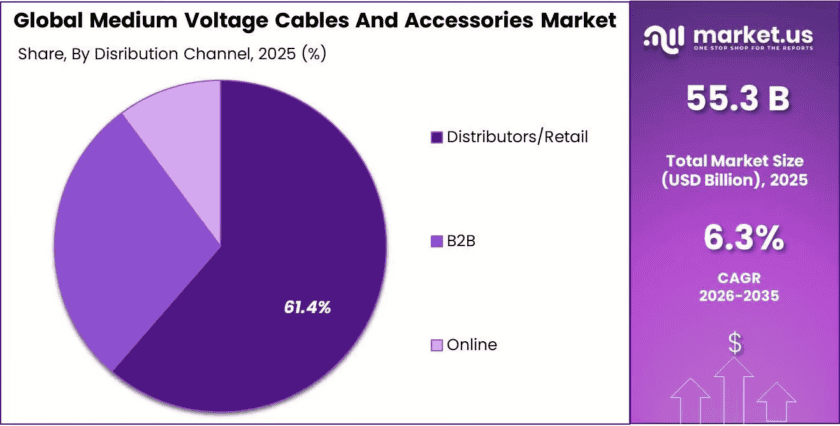
According to the Market.us figures provided for this release, the global market was valued at USD 55.3 billion in 2025 and is projected to reach USD 102.2 billion by 2035, registering a compound annual growth rate (CAGR) of 6.3% during 2026–2035. Asia-Pacific held the leading regional position in 2025, accounting for 34.67% of the market and generating USD 19.1 billion in revenue.
Cables remained the leading product category with a 58.78% share, while heat-shrink technology accounted for 34.23%. Overhead installations represented 43.67%, and residential applications held 45.67%. Growing electricity demand, renewable energy connections and grid modernisation are supporting demand. However, raw-material price changes, project delays and technical installation requirements remain important challenges for manufacturers and utilities.
Key Takeaways
- The global Medium Voltage Cables and Accessories Market was valued at USD 55.3 billion in 2025.
- The market is projected to reach USD 102.2 billion by 2035, at a CAGR of 6.3%.
- Asia-Pacific dominated the market with a 34.67% share, valued at USD 19.1 billion in 2025.
- Cables led the product segment with a 58.78% share.
- Heat-shrink technology held 34.23% of the technology segment.
- Overhead installations accounted for 43.67% of the installation segment.
- Residential applications represented 45.67% of end-user demand.
- Distributors and retail channels accounted for 61.45% of distribution revenue.
- The European Commission reports that 40% of EU electricity distribution grids are more than 40 years old, creating a need for modernisation.
Regional Analysis
Asia-Pacific – Dominating Region
Asia-Pacific held the leading position in the Medium Voltage Cables and Accessories Market in 2025, accounting for 34.67% of global revenue, or USD 19.1 billion. Regional demand is supported by electricity network expansion, industrial development, urban infrastructure and renewable energy connections.
The growing need to connect substations, residential developments, factories and commercial facilities is supporting demand for medium voltage cables, joints and terminations. China, Japan, South Korea and Australia are important markets in the region. Investment in grid capacity and reliable distribution infrastructure is expected to remain an important source of demand.
Market Dynamics
Driver: Ageing Grid Infrastructure and Replacement Demand
Ageing electricity infrastructure is creating a steady requirement for cable replacement and distribution upgrades. The European Commission reports that 40% of EU electricity distribution grids are more than 40 years old, with approximately €584 billion in grid investment required during this decade.
In the United States, utility investment in distribution infrastructure reached USD 50.9 billion in 2023, up 160% from 2003. These investments cover a broad range of grid equipment, including lines and transformers, rather than medium voltage cables alone. However, they indicate a substantial infrastructure spending environment that can support cable, joint and termination demand.
Trend: Digital and More Flexible Electricity Networks
Electricity networks are becoming more digital, flexible and capable of managing variable power flows. The International Energy Agency estimates that more than 2,500 GW of renewable energy, storage and large-load projects are waiting in grid connection queues worldwide.
It also says annual grid investment needs to rise by approximately 50% from around USD 400 billion to meet demand through 2030. These developments are increasing the need for better distribution planning, monitoring and equipment upgrades. Medium voltage cable systems will remain important for connecting new generation, storage facilities and large electricity users to distribution networks.
Restraint: Raw-Material Price Volatility
Copper and aluminium are important inputs in medium voltage cable manufacturing. Changes in their prices can affect production costs, tender prices and profit margins. Cable manufacturers may face difficulty when material costs rise after they have agreed fixed-price contracts with customers.
The IEA has also reported that prices for key grid components have nearly doubled over the past five years, reflecting supply-chain pressure and strong demand. Higher input costs can delay procurement decisions, increase project budgets and encourage buyers to postpone non-urgent upgrades. Manufacturers therefore need effective sourcing strategies, inventory planning and pricing arrangements to manage cost fluctuations.
Opportunity: Grid Modernisation and Resilience Projects
Grid modernisation programmes create opportunities for cable manufacturers and accessory suppliers. The US Department of Energy administers a USD 10.5 billion Grid Resilience and Innovation Partnerships programme to improve grid flexibility and resilience. Its funding areas include distribution modernisation, smart-grid technologies and improved integration of new generation.
Such programmes can support projects requiring cable replacement, underground lines, connectors, joints and terminations. The opportunity is not limited to new cable installations; utilities also need compatible accessories when upgrading existing networks. Suppliers offering tested products, installation support and reliable delivery can compete for projects focused on reducing outages and improving distribution performance.
Emerging Trends
1. Underground Cable Expansion: Utilities are increasingly considering underground distribution lines in areas exposed to storms, fires or dense development. US utilities invested USD 11.8 billion in underground distribution lines in 2023, more than twice the level recorded 20 years earlier.
2. Smart Grid Integration: Digital monitoring and smart-grid systems are becoming more important for managing electricity networks. The US Department of Energy’s GRIP programme provides USD 10.5 billion for grid resilience and innovation, including technologies that improve visibility and system flexibility.
3. Renewable Energy Connections: Solar, wind and battery projects need dependable medium voltage connections to distribution networks. The IEA reports that more than 2,500 GW of renewable, storage and large-load projects are waiting in grid connection queues worldwide, highlighting the need for grid expansion.
4. Advanced Cable Accessories: Utilities are seeking reliable joints, connectors and terminations that support safe cable connections and easier maintenance. As grid investment rises, accessory suppliers have opportunities to provide products compatible with existing networks and new underground distribution installations. The IEA estimates annual grid investment must rise around 50% by 2030.
5. Resilient Distribution Networks: Utilities are strengthening networks to reduce disruption from extreme weather and ageing equipment. US distribution infrastructure investment reached USD 50.9 billion in 2023, with spending supporting new lines and equipment upgrades to improve local grid performance.
Use Cases
1. Residential Electricity Distribution: Medium voltage cables connect substations to local transformers that supply housing developments and residential areas. They help distribute electricity safely across growing communities. The European Commission estimates that 40% of EU distribution grids are more than 40 years old, creating replacement needs.
2. Industrial Power Supply: Manufacturing plants, processing facilities and warehouses use medium voltage cable systems to connect substations, switchgear and major electrical equipment. US utilities invested USD 50.9 billion in distribution infrastructure in 2023, reflecting broader investment in networks serving homes and businesses.
3. Renewable Energy Connections: Solar farms, wind projects and battery storage facilities use medium voltage cables to connect generation equipment to substations and distribution networks. More than 2,500 GW of renewable, storage and large-load projects are waiting in grid connection queues worldwide, according to the IEA.
4. Underground Urban Networks: Underground medium voltage cables are used in cities where space limitations, weather exposure or visual impact make overhead lines less suitable. US utilities invested USD 11.8 billion in underground distribution lines in 2023 to support new developments and replace some overhead infrastructure.
5. Grid Replacement and Maintenance: Utilities use cable joints, splices and terminations when replacing damaged sections or extending existing distribution networks. The European Commission estimates that approximately €584 billion is needed for European electricity grids this decade, supporting a wide range of network upgrade requirements.
Frequently Asked Questions on Medium Voltage Cables and Accessories
1. What are medium voltage cables and accessories?
Medium voltage cables carry electricity through distribution networks, typically between substations and end users. Accessories include joints, splices, connectors and terminations that connect, insulate and protect cable systems during operation.
2. What was the global market size in 2025?
According to the Market.us figures provided for this release, the global Medium Voltage Cables and Accessories Market was valued at USD 55.3 billion in 2025, reflecting demand across utility, residential, commercial and industrial applications.
3. What is the projected market value by 2035?
The Market.us report projects that the global market will reach USD 102.2 billion by 2035, growing at a CAGR of 6.3% during the 2026–2035 forecast period.
4. Which region dominated the market in 2025?
Asia-Pacific dominated the market in 2025, accounting for 34.67% of global revenue and generating approximately USD 19.1 billion. Electricity network expansion, industrial development and infrastructure investment support regional demand.
5. Which product segment held the largest market share?
Cables led the product segment in 2025 with a 58.78% share. They are widely used in electricity distribution networks, industrial facilities, residential developments and renewable energy connections.
6. Which technology held the leading market share?
Heat-shrink technology held the leading position in 2025 with a 34.23% share. It is used in cable joints and terminations to provide insulation, sealing and mechanical protection.
Conclusion
The Medium Voltage Cables and Accessories Market is expected to maintain steady growth as utilities modernise electricity networks and connect new sources of power. The market is projected to increase from USD 55.3 billion in 2025 to USD 102.2 billion by 2035, at a CAGR of 6.3%. Asia-Pacific remains the leading regional market, supported by infrastructure and industrial development.
Demand for cables, joints, connectors and terminations will benefit from grid replacement, underground installations and renewable energy projects. However, manufacturers must manage material costs, supply-chain pressure and installation quality to remain competitive..
Discuss your needs with our analyst
Please share your requirements with more details so our analyst can check if they can solve your problem(s)