Overview
New York, NY – November 19, 2026 The global Field-Erected Cooling Tower Market is experiencing steady growth as industries invest in large-scale cooling infrastructure, power generation facilities, and industrial process operations. Field-erected cooling towers are constructed directly at project sites and are designed to handle high heat loads, large water circulation requirements, and continuous industrial operations.
According to Market.us, the global Field-Erected Cooling Tower Market was valued at USD 3.1 billion in 2025 and is projected to reach USD 5.6 billion by 2035, registering a compound annual growth rate (CAGR) of 6.1% during 2026–2035. Europe dominated the market in 2025, accounting for 35.00% of the global share, equivalent to approximately USD 1.0 billion.
Increasing electricity demand, industrial expansion, and modernization of existing cooling infrastructure are supporting market development. Mechanical draft, counterflow, and wet cooling tower systems remain important solutions for large industrial applications. At the same time, manufacturers are focusing on water conservation, energy-efficient fan systems, corrosion-resistant materials, and improved thermal performance.
Key Takeaways
- Market Valuation: The global Field-Erected Cooling Tower Market reached USD 3.1 billion in 2025.
- Future Forecast: The market is projected to reach USD 5.6 billion by 2035.
- Market Growth: The industry is expected to register a 6.1% CAGR during 2026–2035.
- Leading Region: Europe dominated with a 35.00% share, generating approximately USD 1.0 billion in 2025.
- Tower Type: Mechanical Draft Cooling Towers accounted for the leading share of 53.00%.
- Flow Type: Counterflow Cooling Towers dominated with a 58.00% share.
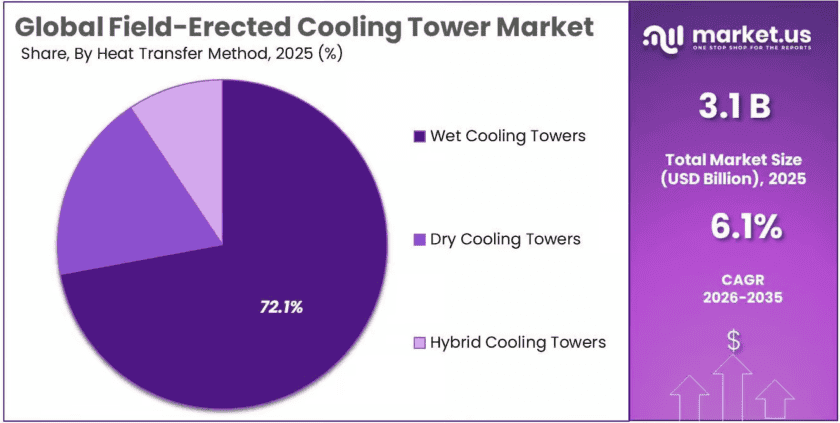
- Heat Transfer Method: Wet Cooling Towers held a leading 72.00% share.
- Construction Material: Concrete accounted for 42.00% of the market.
- Application: Power Generation represented 45.00% of the market.
- End User: Manufacturing Facilities captured 25.00% of the market.
Regional Analysis
Europe – Dominating Region
Europe dominated the Field-Erected Cooling Tower Market in 2025, accounting for 35.00% of the global market and approximately USD 1.0 billion in revenue. The region benefits from its established power generation, chemical processing, petrochemical, and manufacturing industries.
Germany, France, the United Kingdom, Italy, and the Netherlands are important industrial markets. Investment in industrial modernization, water management, and energy efficiency supports demand for large cooling infrastructure. According to the European Environment Agency, electricity production is a significant source of water abstraction across European countries, reinforcing the importance of efficient cooling infrastructure for thermal power generation.
Market Dynamics
1. Driver – Increasing Demand for Industrial Cooling Infrastructure
Growing investment in electricity generation, manufacturing, and chemical processing is supporting demand for field-erected cooling towers. These systems provide large heat-rejection capacity for facilities operating continuously under demanding conditions.
According to the US Energy Information Administration, 53% of US electric generating capacity uses closed-cycle cooling systems, which commonly rely on cooling towers. The expansion and modernization of thermal power infrastructure create opportunities for large cooling tower installations. In addition, industrial facilities require dependable cooling to protect equipment, maintain production quality, and reduce operational interruptions. These requirements are encouraging investment in customized cooling tower structures.
2. Trend – Adoption of Water-Efficient Cooling Technologies
Water efficiency is becoming an important trend in the field-erected cooling tower industry. Manufacturers and facility operators are adopting automated blowdown controls, conductivity monitoring, improved drift eliminators, and advanced water treatment systems.
According to the US Department of Energy, increasing cooling tower cycles of concentration from 3 to 6 can reduce makeup water requirements by 20% and blowdown by 50%. These improvements help industrial facilities control water expenses while maintaining cooling performance. The growing focus on water conservation is also encouraging the use of reclaimed water and improved filtration technologies in large industrial cooling installations.
3. Restraint – High Initial Installation and Maintenance Costs
High initial investment remains a major restraint for the Field-Erected Cooling Tower Market. These systems require site preparation, civil construction, structural materials, specialized engineering, installation equipment, and skilled labor. Large concrete towers can also involve lengthy construction schedules and significant project coordination.
In addition, operators must manage water treatment, corrosion, scaling, biological growth, and mechanical maintenance throughout the equipment’s operating life. The US Department of Energy identifies water treatment and equipment monitoring as important requirements for efficient cooling tower operations. These expenses can increase total ownership costs and delay purchasing decisions, particularly among facilities with limited capital budgets.
4. Opportunity – Growing Demand from Data Centers and Industrial Facilities
Expanding data center infrastructure creates new opportunities for large-scale cooling equipment suppliers. According to the International Energy Agency, global data center electricity consumption is projected to increase from approximately 485 terawatt-hours in 2025 to 950 terawatt-hours by 2030. Higher computing loads increase the need for reliable heat-management infrastructure.
Field-erected cooling towers can serve suitable large campuses where centralized evaporative cooling is selected. The US Department of Energy also identifies cooling towers as important components of data center cooling systems. Manufacturers can benefit by offering customized tower designs, water-efficient operation, and integrated monitoring solutions for large facilities.
5. Challenge – Water Availability and Environmental Compliance
Water availability and environmental compliance remain important challenges for field-erected cooling tower projects. Evaporative cooling requires continuous makeup water to replace evaporation, blowdown, and drift losses. The US Geological Survey reported that thermoelectric power plants withdrew approximately 59,889 million gallons of freshwater per day in 2020 across the lower 48 states.
Water-intensive operations can face additional pressure in drought-prone regions. Facilities must also manage wastewater discharge, dissolved minerals, corrosion, and biological growth. These requirements increase operating complexity and encourage project developers to evaluate hybrid cooling, dry cooling, reclaimed water, and advanced treatment technologies before selecting tower designs.
Emerging Trends in the Field-Erected Cooling Tower Market
1. Smart Cooling Tower Monitoring
Industrial operators are adopting automated sensors, conductivity controllers, and digital monitoring systems. The US Department of Energy identifies increasing cycles from 3 to 6 as a method to reduce makeup water by 20%, supporting more efficient tower operations.
2. Hybrid Cooling Technology
Hybrid cooling combines wet and dry cooling methods to manage water consumption and heat rejection. These systems are attracting attention in water-stressed regions where industrial facilities need dependable cooling while reducing dependence on continuous freshwater supplies.
3. Data Center Cooling Expansion
The International Energy Agency projects data center electricity consumption to reach approximately 950 TWh by 2030, compared with 485 TWh in 2025. This growth is increasing interest in advanced cooling infrastructure for large computing facilities.
4. Reclaimed Water Utilization
Industrial facilities are increasingly evaluating treated wastewater as an alternative source of cooling tower makeup water. EPA guidance identifies alternative water supplies and improved water treatment as practical cooling tower efficiency measures, helping facilities reduce freshwater requirements.
5. Advanced Water Treatment Systems
Automated chemical dosing, filtration, and conductivity monitoring are gaining importance. DOE guidance recommends automated chemical feed systems for large cooling towers above 100 tons, helping control scaling, corrosion, and biological growth while improving water management.
Use Cases of Field-Erected Cooling Towers
1. Thermal Power Generation
Field-erected cooling towers remove excess heat from steam-cycle power plants and support water recirculation. The EIA reports that 53% of US electric generating capacity uses closed-cycle cooling systems, demonstrating the importance of recirculating cooling infrastructure.
2. Chemical and Petrochemical Processing
Chemical plants use large cooling towers to remove process heat from condensers, heat exchangers, and production equipment. These installations support continuous manufacturing operations and temperature control, particularly in facilities requiring high cooling capacity throughout the year.
3. Large Manufacturing Facilities
Steel, metal, glass, and other manufacturing facilities use cooling towers to manage heat generated during production. The US Department of Energy identifies industrial process cooling as an important application for cooling systems supporting production equipment and manufacturing operations.
4. Oil and Gas Facilities
Refineries and gas processing facilities use large cooling systems to maintain suitable operating temperatures in heat exchangers and process equipment. Field-erected towers can be engineered for high heat loads and continuous industrial operations.
5. Data Center Campuses
Large data centers can use cooling towers as part of centralized chiller and condenser-water systems. The IEA projects electricity consumption to reach 950 TWh by 2030, increasing the importance of reliable cooling infrastructure for computing facilities.
Frequently Asked Questions (FAQs)
1. What is a field-erected cooling tower?
A field-erected cooling tower is a large industrial cooling structure assembled directly at the installation site. It removes excess heat from circulating water and supports large facilities requiring continuous and high-capacity cooling operations.
2. What is the global Field-Erected Cooling Tower Market size in 2025?
According to Market.us, the global Field-Erected Cooling Tower Market was valued at approximately USD 3.1 billion in 2025, supported by demand from power generation, manufacturing, chemical processing, and other industrial applications.
3. What will the Field-Erected Cooling Tower Market be worth by 2035?
The global market is projected to reach USD 5.6 billion by 2035, growing at a compound annual growth rate of 6.1% during 2026–2035, according to Market.us.
4. Which region dominates the Field-Erected Cooling Tower Market?
Europe dominated the market in 2025 with a 35.00% share, equivalent to approximately USD 1.0 billion. Its established industrial infrastructure and power generation facilities support regional demand.
5. Which tower type holds the largest market share?
Mechanical Draft Cooling Towers dominated the tower type segment in 2025, accounting for 53.00% of the market. Their controlled airflow and suitability for large industrial cooling requirements support adoption.
6. What is the leading flow type in the market?
Counterflow Cooling Towers held the leading position with a 58.00% share in 2025. Their effective heat transfer arrangement makes them suitable for various large industrial and power generation applications.
7. Why are wet cooling towers widely used?
Wet cooling towers accounted for 72.00% of the market in 2025. They use evaporative cooling to remove heat efficiently and are widely selected for power generation and industrial process cooling.
Conclusion
The Field-Erected Cooling Tower Market is expected to maintain steady growth as industries invest in large-scale cooling infrastructure and modernize existing facilities. The market is projected to increase from USD 3.1 billion in 2025 to USD 5.6 billion by 2035, registering a 6.1% CAGR. Europe remains the leading regional market, supported by established industrial and power generation activities.
Mechanical draft, counterflow, and wet cooling towers continue to represent important market segments. Meanwhile, data center expansion, industrial modernization, and water-efficient cooling technologies are creating new opportunities. Manufacturers focusing on customized engineering, lower water consumption, and reliable performance are positioned to benefit from future demand.
Discuss your needs with our analyst
Please share your requirements with more details so our analyst can check if they can solve your problem(s)