Overview
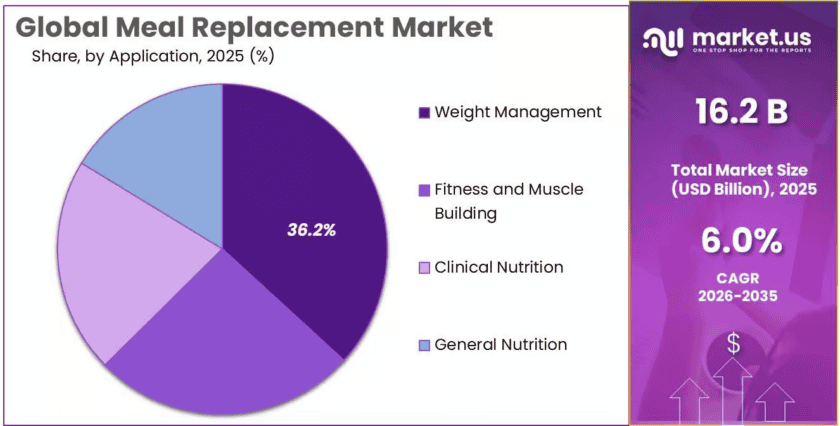
New York, NY – Nov 20, 2026 – The global meal replacement market is expanding as consumers seek convenient food options that support weight management, fitness goals and everyday nutrition. Products include powdered meal mixes, ready-to-drink shakes, nutrition bars and other prepared formats designed to replace one or more regular meals. According to the Market.us figures supplied for this release, the market was valued at USD 16.2 billion in 2025 and is projected to reach USD 29.0 billion by 2035, registering a compound annual growth rate (CAGR) of 6.0% from 2026 to 2035.
In 2025, North America led the market with a 35.0% share, representing USD 5.6 billion in revenue. Powder products accounted for 38.0%, while liquid formats held 40.0%. Supermarkets and hypermarkets represented 29.0% of distribution, and weight management was the leading application with 36.0%. Adults accounted for 37.0% of end-user demand.
Key Takeaways
- The global Meal Replacement Market was valued at USD 16.2 billion in 2025 and is projected to reach USD 29.0 billion by 2035, at a CAGR of 6.0%.
- Powder products led the product-type segment with a 38.0% share in 2025.
- Liquid products accounted for 40.0% of the market by form.
- Supermarkets and hypermarkets represented 29.0% of distribution-channel revenue.
- Weight management was the leading application, with a 36.0% share.
- Adults accounted for 37.0% of end-user demand.
- North America led the regional market with a 35.0% share, valued at USD 5.6 billion.
Regional Analysis
North America – Dominating Region
North America accounted for 35.0% of the global Meal Replacement Market in 2025, generating USD 5.6 billion in revenue. Demand is supported by established retail networks, broad product availability and consumer interest in weight management and convenient nutrition.
The United States recorded an adult obesity prevalence of 40.3% during August 2021–August 2023, according to the National Center for Health Statistics. This public-health context supports interest in structured dietary approaches, although meal replacement products are only one possible option and are not a substitute for individual medical advice.
Market Dynamics
Driver: Growing Demand for Convenient Nutrition
Time constraints and changing food habits are supporting demand for convenient meal options. The United States Department of Agriculture’s Economic Research Service reported that average consumption of ready-to-eat foods increased from 1.9 times in 2007–2008 to 2.2 times during 2017–March 2020, measured over the previous 30 days. This trend indicates rising use of foods that require little preparation.
Meal replacement powders, bars and ready-to-drink products can serve consumers seeking portable options during work, travel or busy daily schedules. However, convenience does not automatically mean nutritional balance, making product composition an important purchase factor.
Trend: Greater Focus on Weight Management
Weight management is an important application for meal replacement products. The US National Center for Health Statistics reported that 40.3% of adults aged 20 and older had obesity during August 2021–August 2023.
This creates a public-health need for effective, sustainable weight-management approaches. Research published in 2024 evaluated meal replacement use over 90 days in adults with obesity and reported an average weight reduction of 7.38 kg in the meal replacement group. The study was relatively small, so results should not be treated as a guaranteed outcome for all consumers.
Restraint: Nutritional Quality and Added Sugar Concerns
Nutritional quality can limit consumer acceptance when products contain high levels of added sugars, saturated fat or sodium, or do not provide a suitable range of nutrients. The US Food and Drug Administration states that the Daily Value for added sugars is 50 grams on a 2,000-calorie diet and advises limiting added sugars to less than 10% of daily calories.
Consumers may compare labels before choosing a product, putting pressure on manufacturers to improve formulations. Companies must balance taste, texture, shelf life and nutritional composition while keeping products affordable.
Opportunity: Product Transparency and Personalised Nutrition
Manufacturers have an opportunity to build consumer confidence through clear nutritional labelling and products designed for different dietary needs. The FDA Nutrition Facts label includes information on calories, protein, dietary fibre, sodium, added sugars and selected vitamins and minerals.
Its guidance considers 5% Daily Value or less a low amount and 20% or more a high amount of a nutrient per serving. Companies can use this information to communicate product composition more clearly and develop options for weight management, fitness and general nutrition. Transparent claims and accurate serving information can help consumers make informed choices.
Emerging Trends
1. Ready-to-Drink Products: Ready-to-drink shakes offer a portable option for consumers who do not have time to prepare meals. USDA data show ready-to-eat food consumption increased from 1.9 to 2.2 times per month between 2007–2008 and 2017–March 2020, reflecting broader interest in convenient food formats.
2. Weight-Management Formulations: Brands are developing products for portion-controlled eating and structured weight-management plans. A 2024 clinical study followed participants for 90 days and reported a mean weight reduction of 7.38 kg in its meal replacement group. Individual results vary, and professional guidance remains important.
3. Improved Nutritional Labelling: Consumers are paying greater attention to calories, protein, fibre and added sugars. FDA guidance identifies 5% Daily Value or less as low and 20% or more as high for a nutrient per serving, encouraging clearer product comparisons.
4. More Product Formats: Meal replacement brands are offering powders, bars and liquid drinks to suit different routines. The Market.us report identifies powder as the leading product type at 38.0%, while liquid formats represented 40.0% by form in 2025.
5. Focus on Added-Sugar Reduction: Manufacturers are reviewing sweeteners and flavour systems as consumers become more aware of added sugar intake. The FDA’s reference Daily Value is 50 grams per day for added sugars on a 2,000-calorie diet, encouraging attention to formulation and label information.
Use Cases
1. Weight Management: Meal replacement shakes or bars can be used as part of a planned calorie-controlled diet. A 2024 study involving adults with obesity reported an average 7.38 kg weight reduction over 90 days in its meal replacement group. Results are not guaranteed and depend on individual circumstances.
2. Workplace Convenience: Employees with limited time for meal preparation may use ready-to-drink products or nutrition bars as convenient food options. USDA data recorded an increase in ready-to-eat food consumption from 1.9 to 2.2 occasions over the previous 30 days between the two survey periods.
3. Fitness and Exercise Routines: Some consumers use meal replacement products when they need a portable food option around exercise schedules. Products can provide protein and carbohydrates, depending on their formulation. FDA nutrition labels help consumers compare protein, calories and other nutrients per serving.
4. Travel and Outdoor Activities: Powder sachets, bars and sealed drinks are easy to carry during travel or outdoor activities. Clear serving information helps users understand how much they are consuming. FDA guidance explains that one package may contain more than one serving, making label checks important.
5. Structured Nutrition Programmes: Dietitians and healthcare professionals may include meal replacement products in selected nutrition plans for adults who need structured dietary support. A 2024 study assessed outcomes at 45 and 90 days, showing how products can be evaluated over a defined intervention period.
Frequently Asked Questions on Meal Replacement and the Meal Replacement Market
1. What is a meal replacement product?
A meal replacement product is a packaged food or drink designed to replace one regular meal. Common formats include powders, ready-to-drink shakes and nutrition bars containing varying amounts of protein, carbohydrates, fats, fibre, vitamins and minerals.
2. What was the global Meal Replacement Market size in 2025?
According to the Market.us figures provided for this release, the global Meal Replacement Market was valued at USD 16.2 billion in 2025. The market includes products such as powders, shakes, nutrition bars and other meal replacement formats.
3. What is the projected market size by 2035?
The Market.us report projects that the global Meal Replacement Market will reach USD 29.0 billion by 2035, growing at a CAGR of 6.0% during 2026–2035.
4. Which region dominated the Meal Replacement Market in 2025?
North America dominated the market in 2025, accounting for 35.0% of global revenue and generating approximately USD 5.6 billion. Its position is supported by established retail channels and consumer interest in convenient nutrition products.
5. Which product type held the largest market share?
Powder products led the product-type segment in 2025 with a 38.0% share. Their popularity is linked to flexible preparation, portability and availability in different flavours and nutritional formulations.
6. What are the main applications of meal replacement products?
The main applications include weight management, fitness and muscle building, clinical nutrition and general nutrition. Weight management was the leading application in 2025, accounting for 36.0% of the market, according to Market.us.
Conclusion
The Meal Replacement Market is positioned for continued growth as consumers look for convenient food formats and structured nutrition options. Market.us estimates that the market will increase from USD 16.2 billion in 2025 to USD 29.0 billion by 2035, at a CAGR of 6.0%.
North America remains the leading regional market, while powder and liquid products represent important product formats. Future growth will depend on product quality, transparent nutritional information, affordable pricing and consumer confidence. Manufacturers that balance convenience with nutritional value can strengthen their position across weight management, fitness and general nutrition applications.
Discuss your needs with our analyst
Please share your requirements with more details so our analyst can check if they can solve your problem(s)