Overview
New York, NY – November 19, 2026 The global Feed Amino Acids Market is witnessing steady growth as livestock producers increasingly focus on animal nutrition, feed efficiency, and higher-quality animal protein production. Feed amino acids are essential nutritional ingredients used in poultry, swine, ruminant, aquaculture, and companion animal feed. Major products include lysine, methionine, threonine, valine, and other essential amino acids that support muscle development, growth, reproduction, and protein utilization.
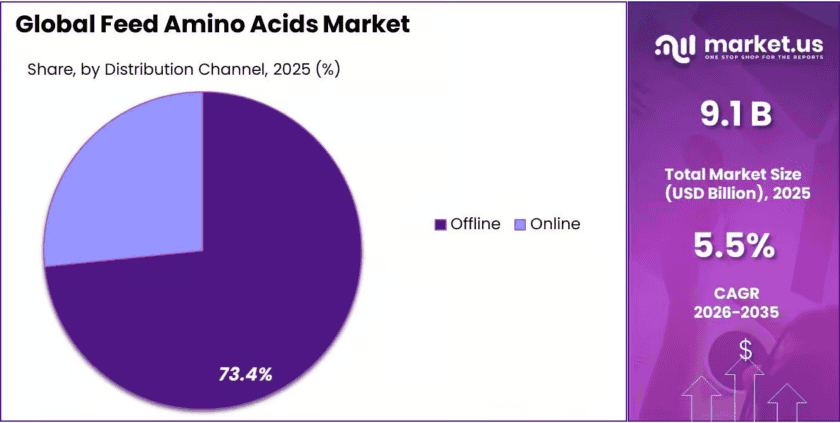
According to Market.us, the global Feed Amino Acids Market was valued at USD 9.1 billion in 2025 and is projected to reach USD 15.5 billion by 2035, expanding at a compound annual growth rate (CAGR) of 5.5% during 2026–2035. In 2025, Asia-Pacific dominated the market with a 36.78% share, generating approximately USD 3.8 billion in revenue.
Growing poultry and pork production, increasing aquaculture activities, and the adoption of scientifically balanced animal diets are supporting market expansion. The use of supplemental amino acids also allows feed manufacturers to reduce excessive crude protein in animal diets while maintaining essential nutritional requirements.
Furthermore, developments in microbial fermentation, improved feed formulation, and precision animal nutrition are creating new opportunities for manufacturers. Environmental regulations and growing attention to nitrogen management are also encouraging livestock producers to adopt more efficient feeding practices.
Key Takeaways
- Market Valuation: The global Feed Amino Acids Market reached USD 9.1 billion in 2025 and is expected to reach USD 15.5 billion by 2035.
- Market Growth: The market is projected to expand at a 5.5% CAGR during 2026–2035.
- Leading Product Segment: Lysine dominated the market with a 34.23% share in 2025, supported by its importance in balanced livestock feed formulations.
- Leading Livestock Segment: Poultry accounted for a dominant 43.23% share, reflecting widespread amino acid supplementation in commercial poultry nutrition.
- Leading Form: Dry amino acids captured 63.40% of the market because of their convenient storage, transportation, and blending characteristics.
- Distribution Channel: Offline distribution accounted for 73.40%, supported by established supplier relationships and bulk purchasing arrangements.
- Leading Region: Asia-Pacific dominated with a 36.78% share, equivalent to approximately USD 3.8 billion in 2025.
- Major Growth Factors: Increasing poultry production, aquaculture development, precision feeding, and demand for efficient protein utilization are supporting market growth.
Regional Analysis
Asia-Pacific – Dominating Region
Asia-Pacific dominated the Feed Amino Acids Market in 2025, accounting for 36.78% of global revenue, equivalent to approximately USD 3.8 billion. The region benefits from large-scale poultry and swine production, expanding commercial feed manufacturing, and increasing demand for animal protein.
China, Japan, South Korea, and Southeast Asian countries contribute to regional demand through established livestock industries and growing adoption of formulated animal feed. The Food and Agriculture Organization (FAO) reported that aquaculture produced 103 million tonnes of aquatic animals globally in 2024, with Asia maintaining an important position in aquatic food production. This creates opportunities for amino acid suppliers serving aquafeed manufacturers.
North America – Established Market
North America represents an established market supported by advanced livestock farming, commercial feed manufacturing, and scientifically developed animal nutrition practices. The United States has significant poultry, swine, and dairy production industries that require consistent feed formulations.
Growing interest in low-protein diets, nitrogen management, and feed conversion efficiency is supporting the adoption of lysine, methionine, and threonine. Government guidance from the United States Environmental Protection Agency highlights the importance of optimizing dietary protein to reduce nitrogen content in animal manure.
Market Dynamics
1. Driver – Increasing Demand for Poultry and Animal Protein
Growing demand for poultry, pork, dairy, and other animal protein products is an important driver of the Feed Amino Acids Market. Commercial livestock producers increasingly use lysine, methionine, and threonine to improve nutritional balance and support efficient animal growth.
According to the OECD-FAO Agricultural Outlook 2025–2034, global meat production is projected to increase by 13%, reaching approximately 406 million tonnes by 2034. Poultry is expected to account for 62% of additional meat production during this period. This expansion supports demand for formulated animal feed and nutritional supplements. Amino acids help producers meet essential protein requirements while improving feed utilization and controlling feeding costs.
2. Trend – Growing Adoption of Low-Protein Feed Formulations
The adoption of low-protein feed formulations is becoming an important trend as livestock producers focus on reducing feed costs and improving nitrogen efficiency. Supplemental amino acids allow feed manufacturers to reduce unnecessary crude protein while maintaining essential nutritional requirements.
The United States Department of Agriculture’s Natural Resources Conservation Service explains that excess dietary protein can increase nitrogen excretion, contributing to ammonia and nitrous oxide emissions. The United States Environmental Protection Agency also identifies dietary formulation and phase feeding as methods for reducing excess nutrients in manure. These practices are encouraging the use of precisely measured lysine, methionine, and threonine in poultry and swine diets.
3. Restraint – Trade Barriers and Raw Material Cost Pressures
Trade restrictions, production costs, and international supply-chain disruptions can limit the growth of the Feed Amino Acids Market. Amino acid manufacturers depend on reliable supplies of energy, fermentation feedstocks, chemicals, and transportation services. For example, the European Commission introduced definitive anti-dumping duties on Chinese-origin lysine imports under Regulation (EU) 2025/1330.
The applicable duties range from 47.7% to 58.2%, depending on the manufacturer. Such measures can increase import costs and create additional sourcing challenges for European feed manufacturers. Changes in raw material prices and energy expenses can also affect production economics, making it difficult for suppliers to maintain competitive product prices.
4. Opportunity – Expansion of Aquaculture and Precision Animal Nutrition
The expansion of aquaculture and precision animal nutrition offers considerable opportunities for feed amino acid manufacturers. According to the FAO’s State of World Fisheries and Aquaculture 2026 report, global aquaculture production of aquatic animals reached 103 million tonnes in 2024, representing more than half of total aquatic animal production. Commercial aquaculture producers require balanced diets to support growth, feed utilization, and production efficiency.
Amino acids such as lysine and methionine can help improve the nutritional composition of aquafeed. Manufacturers can also develop species-specific amino acid blends and customized feeding solutions for fish and crustaceans. These applications create opportunities to expand product portfolios and serve specialized feed manufacturers.
Emerging Trends in the Feed Amino Acids Market
1. Microbial Fermentation Technology
Manufacturers are improving microbial fermentation processes to produce lysine, threonine, and tryptophan. Fermentation-based production supports large-scale manufacturing and process efficiency. The growing global requirement for essential amino acids is encouraging investment in improved microbial strains and production technologies.
2. Low-Protein Animal Feed Development
Feed manufacturers are increasingly developing low-protein diets supplemented with essential amino acids. The United States Environmental Protection Agency identifies dietary protein optimization as a method of reducing nitrogen in manure. This approach supports more efficient nutrient management in livestock farming.
3. Growth of Aquaculture Nutrition
Aquaculture is creating new applications for feed amino acids. FAO reported that aquatic animal production from aquaculture reached 103 million tonnes in 2024. Increasing fish and crustacean production is encouraging manufacturers to develop specialized amino acid formulations for aquafeed.
4. Precision Animal Nutrition
Livestock producers are adopting more accurate feed formulations based on animal age, production stage, and nutritional requirements. The USDA recommends matching dietary protein and other nutrients with animal requirements. This approach helps avoid excessive nutrient consumption and unnecessary feed expenses.
5. Stronger Feed Additive Safety Standards
Regulatory compliance is becoming increasingly important in amino acid manufacturing. The European Union’s Regulation 1831/2003 establishes authorization requirements for feed additives. EFSA evaluates safety, efficacy, and analytical methods before authorization, encouraging manufacturers to strengthen quality control and product documentation.
Use Cases of Feed Amino Acids
1. Poultry Feed Formulation
Lysine and methionine are commonly incorporated into broiler and layer diets to support muscle development, egg production, and protein utilization. OECD-FAO projects global poultry meat production to reach approximately 173.4 million tonnes by 2034, supporting demand for balanced poultry nutrition.
2. Swine Nutrition
Feed amino acids are used in piglet, grower, finisher, and breeding diets to meet essential nutritional requirements. Lysine and threonine support balanced protein intake. Low-protein feeding strategies can also reduce excess nitrogen excretion while maintaining appropriate animal growth and performance.
3. Dairy and Cattle Feed
Methionine and lysine are used in dairy nutrition to support protein metabolism and milk production. Precision feeding helps dairy producers match nutrient intake with production requirements. The USDA identifies dietary formulation as an important method of reducing unnecessary nutrient intake in livestock.
4. Aquaculture Feed Production
Amino acids are incorporated into fish and shrimp feed to improve dietary protein balance and support growth. FAO recorded 103 million tonnes of aquatic animal production from aquaculture in 2024. This expanding production base creates opportunities for specialized amino acid-based aquafeed formulations.
5. Sustainable Livestock Production
Amino acid supplementation supports lower-protein feed formulations by supplying specific essential nutrients without excessive crude protein. The EPA identifies dietary protein optimization as a way to reduce nitrogen in manure and the potential for ammonia formation, supporting more sustainable livestock operations.
Frequently Asked Questions (FAQs)
1. What are feed amino acids?
Feed amino acids are nutritional ingredients added to animal feed to support growth, muscle development, reproduction, and protein synthesis. Common examples include lysine, methionine, threonine, tryptophan, and valine, which help maintain balanced animal diets.
2. What is the global Feed Amino Acids Market size in 2025?
According to Market.us, the global Feed Amino Acids Market was valued at approximately USD 9.1 billion in 2025. Increasing livestock production, demand for animal protein, and improved animal nutrition practices support market expansion.
3. What is the projected market size by 2035?
The global Feed Amino Acids Market is projected to reach USD 15.5 billion by 2035, growing at a CAGR of 5.5% during 2026–2035, supported by increasing demand for balanced livestock feed.
4. Which amino acid dominates the market?
Lysine dominated the Feed Amino Acids Market in 2025, accounting for 34.23% of the market. Its widespread use in poultry and swine diets, along with its role in protein utilization, supports its leading position.
5. Which livestock segment holds the largest market share?
Poultry held the largest livestock segment share of 43.23% in 2025. The segment benefits from commercial broiler and layer production, increasing demand for poultry meat and eggs, and widespread use of balanced feed formulations.
6. Which region dominates the Feed Amino Acids Market?
Asia-Pacific dominated the global market in 2025 with a 36.78% share, valued at approximately USD 3.8 billion. Its large livestock population, commercial feed production, and expanding poultry and aquaculture industries support regional demand.
Conclusion
The Feed Amino Acids Market is expected to experience steady growth as livestock producers increasingly prioritize animal nutrition, feed efficiency, and sustainable production. The market is projected to increase from USD 9.1 billion in 2025 to USD 15.5 billion by 2035, registering a 5.5% CAGR. Asia-Pacific will remain an important regional market, supported by commercial livestock production and increasing demand for animal protein.
Lysine and poultry will continue to represent important market segments. Meanwhile, low-protein feed formulations, aquaculture expansion, and precision nutrition will create additional business opportunities. Manufacturers focusing on product quality, production efficiency, and specialized nutritional solutions will be better positioned for future growth.
Discuss your needs with our analyst
Please share your requirements with more details so our analyst can check if they can solve your problem(s)