Overview
New York, NY – Nov 20, 2026 – The global Gas Turbine Services Market is witnessing strong growth as electricity demand, industrial expansion, and power infrastructure modernization increase the need for reliable turbine operations. According to Market.us, the global market was valued at USD 34.3 billion in 2025 and is projected to reach USD 69.7 billion by 2035, registering a compound annual growth rate (CAGR) of 7.4% during 2026–2035.
Gas turbine services include maintenance, repair, overhaul, spare parts replacement, inspection, and performance improvement. These services help power plants, oil and gas facilities, and industrial operators maintain equipment reliability and reduce unexpected shutdowns.
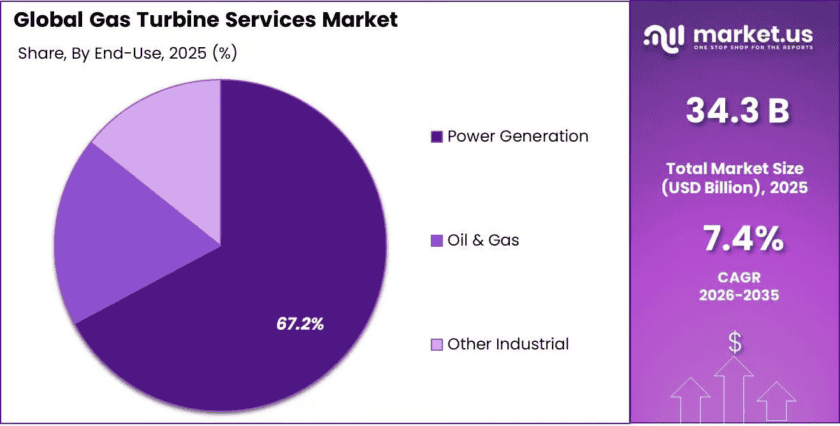
In 2025, heavy-duty gas turbines accounted for 52.34% of the market, while the 100–200 MW capacity segment held a 41% share. Power generation remained the leading end-use segment with 67.24% share. Growing electricity requirements, ageing turbine installations, and increasing demand for efficient power generation are supporting service requirements. Digital monitoring, predictive maintenance, and advanced turbine upgrades are also creating new opportunities for service providers.
Key Takeaways
- The global Gas Turbine Services Market was valued at USD 34.3 billion in 2025.
- The market is projected to reach USD 69.7 billion by 2035, registering a CAGR of 7.4% during 2026–2035.
- Heavy Duty turbines dominated the turbine type segment with a 52.34% share in 2025.
- The 100–200 MW capacity segment accounted for a leading 41% share.
- Spare Parts Supply dominated the service type segment with 64.34% share, reflecting the recurring requirement for replacement components.
- Power Generation held the leading end-use position with 67.24% share.
- Original Equipment Manufacturers (OEMs) accounted for approximately 61.23% share of the service provider segment.
- North America remained the leading regional market, generating approximately USD 11.7 billion in revenue in 2025.
Regional Analysis
North America – Dominating Region
In 2025, North America held a dominant position in the Gas Turbine Services Market, generating approximately USD 11.7 billion in revenue and accounting for a 34.23% share according to the market report’s key takeaways. The United States supports regional demand through its extensive natural gas power generation infrastructure, industrial facilities, and oil and gas operations.
According to the US Energy Information Administration (EIA), utility-scale natural gas power plants had approximately 513,400.6 MW of net summer generating capacity in 2025. The large installed turbine base creates recurring demand for inspections, component replacement, maintenance, and major overhauls.
Market Dynamics
1. Driver – Increasing Electricity Demand and Gas Power Generation
Growing electricity consumption is a major driver of the Gas Turbine Services Market. Power producers require reliable turbines to maintain electricity supply, support grid stability, and manage changing power demand.
According to the US EIA, natural gas-fired utility-scale facilities generated approximately 1.81 million gigawatt-hours of electricity in 2025. The country also had approximately 513,400.6 MW of natural gas utility-scale net summer capacity. This large installed infrastructure creates recurring requirements for maintenance, spare parts, inspections, and turbine overhauls.
2. Trend – Digital Monitoring and Predictive Maintenance
Digital monitoring and predictive maintenance are becoming important trends in gas turbine servicing. Operators are increasingly using sensors, performance analytics, vibration monitoring, and remote diagnostics to identify equipment problems before they cause unexpected shutdowns. These systems help service teams monitor operating temperatures, pressure, fuel consumption, and component conditions.
The US Department of Energy’s advanced turbine research programs also emphasize improvements in turbine performance, durability, and efficiency. In addition, the US EIA reported 105 natural gas utility-scale generator additions during 2025, representing approximately 4,589.6 MW of net summer capacity. These developments increase the need for advanced maintenance and technical support.
3. Restraint – High Maintenance Costs and Regulatory Requirements
High maintenance costs remain a major challenge for gas turbine service providers and equipment operators. Turbines operate under high temperatures, pressure, and mechanical stress, requiring specialized inspection equipment, skilled technicians, and expensive replacement components. Major overhauls can also require extended shutdown periods, affecting electricity production and industrial operations. Environmental compliance creates additional technical requirements.
The US Environmental Protection Agency finalized amendments to stationary combustion turbine emission standards on January 9, 2026, covering nitrogen oxides and sulfur dioxide. Operators may need additional combustion controls and emissions-reduction equipment to meet applicable requirements. These factors can increase operating expenses and delay maintenance investments.
4. Opportunity – Turbine Modernization and Advanced Service Agreements
Turbine modernization offers significant opportunities for service providers as power producers seek better efficiency, equipment reliability, and longer operating life. Operators are investing in advanced inspection systems, component upgrades, digital monitoring, and improved combustion technology.
According to the US EIA, natural gas utility-scale capacity additions reached approximately 4,589.6 MW in 2025, while new generator additions totaled 105 units. This expanding infrastructure creates opportunities for installation support, spare parts supply, maintenance contracts, and technical services. Additional opportunities are emerging from emissions-control upgrades, fuel-flexibility improvements, and long-term service agreements that help customers manage operating costs and equipment performance.
Emerging Trends in Gas Turbine Services
1. Predictive Maintenance and Artificial Intelligence
Gas turbine operators are increasingly using artificial intelligence and sensor-based monitoring to identify equipment problems early. These systems track temperature, vibration, and pressure. The US EIA recorded 105 natural gas generator additions in 2025, increasing the installed equipment base requiring maintenance.
2. Hydrogen-Compatible Turbine Technology
Turbine manufacturers are developing combustion systems capable of using hydrogen blends and alternative fuels. These improvements require specialized inspection and component services. The US EPA’s 2026 turbine standards also highlight the importance of controlling emissions from stationary combustion equipment.
3. Advanced Emissions-Control Upgrades
Gas turbine operators are investing in improved combustion controls and selective catalytic reduction systems to meet emissions requirements. The US EPA’s 2026 standards include a 5 parts per million NOx limit for certain large, highly utilized natural gas turbines equipped with combustion controls and SCR.
4. Combined-Cycle Turbine Modernization
Power producers are upgrading combined-cycle plants to improve electricity output and operating efficiency. The EIA reported approximately 1.81 million gigawatt-hours of natural gas-fired utility-scale generation in 2025, supporting continued demand for turbine inspections, repairs, and performance upgrades.
5. Expansion of Long-Term Service Agreements
Power producers are increasingly focusing on planned maintenance contracts, scheduled inspections, and replacement-part availability. In 2025, the US had approximately 513,400.6 MW of utility-scale natural gas net summer capacity, creating a substantial installed equipment base for recurring service requirements.
Use Cases of Gas Turbine Services
1. Electricity Generation and Combined-Cycle Plants
Gas turbine services support electricity generation by maintaining combustion systems, compressors, and turbine components. US natural gas-fired utility-scale plants generated approximately 1.81 million gigawatt-hours of electricity in 2025, demonstrating the importance of reliable turbine operations.
2. Oil and Gas Processing Facilities
Oil and gas facilities use gas turbines to generate electricity and drive compressors. Maintenance teams inspect hot-section components, fuel systems, and rotating equipment. Regular servicing helps maintain reliable operations across processing facilities and pipeline infrastructure.
3. Industrial Manufacturing and Captive Power
Manufacturing facilities use gas turbines for captive electricity and combined heat and power applications. The US industrial sector generated approximately 97,871 thousand megawatt-hours of utility-scale natural gas electricity in 2025, supporting demand for equipment maintenance and technical services.
4. Emergency and Peak-Load Power Supply
Gas turbines support peak electricity demand and provide flexible generation when electricity requirements increase. The EIA reported approximately 1,811,004 thousand megawatt-hours of natural gas utility-scale generation in 2025. Reliable servicing helps operators maintain equipment readiness.
5. Emissions-Control and Turbine Upgrade Projects
Service providers upgrade combustion systems, inspect emission-control equipment, and improve turbine performance. The EPA’s 2026 standards specify a 5 ppm NOx limit for certain large, highly utilized natural gas turbines using combustion controls and selective catalytic reduction.
Frequently Asked Questions on Gas Turbine Services Market
1. What are Gas Turbine Services?
Gas turbine services include maintenance, repair, overhaul, inspection, spare parts replacement, and performance upgrades. These services help power plants and industrial facilities maintain equipment reliability, improve efficiency, and reduce unexpected operational interruptions.
2. What is the global Gas Turbine Services Market size in 2025?
According to Market.us, the global Gas Turbine Services Market was valued at approximately USD 34.3 billion in 2025. Demand is supported by power generation, industrial operations, and maintenance of installed turbine equipment.
3. What is the projected market size by 2035?
The global Gas Turbine Services Market is projected to reach approximately USD 69.7 billion by 2035. Increasing electricity demand, turbine modernization, and the growing requirement for specialized maintenance services are supporting this expansion.
4. What is the expected CAGR of the market?
The Gas Turbine Services Market is expected to register a compound annual growth rate of 7.4% during 2026–2035. This growth reflects increasing investments in power generation infrastructure and turbine maintenance.
5. Which region dominates the Gas Turbine Services Market?
North America dominates the market, generating approximately USD 11.7 billion in revenue in 2025. Its established natural gas power generation infrastructure, industrial facilities, and ageing turbine installations support recurring service demand.
6. Which turbine type holds the largest market share?
Heavy-duty gas turbines held the leading position with a 52.34% market share in 2025. Their extensive use in utility-scale power generation and industrial operations creates consistent demand for maintenance and overhaul services.
Conclusion
The Gas Turbine Services Market is expected to experience strong growth through 2035, supported by rising electricity demand, industrial expansion, and modernization of existing power generation infrastructure. The market is projected to increase from USD 34.3 billion in 2025 to USD 69.7 billion by 2035, registering a CAGR of 7.4%. North America remains the leading regional market, while Asia-Pacific offers additional growth opportunities through industrial and power infrastructure investments.
Heavy-duty turbines, 100–200 MW capacity systems, and spare parts supply continue to represent important market segments. Going forward, predictive maintenance, digital monitoring, emissions-control upgrades, and advanced turbine technologies will create new opportunities for service providers.
Discuss your needs with our analyst
Please share your requirements with more details so our analyst can check if they can solve your problem(s)