Overview
New York, NY – Nov 17, 2026 – The global Rotary Uninterruptible Power Supply (UPS) Market is gaining importance as industries increasingly require reliable electricity to protect critical equipment and maintain continuous operations. The market was valued at USD 1.0 billion in 2025 and is projected to reach USD 1.6 billion by 2035, registering a compound annual growth rate (CAGR) of 5.0% during 2026–2035. In 2025, Asia-Pacific dominated the market with a 34.32% share, generating USD 0.3 billion in revenue.
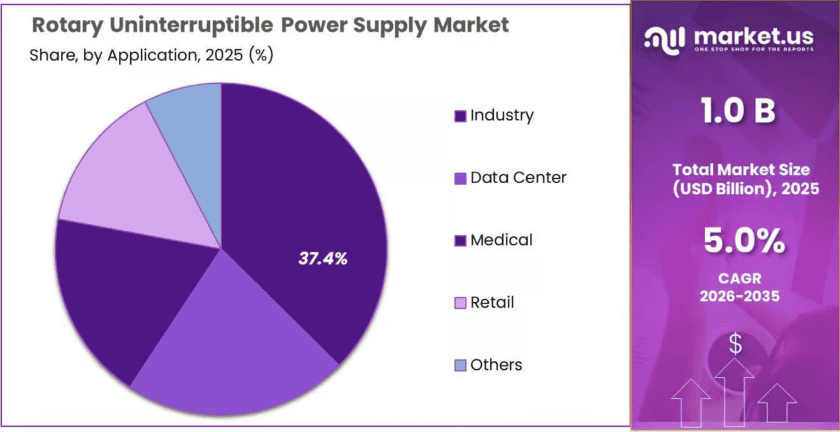
Diesel-based systems accounted for 61.23%, while systems with power ratings of up to 1000 kVA held 41.23%. The industrial application segment led with a 37.42% share. Growing data center investments, industrial automation, power quality requirements, and demand for uninterrupted electricity are supporting market development.
Rotary UPS systems use flywheels, motor-generator sets, and alternators to provide stable power during electrical disturbances. Their ability to support high-capacity operations makes them important for manufacturing facilities, data centers, healthcare infrastructure, and other critical applications.
Key Takeaways
- Market valuation: The global market reached USD 1.0 billion in 2025.
- Future growth: Market revenue is projected to reach USD 1.6 billion by 2035, at a 5.0% CAGR.
- Dominating type: Diesel rotary UPS systems held a leading 61.23% share in 2025.
- Leading power rating: The up to 1000 kVA category accounted for 41.23%.
- Leading application: Industrial applications captured 37.42% of the market.
- Dominating region: Asia-Pacific held a 34.32% share, equivalent to USD 0.3 billion in 2025.
Regional Analysis
Asia-Pacific – Dominating Region
Asia-Pacific dominated the Rotary Uninterruptible Power Supply Market in 2025, accounting for 34.32% of the global market, with revenue of USD 0.3 billion. Regional demand is supported by expanding manufacturing facilities, industrial automation, data center construction, and investments in critical electrical infrastructure.
China, Japan, South Korea, and Australia contribute through their electronics, industrial, and digital infrastructure industries. According to the International Energy Agency (IEA), electricity demand in Southeast Asia is expected to increase by an average of 5.4% annually during 2026–2030. Growing electricity requirements are encouraging industries to strengthen backup power capacity and improve operational reliability.
Market Dynamics
1. Driver – Increasing Demand for Uninterrupted Industrial Power
The growing dependence on continuous electricity across manufacturing, data centers, and critical infrastructure is a major driver of the Rotary Uninterruptible Power Supply Market. Industrial facilities require stable voltage and frequency to protect automated machinery and prevent production interruptions.
According to the IEA, global data center electricity consumption reached 415 TWh in 2024, representing approximately 1.5% of global electricity consumption. This increasing power requirement supports demand for reliable backup systems. Rotary UPS technology provides power continuity, electrical isolation, and protection against voltage disturbances, making it suitable for facilities where unexpected power interruptions can cause operational and financial losses.
2. Trend – Growing Adoption of Energy-Efficient and Modular UPS Systems
Energy efficiency and modular system design are becoming important trends in the Rotary UPS Market. Manufacturers are focusing on improved load management, digital monitoring, and flexible system configurations to reduce energy losses and support changing power requirements.
The US Department of Energy states that UPS efficiency has improved from approximately 85–90% in the 1990s to 95% or higher in 2023 for commonly used double-conversion systems. Its guidance also recommends modular UPS installations for facilities expecting future expansion. These developments are encouraging operators to select systems that balance power protection, operating efficiency, and long-term capacity requirements.
3. Restraint – High Initial Investment and Operating Costs
High installation costs remain a major restraint for the Rotary UPS Market. Rotary systems require specialized rotating machinery, flywheels, generators, electrical controls, installation work, and regular maintenance. These requirements can increase initial investment compared with simpler power protection alternatives.
Operating costs can also rise when systems are incorrectly sized or operate under low-load conditions. The US Department of Energy explains that lightly loaded UPS systems may lose a significant portion of their input energy and recommends selecting equipment according to actual load requirements. These investment and efficiency considerations can delay adoption among smaller manufacturing facilities and businesses with limited capital budgets.
4. Opportunity – Expansion of AI Data Centers and Critical Infrastructure
The expansion of artificial intelligence infrastructure creates strong opportunities for rotary UPS manufacturers. Data centers require dependable electricity to protect servers, networking equipment, and critical computing operations. According to the IEA’s updated outlook, global data center electricity consumption is projected to increase from 485 TWh in 2025 to 950 TWh in 2030.
This rising demand creates opportunities for high-capacity, modular, and hybrid power protection systems. Manufacturers can strengthen their position by developing solutions with advanced monitoring, improved load management, and integration with generators and other energy storage technologies. Growing investments in digital infrastructure and industrial modernization can further support market expansion.
Emerging Trends in the Rotary Uninterruptible Power Supply Market
1. AI-Based Data Center Power Protection: Growing AI workloads are increasing demand for reliable power protection. The IEA projects global data center electricity consumption to reach 950 TWh by 2030, encouraging operators to invest in high-capacity backup systems and advanced power management technologies.
2. Modular Rotary UPS Installations: Companies are adopting modular power protection systems to match changing electricity requirements. The US Department of Energy recommends modular UPS designs for expanding data centers because additional capacity can be installed as facility loads increase.
3. Digital Monitoring and Predictive Maintenance: Manufacturers are introducing digital monitoring to track equipment performance, operating loads, and maintenance requirements. Continuous monitoring helps facility operators identify abnormal conditions early and reduce unexpected equipment failures during critical operations.
4. Higher Energy Efficiency: Energy-efficient UPS technology is gaining importance as electricity expenses increase. The US Department of Energy reports that modern double-conversion UPS efficiency reached 95% or higher in 2023, encouraging further improvements in power conversion and system design.
5. Hybrid Power Protection Systems: Integration of rotary machines with battery storage and generator systems is gaining attention. The IEA estimates that data centers could install 20–25 GW of battery storage by 2030, creating opportunities for combined energy storage and backup power solutions.
Use Cases of Rotary Uninterruptible Power Supply
1. Data Center Operations: Rotary UPS systems protect servers, storage equipment, and networking infrastructure from electrical interruptions. Global data center electricity consumption reached 415 TWh in 2024, highlighting the growing importance of dependable power protection for digital infrastructure.
2. Manufacturing Facilities: Manufacturing plants use rotary UPS systems to protect automated production lines, industrial motors, and control equipment. These systems help prevent production stoppages, equipment damage, and process interruptions in facilities operating continuously across multiple production shifts.
3. Healthcare Infrastructure: Hospitals and medical facilities require reliable electricity for diagnostic equipment, critical monitoring systems, and essential electrical infrastructure. Rotary UPS installations can support dependable power availability during electrical disturbances and help maintain continuity for critical hospital operations.
4. Oil and Gas Operations: Oil and gas facilities use rotary UPS systems to support control rooms, monitoring equipment, instrumentation, and critical electrical processes. Reliable backup power is important for maintaining operational stability and protecting essential equipment in demanding industrial environments.
5. Telecommunications Infrastructure: Telecom facilities depend on continuous electricity to operate communication networks, data transmission equipment, and switching systems. Rotary UPS solutions can support reliable power availability during grid disturbances, helping operators maintain network services and reduce unexpected interruptions.
Frequently Asked Questions on the Rotary Uninterruptible Power Supply Market
1. What is a Rotary Uninterruptible Power Supply?
A Rotary Uninterruptible Power Supply is a power protection system that uses rotating machinery, such as motor-generator sets and flywheels, to maintain continuous electricity during outages and electrical disturbances.
2. What was the global Rotary UPS Market value in 2025?
The global Rotary Uninterruptible Power Supply Market was valued at USD 1.0 billion in 2025. It is projected to reach USD 1.6 billion by 2035, registering a CAGR of 5.0%.
3. Which region dominated the Rotary UPS Market in 2025?
Asia-Pacific dominated the market in 2025, accounting for 34.32% of global revenue, equivalent to USD 0.3 billion. Industrial development and growing data center investments supported its leading position.
4. Which type dominated the Rotary UPS Market in 2025?
Diesel-based rotary UPS systems dominated the market in 2025, capturing 61.23% of the total share. Their reliable backup capabilities and suitability for high-capacity industrial applications supported their adoption.
5. Which power rating segment held the largest market share?
The up to 1000 kVA segment dominated in 2025, accounting for 41.23% of the market. Its suitability for medium-sized industrial facilities, healthcare institutions, and commercial infrastructure supported demand.
6. What was the leading application segment in 2025?
The industrial application segment held the leading position in 2025, capturing 37.42% of the market. Manufacturing facilities use rotary UPS systems to protect machinery and maintain continuous production operations.
Conclusion
The Rotary Uninterruptible Power Supply Market is positioned for steady growth as industries increase their dependence on reliable electricity and continuous operations. The market is projected to expand from USD 1.0 billion in 2025 to USD 1.6 billion by 2035, at a CAGR of 5.0%. Asia-Pacific remains the leading regional market, while diesel systems, up to 1000 kVA power ratings, and industrial applications hold significant positions.
Growing AI infrastructure, data center investments, and industrial automation will create further opportunities. Manufacturers focusing on energy efficiency, modular designs, digital monitoring, and reliable power protection are expected to strengthen their competitive position.
Discuss your needs with our analyst
Please share your requirements with more details so our analyst can check if they can solve your problem(s)