Overview
New York, NY – Nov 20, 2026 – The global Field-Erected Cooling Tower Market is gaining momentum as power generation, chemical processing, oil and gas, and manufacturing industries require reliable systems to manage large volumes of industrial heat. According to the market figures provided by Market.us, the global market was valued at USD 3.1 billion in 2025 and is projected to reach USD 5.6 billion by 2035, registering a compound annual growth rate (CAGR) of 6.1% during 2026–2035.
Field-erected cooling towers are assembled directly at industrial sites and are designed to handle high cooling loads and continuous operating requirements. Their large capacity makes them suitable for power plants, manufacturing facilities, and chemical processing units.
Growing industrial activity, investment in electricity infrastructure, and increasing attention to water and energy efficiency are supporting market demand. Modern tower designs also incorporate improved heat-transfer systems, automated water treatment, and corrosion-resistant construction materials. These developments are encouraging industries to upgrade older cooling infrastructure and install large-capacity cooling systems.
Key Takeaways
- The global Field-Erected Cooling Tower Market is projected to grow from USD 3.1 billion in 2025 to USD 5.6 billion by 2035, registering a CAGR of 6.1% during 2026–2035.
- Mechanical Draft Cooling Towers dominated the tower type segment with a 53% share in 2025, supported by controlled airflow and reliable cooling performance.
- Counterflow Cooling Towers accounted for a leading 58% share, owing to their effective heat-transfer performance and suitability for large industrial installations.
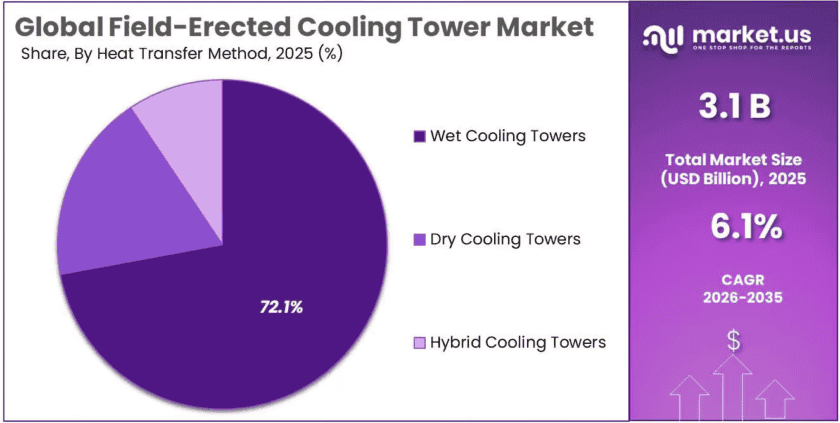
- Wet Cooling Towers captured approximately 72% of the market, supported by their ability to manage high heat loads through evaporative cooling.
- Concrete represented 42% of the construction material segment because of its strength and suitability for large structures.
- Power Generation accounted for 45% of application demand, reflecting the cooling requirements of thermal power plants.
- Manufacturing Facilities represented more than 25% of end-user demand due to their continuous industrial cooling requirements.
- Europe maintained its leading regional position with a 35% share, representing approximately USD 1.0 billion in revenue in 2025.
Regional Analysis
Europe – Dominating Region (35% Share)
In 2025, Europe held a dominant market position, capturing 35% of the global Field-Erected Cooling Tower Market, valued at approximately USD 1.0 billion. Germany, France, the United Kingdom, Italy, and the Netherlands support regional demand through established power generation, chemical processing, and manufacturing industries.
According to the European Environment Agency, electricity cooling accounted for 33% of total water abstraction across the EU during 2020–2023. This highlights the importance of industrial cooling infrastructure and water-management improvements. The region’s focus on industrial modernization, environmental compliance, and water-efficient technologies is supporting investments in advanced cooling towers.
Market Dynamics
1. Driver – Growing Demand for Industrial and Power Generation Cooling
Increasing electricity production and industrial activity are major drivers of the Field-Erected Cooling Tower Market. Power plants, refineries, chemical facilities, and manufacturing units require continuous heat removal to maintain stable operations. According to the USGS, approximately 59,889 million gallons per day of freshwater was withdrawn for thermoelectric power generation across the lower 48 states in 2020.
This highlights the scale of cooling requirements in electricity generation. Field-erected towers provide customized designs for large heat loads and complex operating conditions. Investments in power infrastructure, industrial expansion, and replacement of ageing cooling equipment are expected to support market demand.
2. Trend – Increasing Adoption of Water-Efficient Cooling Technologies
Water efficiency is becoming an important consideration in cooling tower design and operation. Industrial operators are adopting automated blowdown controls, improved water distribution, drift eliminators, and advanced treatment systems to reduce water losses.
The US Department of Energy states that increasing cooling tower cycles of concentration from three to six can reduce makeup water requirements by 20% and blowdown by 50%. This makes water-efficient designs attractive for facilities facing higher water costs and stricter environmental requirements. Manufacturers are also focusing on monitoring systems that track conductivity, water quality, and operating performance.
3. Restraint – High Installation Costs and Water Availability
High initial investment and water requirements can restrict the adoption of field-erected cooling towers. These projects require structural foundations, site preparation, large mechanical components, specialized installation teams, and regular maintenance. Wet cooling towers also require continuous makeup water to replace evaporation, drift, and blowdown losses.
The US Department of Energy explains that cooling tower performance depends on water quality and cycles of concentration, as excessive concentration can increase scaling and corrosion risks. Facilities operating in water-stressed locations may face additional treatment and supply costs. These factors can increase project budgets and delay investment decisions, particularly among cost-sensitive industrial operators.
4. Opportunity – Industrial Modernization and Advanced Cooling Systems
Modernization of existing industrial facilities offers strong opportunities for field-erected cooling tower manufacturers. Power plants, chemical facilities, and large manufacturing units are upgrading older cooling equipment to improve heat-transfer performance, reduce water consumption, and maintain operational reliability.
The USGS reported that thermoelectric water withdrawals declined by 14,335 million liters per day between 2008 and 2020, while cooling technologies continued to change. This creates opportunities for suppliers offering replacement towers, hybrid cooling solutions, and water-efficient reconstruction projects. Additional demand may emerge from large data centers and industrial campuses requiring centralized heat-rejection systems.
Emerging Trends
1. Smart Cooling Tower Monitoring
Industrial operators are adopting digital monitoring systems to track water temperature, conductivity, vibration, and fan performance. Automated controls can identify operating problems early and support preventive maintenance. The US Department of Energy recommends conductivity controllers to manage blowdown and improve cooling tower water efficiency.
2. Water Recycling and Reuse
Reclaimed water is gaining attention as an alternative makeup-water source for large cooling towers. The DOE reports that increasing cycles of concentration from 3 to 6 can reduce makeup water by 20%, supporting more efficient industrial water management.
3. Hybrid Cooling Technology
Hybrid cooling towers combine wet and dry cooling methods to manage heat while controlling water consumption and visible plume formation. Their adoption is relevant in water-stressed locations. The EPA identifies wet-dry combinations as an established cooling tower design classification.
4. Improved Drift and Emission Control
Manufacturers are improving drift eliminators, fill arrangements, and water distribution systems to reduce water droplets escaping into surrounding air. The EPA identifies drift as a source of particulate emissions and highlights the importance of tower design and maintenance.
5. Better Biological Water Management
Cooling tower operators are strengthening water treatment and monitoring practices to control bacterial growth. The CDC identifies sediment, biofilm, temperature, water age, and disinfectant levels as important factors affecting Legionella growth. Automated monitoring is becoming increasingly important.
Use Cases
1. Thermal Power Generation
Field-erected cooling towers remove excess heat from steam-cycle power plants and support continuous electricity production. USGS estimated freshwater withdrawals of 59,889 million gallons per day for thermoelectric generation in 2020, demonstrating the importance of cooling infrastructure.
2. Chemical and Petrochemical Processing
Chemical plants use large cooling towers to control process temperatures, support heat exchangers, and protect production equipment. The EPA identifies chemical manufacturing and petroleum refining among industries using cooling towers for industrial heat removal.
3. Oil and Gas Refineries
Refineries use field-erected cooling towers to remove heat from processing equipment, condensers, and circulation systems. Their customized capacity supports continuous operations across large facilities where dependable cooling is essential for production efficiency.
4. Steel and Metal Manufacturing
Steel and metal production facilities require cooling water for furnaces, casting equipment, compressors, and industrial machinery. Large cooling towers help manage process heat and maintain operating conditions. EPA identifies primary metals processing among industrial cooling tower applications.
5. Large Data Center Campuses
Large data centers can use centralized cooling tower systems to reject heat from water-cooled cooling infrastructure. The US Department of Energy identifies cooling towers as an important part of many data center cooling systems and provides specific water-efficiency guidance for these facilities.
Frequently Asked Questions on Field-Erected Cooling Tower Market
1. What is a Field-Erected Cooling Tower?
A field-erected cooling tower is a large industrial cooling structure assembled directly at the installation site. It removes excess heat from circulating water and supports continuous operations in power plants and industrial facilities.
2. What is the global Field-Erected Cooling Tower Market size in 2025?
According to Market.us, the global Field-Erected Cooling Tower Market was valued at approximately USD 3.1 billion in 2025. The market is projected to reach USD 5.6 billion by 2035.
3. What is the expected market growth rate?
The global market is projected to register a CAGR of 6.1% between 2026 and 2035. Growth is supported by industrial expansion, electricity generation investments, and increasing demand for large-capacity cooling infrastructure.
4. Which region dominates the Field-Erected Cooling Tower Market?
Europe dominated the global market in 2025 with a 35% share, representing approximately USD 1.0 billion in revenue. Its established industrial base and power generation infrastructure support regional demand.
5. Which tower type holds the largest market share?
Mechanical Draft Cooling Towers dominated the tower type segment with a 53% share in 2025. Their controlled airflow, operational flexibility, and reliable heat-transfer performance support their adoption across large industrial facilities.
6. Why are wet cooling towers widely used in industrial facilities?
Wet cooling towers use water evaporation to remove excess heat from industrial processes. Their ability to handle large cooling loads makes them suitable for power generation, chemical processing, petrochemical, and manufacturing applications.
7. What are the major applications of field-erected cooling towers?
Major applications include power generation, industrial process cooling, chemical and petrochemical processing, oil and gas refining, steel manufacturing, and large HVAC installations. These industries require reliable heat removal for continuous operations.
Conclusion
The Field-Erected Cooling Tower Market is expected to experience steady growth through 2035, supported by increasing cooling requirements across power generation, manufacturing, chemical processing, and oil and gas industries. The market is projected to increase from USD 3.1 billion in 2025 to USD 5.6 billion by 2035, at a CAGR of 6.1%.
Europe currently leads the market, while Asia-Pacific offers considerable growth potential through industrial expansion. Mechanical draft, counterflow, wet cooling, and concrete-based systems remain important market segments. Going forward, water conservation, hybrid cooling technology, digital monitoring, and industrial infrastructure modernization will create new opportunities for manufacturers and technology providers.
Discuss your needs with our analyst
Please share your requirements with more details so our analyst can check if they can solve your problem(s)