Overview
New York, NY – Nov 20, 2026 – The global Gummy Vitamins Market is experiencing strong growth as consumers increasingly prefer convenient and easy-to-consume nutritional supplements. According to Market.us, the global market was valued at USD 10.4 billion in 2025 and is projected to reach USD 28.2 billion by 2035, expanding at a compound annual growth rate (CAGR) of 10.6% during 2026–2035.
Gummy vitamins are becoming a popular alternative to traditional tablets and capsules because of their chewable texture, different flavors, and convenient consumption. Growing awareness of nutritional requirements, increasing supplement usage, and demand for personalized wellness products are supporting market expansion.
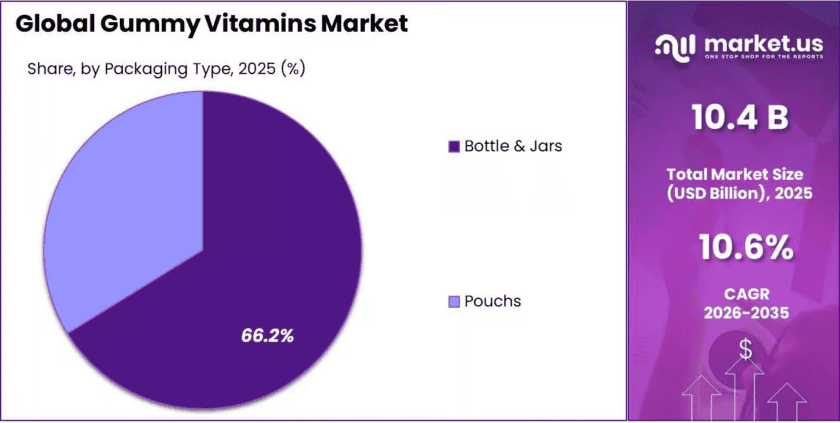
In 2025, multivitamin gummies dominated the product type segment with a 67.34% share, while plant-based products accounted for 72.34%. Bottles and jars represented 66.23% of packaging demand, and supermarkets and hypermarkets captured 38.78% of distribution channel revenue.
Asia-Pacific maintained its leading regional position with a 37.67% share, generating approximately USD 3.9 billion in revenue. Product innovation, sugar-free formulations, plant-based ingredients, and expanding retail distribution are expected to create further opportunities for manufacturers.
Key Takeaways
- The global Gummy Vitamins Market was valued at USD 10.4 billion in 2025.
- The market is projected to reach USD 28.2 billion by 2035, registering a CAGR of 10.6% during 2026–2035.
- Multivitamins dominated the product type segment with a 67.34% share in 2025.
- Plant-based gummy vitamins accounted for a leading 72.34% share, supported by demand for vegetarian-friendly and naturally sourced ingredients.
- Bottles and jars captured 66.23% share of the packaging segment because of their convenience and storage benefits.
- Supermarkets and hypermarkets held a leading 38.78% share of the distribution channel segment.
- Asia-Pacific dominated the global market with a 37.67% share, generating approximately USD 3.9 billion in revenue.
Regional Analysis
Asia-Pacific – Dominating Region
In 2025, Asia-Pacific held a dominant market position, capturing 37.67% of the global Gummy Vitamins Market and generating approximately USD 3.9 billion in revenue. China, Japan, South Korea, Australia, and other Southeast Asian economies contribute to regional demand through growing nutritional supplement consumption and expanding retail distribution.
Increasing awareness of preventive nutrition, demand for convenient supplement formats, and rising availability of different vitamin formulations are supporting market development. Manufacturers are also expanding plant-based, multivitamin, and targeted nutritional product offerings. Growing supermarket, pharmacy, and online retail networks are expected to strengthen the region’s position during the forecast period.
Market Dynamics
1. Driver – Increasing Consumption of Dietary Supplements
Increasing dietary supplement consumption is a major driver of the Gummy Vitamins Market. Consumers are showing greater interest in nutritional products that support their everyday dietary requirements. According to the CDC, 60.2% of US adults aged 20 years and older used at least one dietary supplement during August 2021–August 2023, compared with 53.8% in 2013–2014.
Gummy vitamins provide an alternative to traditional tablets and capsules through chewable formats and different flavors. Growing product availability, multivitamin formulations, and targeted nutritional products are supporting consumer interest and encouraging manufacturers to expand their product portfolios.
2. Trend – Growing Demand for Plant-Based and Sugar-Free Gummies
Plant-based and sugar-free formulations are becoming important trends in the Gummy Vitamins Market. Manufacturers are increasingly using pectin instead of animal-derived gelatin to develop vegetarian and vegan products.
The NIH Dietary Supplement Label Database includes gummy products with 0 grams of total sugar and 3 grams of dietary fiber per serving, demonstrating the availability of alternative formulations. Brands are also developing products with natural flavors, fruit-based colors, and reduced-sugar ingredients. These developments are helping manufacturers serve consumers seeking different ingredient choices while maintaining the convenient texture and taste associated with gummy supplements.
3. Restraint – Sugar Content and Nutrient Formulation Limitations
Sugar content and formulation limitations can restrict the growth of gummy vitamins. Unlike tablets and capsules, gummies require suitable gelling agents, stabilizers, sweeteners, and flavoring ingredients to maintain their texture and stability.
Some products also contain added sugar, which may discourage consumers seeking reduced-sugar nutritional supplements. For example, an NIH-listed children’s gummy vitamin label declares 3 grams of added sugar per two-gummy serving. Manufacturers must also maintain accurate nutrient quantities and ensure product stability throughout shelf life. The FDA requires dietary supplement manufacturers to follow quality specifications covering identity, purity, strength, composition, and contaminants, increasing production and testing requirements.
4. Opportunity – Expansion of Personalized and Targeted Nutrition
Personalized nutrition offers significant opportunities for gummy vitamin manufacturers. Consumers are increasingly interested in products containing specific nutrients such as vitamin C, vitamin D, vitamin B12, zinc, and biotin. The CDC reported that 38.7% of US adults used two or more dietary supplements during August 2021–August 2023, indicating demand for multiple nutritional products.
Manufacturers can use this opportunity to introduce targeted formulations for different age groups and nutritional preferences. Product development involving plant-based ingredients, sugar-free formulations, and specialized multivitamin combinations can also support differentiation. Expansion through pharmacies, supermarkets, and online retail channels provides additional opportunities for market penetration.
Emerging Trends in Gummy Vitamins
1. Increasing Demand for Sugar-Free Gummies
Manufacturers are introducing sugar-free gummy vitamins to attract consumers seeking reduced-sugar nutritional products. An NIH-listed gummy supplement provides 0 grams of total sugar and 3 grams of dietary fiber per serving, demonstrating formulation innovation.
2. Growing Popularity of Plant-Based Ingredients
Pectin-based formulations are gaining attention as alternatives to animal-derived gelatin. Manufacturers are using plant-based gelling agents, natural colors, and fruit extracts. Plant-derived products accounted for 72.34% of the global market in 2025.
3. Expansion of Personalized Vitamin Formulations
Manufacturers are developing gummies containing targeted nutrients such as vitamin C, vitamin D, vitamin B12, and zinc. The CDC reported that 38.7% of US adults used two or more supplements during 2021–2023, supporting interest in multiple nutritional products.
4. Development of Improved Nutrient Combinations
Gummy vitamin producers are combining multiple vitamins and minerals into convenient formulations. Multivitamins held a 67.34% market share in 2025. New product development is focusing on nutrient stability, accurate dosage, and improved flavor profiles.
5. Growth of Convenient and Protective Packaging
Manufacturers are improving bottles, jars, and resealable pouches to protect gummies from moisture and contamination. Bottles and jars accounted for 66.23% of packaging demand in 2025, highlighting their importance in product storage and distribution.
Use Cases of Gummy Vitamins
1. Daily Multivitamin Supplementation
Adults use multivitamin gummies as a convenient way to consume several nutrients in one product. An NIH-listed adult gummy formulation provides 10 mcg of vitamin D and 60 mg of vitamin C per two-gummy serving.
2. Children’s Nutritional Supplement Products
Children’s gummy vitamins provide selected vitamins in chewable formats. An NIH-listed product specifies 1 gummy for children aged 2–3 years and 2 gummies for those aged 4 years and older, demonstrating age-specific serving instructions.
3. Vitamin C Supplementation
Vitamin C gummies offer a convenient format for consumers seeking targeted vitamin formulations. One product recorded in the NIH database provides 250 mg of vitamin C per two-gummy serving, showing how manufacturers develop single-vitamin products.
4. Plant-Based Nutritional Supplementation
Plant-based gummy vitamins serve consumers seeking alternatives to animal-derived gelatin. Pectin-based formulations use plant-derived gelling ingredients. The plant-source segment accounted for 72.34% of the global market in 2025, reflecting its commercial importance.
5. Targeted Adult and Senior Nutrition
Manufacturers offer multivitamin gummies for different adult age groups and nutritional preferences. CDC data show that 75.9% of US adults aged 60 and older used dietary supplements during August 2021–August 2023, indicating a substantial supplement-consuming population.
Frequently Asked Questions on Gummy Vitamins Market
1. What are Gummy Vitamins?
Gummy vitamins are chewable dietary supplements containing vitamins and minerals in a soft, flavored format. They are available in different shapes, flavors, and nutrient combinations and provide an alternative to traditional tablets and capsules.
2. What is the global Gummy Vitamins Market size in 2025?
According to Market.us, the global Gummy Vitamins Market was valued at approximately USD 10.4 billion in 2025. Increasing dietary supplement consumption, convenient product formats, and expanding retail availability support market development.
3. What is the projected market size by 2035?
The global Gummy Vitamins Market is projected to reach approximately USD 28.2 billion by 2035. Growing demand for convenient nutritional supplements, plant-based products, and specialized vitamin formulations is expected to support this expansion.
4. What is the expected CAGR of the Gummy Vitamins Market?
The market is expected to register a compound annual growth rate of 10.6% during 2026–2035. Increasing supplement consumption, product innovation, and expanding distribution networks are important factors supporting this growth.
5. Which region dominates the Gummy Vitamins Market?
Asia-Pacific dominated the global market in 2025 with a 37.67% share, generating approximately USD 3.9 billion in revenue. Growing supplement consumption and expanding retail availability support regional demand.
6. Which product type dominates the Gummy Vitamins Market?
Multivitamins dominated the product type segment with a 67.34% share in 2025. Their popularity is supported by formulations combining multiple essential vitamins in convenient chewable products for different consumer groups.
7. Which source segment holds the largest market share?
Plant-based gummy vitamins accounted for 72.34% of the global market in 2025. Pectin, fruit extracts, and plant-derived ingredients support demand among consumers seeking vegetarian and vegan nutritional supplement alternatives.
Conclusion
The Gummy Vitamins Market is expected to experience strong growth through 2035, supported by increasing dietary supplement consumption and demand for convenient nutritional products. The market is projected to increase from USD 10.4 billion in 2025 to USD 28.2 billion by 2035, registering a CAGR of 10.6%.
Asia-Pacific currently leads the market with a 37.67% share, while North America and Europe offer additional opportunities. Multivitamin and plant-based formulations remain important market segments. Going forward, sugar-free products, pectin-based ingredients, personalized nutrition, and improved packaging are expected to create new opportunities for manufacturers and distributors.
Discuss your needs with our analyst
Please share your requirements with more details so our analyst can check if they can solve your problem(s)