Overview
New York, NY – Nov 20, 2026 – The global Hydraulic Workover Unit Market is gaining importance as oil and gas operators increase efforts to maintain existing wells, improve production, and extend the operating life of mature oilfields. Hydraulic workover units provide a cost-effective solution for well intervention, completion, maintenance, and workover operations without requiring a conventional drilling rig in many applications.
These units use hydraulic systems to insert and remove tubing and other well components under controlled conditions. Their ability to perform operations under pressure makes them useful for onshore and offshore oil and gas facilities. Increasing investments in well maintenance, production optimization, and unconventional oil and gas development are supporting demand.
The market is also benefiting from improvements in automated pipe handling, remote monitoring, and well-control technology. Operators are increasingly focusing on equipment reliability, personnel safety, and reduced intervention downtime. These requirements are encouraging service providers to develop more efficient and technologically advanced hydraulic workover solutions.
Key Takeaways
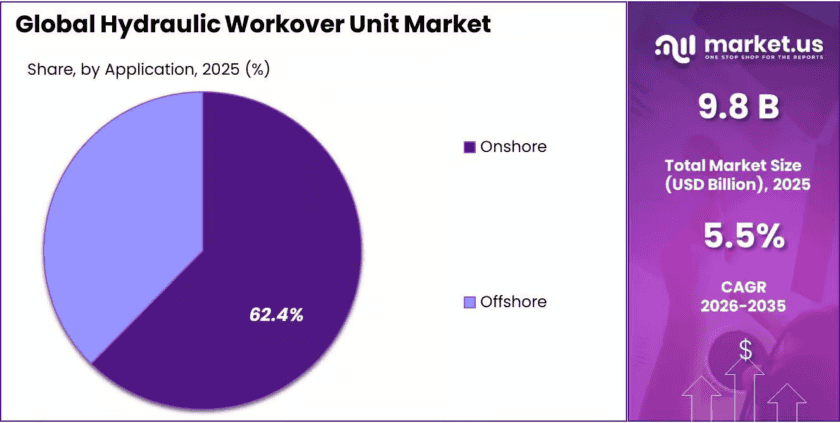
- The global Hydraulic Workover Unit Market was valued at USD 9.8 billion in 2025.
- The market is projected to reach USD 16.7 billion by 2035, registering a CAGR of 5.5% during 2026–2035.
- Workover services dominated the service segment with a 73.00% share in 2025.
- Skid-mounted hydraulic workover units captured 58.34% share, supported by their stable installation and operational flexibility.
- The 151–200 tonnes capacity segment held the leading position with a 61.22% share.
- Onshore applications accounted for 62.45% share of the global market.
- North America dominated the regional market with a 32.11% share, generating approximately USD 3.1 billion in revenue.
Regional Analysis
North America – Dominating Region
In 2025, North America held a dominant market position, capturing 32.11% of the global Hydraulic Workover Unit Market and generating approximately USD 3.1 billion in revenue. The United States and Canada benefit from established oil and gas production infrastructure, mature oilfields, and extensive well servicing activities.
According to the US Energy Information Administration, US crude oil production reached a record 13.6 million barrels per day in 2025, increasing by 3% compared with 2024. A large producing-well base creates recurring requirements for tubing replacement, well maintenance, production restoration, and intervention services. These activities support demand for hydraulic workover units across onshore and offshore oilfields.
Market Dynamics
1. Driver – Increasing Oil Production and Mature Well Maintenance
Increasing oil production and the maintenance of existing wells are important drivers of the Hydraulic Workover Unit Market. Operators are focusing on improving production from existing assets rather than depending entirely on new drilling projects. According to the US Energy Information Administration, US crude oil production reached a record 13.6 million barrels per day in 2025, representing a 3% increase over 2024.
This production scale supports demand for equipment used in tubing replacement, well repair, and production restoration. Hydraulic workover units help operators perform these activities with controlled lifting and well-pressure management, making them valuable for maintaining producing oil and gas assets.
2. Trend – Automation and Remote Well Intervention
Automation and remote monitoring are becoming important trends in hydraulic workover operations. Equipment manufacturers are improving hydraulic controls, pipe-handling systems, pressure monitoring, and automated safety functions to reduce manual work and improve operating accuracy. These developments are especially relevant in high-pressure wells and offshore environments where operational risks can be significant.
The US Bureau of Safety and Environmental Enforcement (BSEE) maintains offshore incident and safety reporting systems to monitor operational performance and support safer offshore activities. Digital equipment monitoring and improved control systems can help operators identify equipment problems earlier and improve intervention planning.
3. Restraint – High Equipment and Operational Costs
High equipment costs and complex operating requirements can restrict the adoption of hydraulic workover units. These systems require hydraulic power packages, lifting assemblies, pressure-control equipment, trained operators, and regular inspections. Transportation and installation can also increase project expenses, particularly for offshore and remote locations. Operators must ensure that well-control systems are suitable for specific pressure and operating conditions.
In addition, equipment downtime can delay well maintenance and affect production schedules. OSHA’s oil and gas extraction safety guidance identifies hazards associated with well servicing, pressure-related operations, and moving machinery. These requirements increase the importance and cost of training, maintenance, and safety compliance.
4. Opportunity – Production Optimization and Offshore Well Intervention
Production optimization and offshore well intervention offer significant opportunities for hydraulic workover unit manufacturers. Operators are increasingly focusing on maintaining existing wells, replacing damaged tubing, and restoring production from mature assets. The EIA reported that US oil production from wells drilled before 2025 contributed approximately 8.3 million barrels per day in 2025.
This demonstrates the importance of existing producing wells and creates opportunities for maintenance and intervention services. Hydraulic workover units can support these operations through controlled pipe movement and pressure management. Suppliers offering high-capacity units, advanced safety controls, and mobile equipment configurations can benefit from growing well servicing requirements.
Emerging Trends in Hydraulic Workover Unit
1. Automated Pipe Handling Systems
Manufacturers are introducing automated pipe-handling systems to reduce manual work and improve operating accuracy. These systems support safer tubing movement and faster well intervention. OSHA identifies struck-by and caught-in hazards as important risks during well servicing operations.
2. Growing Demand for High-Capacity Units
Oilfield operators are increasingly requiring equipment capable of handling demanding well intervention activities. The 151–200 tonnes capacity segment held 61.22% share in 2025. Higher lifting capability supports tubing replacement and complex maintenance operations.
3. Remote Monitoring and Digital Controls
Digital monitoring is becoming important for tracking hydraulic pressure, lifting performance, and equipment conditions. Remote monitoring can help operators identify problems early and plan maintenance. OSHA recommends equipment inspections and job-specific safety assessments before well servicing operations.
4. Increasing Focus on Well-Control Safety
Operators are improving pressure-control equipment, blowout preventers, and emergency shutdown systems during intervention activities. BSEE recorded 192 offshore injuries in 2025, highlighting the importance of stronger safety procedures, equipment inspection, and worker training.
5. Greater Focus on Mature Well Intervention
Operators are prioritizing existing well maintenance to sustain oil production. The EIA reported that wells drilled before 2025 produced approximately 8.3 million barrels per day of US crude oil in 2025, demonstrating the importance of maintaining existing assets.
Use Cases of Hydraulic Workover Unit
1. Tubing Replacement and Well Maintenance
Hydraulic workover units remove and replace production tubing in existing wells. These activities help restore production and maintain equipment reliability. OSHA identifies pulling and running tubing as important maintenance activities during oil and gas well servicing.
2. Live-Well Intervention and Snubbing
Hydraulic workover equipment supports tubing movement under controlled well pressure. Snubbing operations allow tubing to enter or leave a pressurized wellbore. OSHA identifies snubbing as a specialized well servicing activity requiring appropriate pressure-control precautions.
3. Sand Removal and Well Cleaning
Operators use workover equipment to support sand cleanout and remove accumulated material from wellbores. These operations help restore production flow and improve well performance. OSHA specifically identifies sand cleanout as a common remedial workover activity.
4. Casing and Liner Repair
Hydraulic workover units support well intervention activities involving damaged casing and liners. Repairs can include patching, replacing, or adding liners to address well integrity problems. OSHA identifies corrosion, abrasion, and pressure as possible causes of casing damage.
5. Offshore Well Maintenance
Offshore operators use specialized workover equipment to maintain producing wells, replace tubing, and perform intervention activities. BSEE recorded 401 lifting-related incidents in 2025, highlighting the importance of safe lifting procedures and equipment handling during offshore operations.
Frequently Asked Questions on Hydraulic Workover Unit Market
1. What is a Hydraulic Workover Unit?
A Hydraulic Workover Unit is specialized oilfield equipment used to perform well maintenance, tubing replacement, completion, and intervention operations. It uses hydraulic lifting systems to move tubular components under controlled operating conditions.
2. What is the global Hydraulic Workover Unit Market size in 2025?
According to Market.us, the global Hydraulic Workover Unit Market was valued at approximately USD 9.8 billion in 2025. Demand is supported by mature well maintenance, oil production activities, and increasing requirements for specialized intervention equipment.
3. What is the projected market size by 2035?
The global Hydraulic Workover Unit Market is projected to reach approximately USD 16.7 billion by 2035. Increasing investments in well intervention, production optimization, and maintenance of existing oil and gas assets are supporting market expansion.
4. What is the expected CAGR of the market?
The Hydraulic Workover Unit Market is expected to register a compound annual growth rate of 5.5% during 2026–2035. Growing well maintenance requirements and investments in oilfield production infrastructure support this growth.
5. Which region dominates the Hydraulic Workover Unit Market?
North America dominated the global market in 2025 with a 32.11% share, generating approximately USD 3.1 billion in revenue. Its established oil and gas production infrastructure supports equipment demand.
6. Which service segment holds the largest market share?
Workover services dominated the service segment with a 73.00% share in 2025. Their importance in tubing replacement, well maintenance, production restoration, and downhole equipment servicing supports their leading position.
7. Which installation type dominates the market?
Skid-mounted hydraulic workover units held the leading position with a 58.34% market share in 2025. Their stable installation, compact design, and suitability for established oilfield facilities support their adoption.
Conclusion
The Hydraulic Workover Unit Market is expected to maintain steady growth through 2035, supported by increasing oil production, mature well maintenance, and demand for specialized intervention equipment. The market is projected to grow from USD 9.8 billion in 2025 to USD 16.7 billion by 2035, registering a CAGR of 5.5%.
North America currently leads the market, while the Middle East, Asia-Pacific, and Latin America offer additional opportunities. Workover services, skid-mounted installations, and 151–200 tonnes capacity units remain important segments. Going forward, automation, remote monitoring, advanced pressure-control systems, and offshore intervention will create new opportunities.
Discuss your needs with our analyst
Please share your requirements with more details so our analyst can check if they can solve your problem(s)