Overview
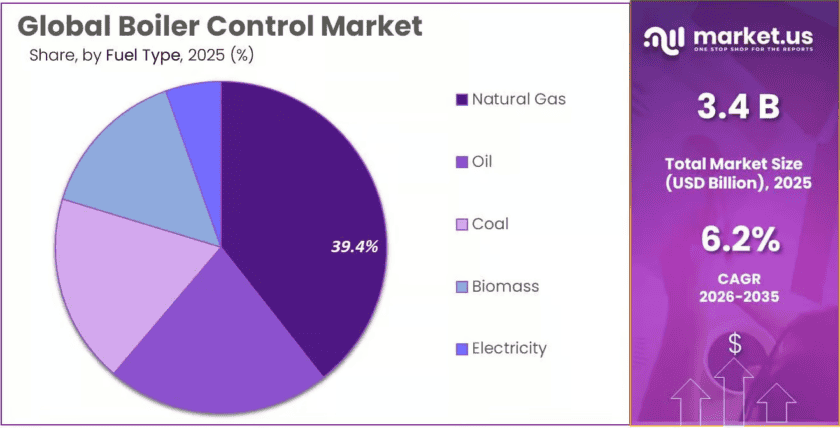
New York, NY – Nov 18, 2026 – The global Boiler Control Market is gaining momentum as industries increase investment in energy-efficient equipment, automated combustion systems, and advanced process monitoring. The market was valued at USD 3.4 billion in 2025 and is projected to reach USD 6.3 billion by 2035, expanding at a compound annual growth rate (CAGR) of 6.2% during 2026–2035.
In 2025, Asia Pacific dominated the global market with a 36.00% share, generating approximately USD 1.2 billion in revenue. Hardware remained the leading component, accounting for 42.00%, while Water-Tube Boilers represented 35.00% of the boiler type segment. Modulating Control captured 31.00%, reflecting the growing importance of flexible fuel and air regulation.
Natural Gas maintained its leading position in the fuel category with a 39.00% share. Increasing demand from chemical processing, oil and gas, power generation, food manufacturing, and commercial buildings is supporting market development. Industrial facilities are adopting modern controllers, sensors, and digital monitoring systems to maintain stable steam production, reduce unnecessary fuel consumption, and improve operational safety.
Key Takeaways
- Market Valuation: The global Boiler Control Market reached USD 3.4 billion in 2025.
- Market Forecast: Global revenue is expected to reach USD 6.3 billion by 2035.
- Growth Rate: The market is projected to register a CAGR of 6.2% between 2026 and 2035.
- Dominating Region: Asia Pacific led the global market with a 36.00% share, representing approximately USD 1.2 billion in revenue.
- Leading Component: Hardware accounted for 42.00% of the component segment.
- Leading Boiler Type: Water-Tube Boilers captured 35.00% of the market.
- Leading Control Type: Modulating Control held a 31.00% share.
- Leading Fuel Type: Natural Gas represented 39.00% of the fuel type segment.
- Leading Application: Commercial applications accounted for 24.00% of the market.
- Important End-Use Industry: Oil and Gas represented 17.00% of the market.
Regional Analysis
Asia Pacific – Dominating Region
Asia Pacific dominated the Boiler Control Market in 2025, accounting for 36.00% of global revenue, equivalent to approximately USD 1.2 billion. The region benefits from its large manufacturing base, expanding industrial infrastructure, and increasing demand for reliable steam generation.
China, Japan, and South Korea are important markets because of their established chemical, food processing, oil and gas, and power generation industries. Industrial modernization is encouraging companies to adopt automatic combustion controls, digital monitoring equipment, and advanced pressure regulation systems. Southeast Asian economies are also creating opportunities through manufacturing expansion and investment in industrial energy efficiency.
Market Dynamics of the Boiler Control Market
1. Driver: Increasing Demand for Combustion Efficiency
The growing focus on combustion efficiency is supporting demand for advanced boiler control systems. Industrial facilities are installing oxygen sensors, automatic fuel-air regulators, and modulating controllers to reduce excess air and unnecessary fuel consumption.
The U.S. Department of Energy explains that oxygen trim systems can improve boiler efficiency by approximately 1–2 percentage points under suitable operating conditions. These improvements encourage manufacturers to upgrade existing equipment instead of replacing complete boiler installations. Better combustion management also helps maintain stable steam production and supports lower operating costs across chemical, manufacturing, and power generation facilities.
2. Trend: Growing Adoption of Digital Boiler Controls
Digital boiler controls are gaining importance as industries move from traditional manual operations toward automated monitoring. Modern distributed control systems can monitor fuel flow, steam pressure, water levels, temperature, and combustion conditions. The U.S. Department of Energy’s industrial energy-efficiency handbook explains that computer-based distributed control systems offer integrated data acquisition, self-diagnostics, and easier system expansion compared with older pneumatic and analog controls.
These capabilities support improved equipment monitoring and maintenance planning. As industrial facilities increase investment in connected automation, demand for programmable controllers, digital instruments, and integrated boiler management platforms is expected to strengthen.
3. Restraint: High Installation and Retrofit Costs
High installation and retrofit costs remain a challenge for boiler control adoption. Modern systems may require replacement of sensors, actuators, electrical panels, wiring, and existing control equipment. Older installations can also require additional engineering and commissioning work before new technologies can operate correctly.
The U.S. Department of Energy identifies first cost, operating cost, infrastructure requirements, and space limitations as important considerations in commercial boiler electrification and retrofit projects. Facilities with low annual boiler utilization may find it difficult to recover the investment through fuel savings. These financial limitations can delay modernization projects, particularly among smaller industrial operators.
4. Opportunity: Hybrid Boiler and Electric Heating Integration
The growing use of electric heating technologies creates opportunities for manufacturers offering integrated boiler control platforms. Industrial and commercial facilities are evaluating systems that coordinate conventional fuel-fired boilers with electric boilers and heat pumps. The U.S. Department of Energy identifies electric heating and incremental boiler replacement as possible approaches for existing buildings.
Its April 2024 guidance examines multiple electrification technologies and retrofit strategies. Control manufacturers can benefit by developing solutions that coordinate heating loads, regulate operating temperatures, and manage different energy sources. Such systems can support flexible heating operations while helping building owners meet their energy-management objectives.
Emerging Trends in the Boiler Control Market
1. Artificial Intelligence and Predictive Monitoring
Artificial intelligence is becoming useful in boiler monitoring. Digital systems can analyze operating data, identify unusual temperature or pressure changes, and support maintenance decisions. The U.S. Department of Energy highlights computer-based controls with integrated data acquisition and self-diagnostic capabilities.
2. Advanced Oxygen Trim Technology
Oxygen trim technology is gaining attention because it automatically adjusts combustion air according to exhaust oxygen levels. The U.S. Department of Energy identifies potential efficiency improvements of approximately 1–2 percentage points under suitable boiler operating conditions.
3. Connected Boiler Monitoring Systems
Connected boiler monitoring is supporting better operational visibility. Digital controllers can collect information on pressure, temperature, fuel supply, and water levels. DOE’s commercial building guidance identifies approximately 703,000 boiler-heated buildings in the United States, representing a large installed base.
4. Electrification and Hybrid Heating Controls
Electric boilers and hybrid heating systems are creating new opportunities for control manufacturers. The U.S. Department of Energy published dedicated electrification guidance in April 2024, covering retrofit strategies, electric heating technologies, and infrastructure requirements for existing buildings.
5. Improved Boiler Load Management
Boiler load management is becoming important for facilities operating multiple units. The U.S. Department of Energy recommends optimizing boiler loading, checking combustion efficiency, and conducting regular efficiency tests. These practices help facilities manage energy consumption and maintain reliable steam production.
Use Cases of Boiler Control Systems
1. Chemical Manufacturing Facilities
Chemical manufacturers use boiler control systems for steam-based production, heating, and processing. According to the U.S. Energy Information Administration’s 2022 Manufacturing Energy Consumption Survey, the chemicals subsector accounted for 56% of purchased manufacturing steam, highlighting its significant thermal energy requirements.
2. Hospitals and Healthcare Buildings
Hospitals use boilers for space heating, hot water, sterilization, and laundry operations. The U.S. Department of Energy reports that approximately 78% of inpatient healthcare buildings use boilers, making reliable temperature, pressure, and water-level controls important for facility operations.
3. Educational Institutions
Schools, colleges, and universities use boilers for classroom heating, hot water, and facility maintenance. DOE data identifies approximately 133,000 boiler-heated educational buildings in the United States. Automated controls help these facilities manage heating schedules and reduce unnecessary energy consumption.
4. Office Buildings and Commercial Facilities
Office buildings use boiler controls to manage central heating and hot-water systems. DOE identifies approximately 133,000 boiler-heated office buildings in the United States. Programmable controllers help regulate temperatures according to occupancy schedules and improve heating system management.
5. Industrial Boiler and Steam Operations
Industrial facilities use automated controls to regulate combustion, steam pressure, and boiler loading. DOE recommends boiler efficiency testing, combustion optimization, and regular maintenance. Its facility checklist identifies 3 important operational priorities: combustion efficiency, boiler loading, and scheduled maintenance.
Frequently Asked Questions on Boiler Control and Boiler Control Market
1. What is the Boiler Control Market?
The Boiler Control Market covers equipment, software, and services used to regulate boiler operations. These systems manage fuel supply, combustion, steam pressure, temperature, water levels, and safety across industrial and commercial applications.
2. What is the global Boiler Control Market size in 2025?
The global Boiler Control Market was valued at approximately USD 3.4 billion in 2025. Demand is supported by industrial automation, energy-efficiency improvements, boiler modernization, and the growing requirement for reliable steam generation.
3. What is the expected market size by 2035?
The market is projected to reach approximately USD 6.3 billion by 2035, registering a CAGR of 6.2% during 2026–2035. Increasing investment in automated combustion, digital monitoring, and industrial heating systems supports this outlook.
4. Which region dominates the Boiler Control Market?
Asia Pacific dominated the global market in 2025, accounting for 36.00% of total revenue, equivalent to approximately USD 1.2 billion. Industrial manufacturing, power generation, and automation investments support regional demand.
5. Which component holds the largest market share?
Hardware leads the component segment with a 42.00% market share in 2025. Sensors, controllers, transmitters, actuators, valves, and control panels are essential for monitoring and regulating boiler performance.
6. What is the leading boiler type in the market?
Water-Tube Boilers led the boiler type segment with a 35.00% share in 2025. Their ability to generate high-pressure steam makes them suitable for power generation and large industrial processing applications.
Conclusion
The Boiler Control Market is expected to maintain steady growth as industries increasingly focus on energy efficiency, automation, and operational safety. The market is projected to grow from USD 3.4 billion in 2025 to USD 6.3 billion by 2035, registering a CAGR of 6.2%. Asia Pacific remains the leading regional market, supported by industrial expansion and manufacturing investments.
Hardware, Water-Tube Boilers, Modulating Control, and Natural Gas represent important market segments. Growing adoption of digital monitoring, oxygen trim technology, and hybrid heating systems will create new business opportunities. Despite installation costs and retrofit challenges, modernization will remain an important growth factor.
Discuss your needs with our analyst
Please share your requirements with more details so our analyst can check if they can solve your problem(s)