Overview
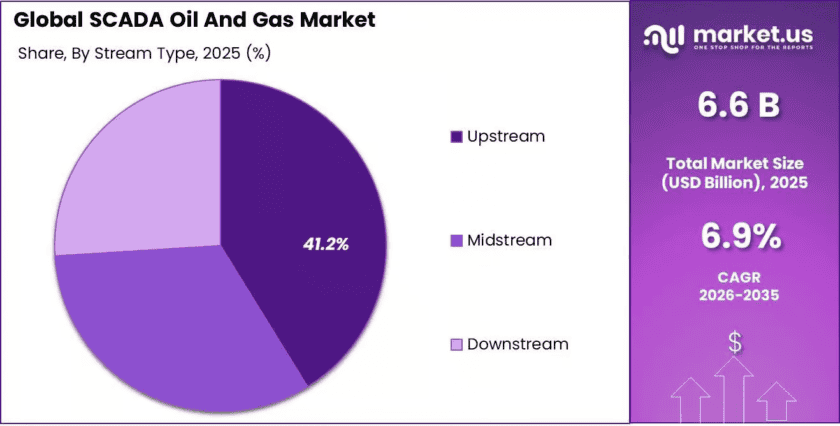
New York, NY – Nov 17, 2026 – The global SCADA Oil and Gas Market is gaining importance as energy companies increase investments in automation, remote monitoring, and digital control technologies. The market was valued at USD 6.60 billion in 2025 and is projected to reach USD 12.81 billion by 2035, registering a compound annual growth rate (CAGR) of 6.9% during 2026–2035. SCADA systems help oil and gas operators monitor pipelines, drilling operations, production facilities, storage units, and refineries through centralized control platforms.
In 2025, hardware dominated the component segment with a 46.43% share, while upstream operations accounted for 41.21%. Pipeline monitoring represented 34.21% of application demand. North America remained the leading regional market, accounting for 37.67%, with revenue of approximately USD 2.4 billion. Increasing oil and gas production, pipeline infrastructure expansion, industrial automation, and operational safety requirements are supporting market demand.
Growing cybersecurity concerns and the need to reduce manual inspections are also encouraging energy companies to upgrade traditional control systems with advanced digital monitoring solutions.
Key Takeaways
- Market valuation: The global SCADA Oil and Gas Market reached USD 6.60 billion in 2025.
- Future outlook: Market revenue is projected to reach USD 12.81 billion by 2035.
- Growth rate: The market is expected to expand at a 6.9% CAGR during 2026–2035.
- Leading component: Hardware captured a dominant 46.43% share in 2025.
- Leading stream type: Upstream operations accounted for 41.21% of the market.
- Leading application: Pipeline monitoring held a 34.21% share.
- Dominating region: North America accounted for 37.67%, generating approximately USD 2.4 billion in revenue.
Regional Analysis
North America – Dominating Region
North America dominated the SCADA Oil and Gas Market in 2025, accounting for 37.67% of global revenue, equivalent to approximately USD 2.4 billion. The region benefits from extensive pipeline infrastructure, established oil and gas production facilities, and strong investment in industrial automation.
The United States and Canada are major contributors because operators require continuous monitoring of drilling sites, processing facilities, compressor stations, and transmission networks. According to the US Energy Information Administration (EIA), the United States produced a record 13.6 million barrels of crude oil per day in 2025. This large production base increases the importance of automated monitoring, equipment control, and production management.
Asia-Pacific – Strong Growth Opportunity
Asia-Pacific is emerging as an important growth region due to expanding natural gas infrastructure, LNG investments, refining capacity, and increasing energy requirements. Countries such as China, Japan, South Korea, and Australia are investing in energy infrastructure that requires reliable monitoring and centralized operational control.
The International Energy Agency (IEA) projects that global natural gas demand will increase by approximately 380 billion cubic metres between 2024 and 2030. This expansion creates opportunities for SCADA deployment across pipelines, gas processing facilities, LNG terminals, and production networks. Growing attention to operational efficiency, remote asset management, and industrial cybersecurity is expected to support regional adoption.
Market Dynamics
1. Driver – Expansion of Oil and Gas Pipeline Infrastructure
Increasing pipeline infrastructure and oil production activities are driving demand for SCADA systems. Operators require continuous monitoring of pressure, temperature, flow rates, and equipment conditions to maintain safe transportation.
According to the US Pipeline and Hazardous Materials Safety Administration (PHMSA), the country had 2,781,712 miles of gas pipelines in 2024, including distribution, gathering, and transmission networks.
This extensive infrastructure creates demand for automated monitoring, leak detection, and remote control solutions. SCADA technology helps operators identify abnormal conditions, reduce manual inspections, and improve pipeline reliability across geographically dispersed oil and gas facilities.
2. Trend – Increasing Adoption of Digital and Cybersecure Control Systems
Oil and gas companies are increasingly adopting digital SCADA platforms with remote access, advanced analytics, and cybersecurity features. These systems help operators monitor multiple facilities through centralized control rooms and identify equipment problems earlier.
In May 2025, the US Transportation Security Administration renewed its Pipeline Security Directive, requiring designated pipeline and LNG facility operators to maintain cybersecurity measures.
CISA also published guidance in January 2025 encouraging operational technology owners to select products with strong authentication and secure design. These developments are encouraging operators to modernize legacy SCADA infrastructure and improve protection against unauthorized access.
3. Restraint – High Investment and Modernization Costs
High implementation and maintenance costs remain important restraints for the SCADA Oil and Gas Market. Companies must invest in sensors, remote terminal units, communication networks, software, cybersecurity systems, and skilled technical staff.
Modernizing older infrastructure can also require system integration and operational testing, increasing project expenses. According to the IEA’s World Energy Investment 2025 report, upstream oil investment was expected to decline by 6% in 2025, reaching approximately USD 420 billion.
Lower investment budgets can delay non-essential automation projects, particularly among smaller operators. This may slow SCADA upgrades across older production facilities and pipeline networks.
4. Opportunity – Expansion of LNG Infrastructure and Remote Monitoring
Expansion of LNG infrastructure offers an important growth opportunity for SCADA providers. New liquefaction facilities, export terminals, gathering pipelines, and compressor stations require reliable monitoring and automated process control.
According to the IEA Global LNG Capacity Tracker, more than 330 billion cubic metres per year of new LNG export capacity is expected to become operational between 2025 and 2030 from projects already under construction. This development creates opportunities for SCADA suppliers to provide monitoring hardware, communication systems, software, and integration services.
Emerging Trends in the SCADA Oil and Gas Market
1. AI-Based Predictive Maintenance: Oil and gas operators are adopting artificial intelligence to identify equipment problems before failures occur. The US produced a record 13.6 million barrels of crude oil per day in 2025, increasing the importance of efficient production monitoring.
2. Cloud-Based SCADA Platforms: Cloud-connected SCADA systems are gaining attention because they allow operators to monitor geographically dispersed facilities. CISA’s January 2025 guidance encourages secure operational technology products with strong authentication and improved network visibility.
3. Advanced Pipeline Cybersecurity: Cybersecurity is becoming a priority as energy infrastructure faces increasing digital threats. The TSA renewed its pipeline cybersecurity directive on May 1, 2025, requiring designated operators to maintain security measures and strengthen infrastructure protection.
4. LNG Facility Automation: New LNG projects are increasing demand for automated monitoring and control systems. The IEA expects more than 330 bcm per year of additional LNG export capacity to become operational between 2025 and 2030.
5. Remote Oilfield Monitoring: Operators are using remote monitoring to manage production sites, pumps, compressors, and field equipment. The US had 110,248 miles of gas gathering pipelines in 2024, highlighting the importance of reliable monitoring across remote infrastructure.
Use Cases of SCADA Oil and Gas
1. Pipeline Pressure and Leak Monitoring: SCADA systems monitor pipeline pressure, temperature, and flow conditions to identify abnormal changes. The US had 83,164 miles of crude oil pipelines in 2024, creating significant requirements for reliable monitoring and operational control.
2. Oilfield Production Monitoring: SCADA technology helps operators monitor wellhead pressure, production volumes, and equipment performance. US crude oil production reached 13.6 million barrels per day in 2025, highlighting the importance of automated production management.
3. Refinery Process Automation: Refineries use SCADA platforms to monitor process conditions, storage tanks, pumps, and equipment performance. Centralized monitoring supports operating efficiency, process visibility, and early identification of abnormal conditions during continuous refinery operations.
4. LNG Terminal Management: LNG terminals use automated control systems to monitor storage, gas processing, transfer operations, and supporting equipment. The IEA’s projected addition of more than 330 bcm per year of LNG capacity by 2030 creates further opportunities for SCADA deployment.
5. Compressor Station Operations: SCADA systems help operators remotely monitor compressor performance, pressure levels, temperature, and equipment conditions. The US reported 300,711 miles of gas transmission pipelines in 2024, supporting demand for automated control across long-distance transportation networks.
Frequently Asked Questions on SCADA Oil and Gas
1. What is SCADA in the oil and gas industry?
SCADA stands for Supervisory Control and Data Acquisition. It is a computerized control system that collects real-time information, monitors equipment, and allows operators to manage oil and gas operations remotely.
2. What was the global SCADA Oil and Gas Market value in 2025?
The global SCADA Oil and Gas Market was valued at USD 6.60 billion in 2025. It is projected to reach USD 12.81 billion by 2035, registering a CAGR of 6.9%.
3. Which region dominated the SCADA Oil and Gas Market in 2025?
North America dominated the market in 2025, accounting for 37.67% of the global market, with approximately USD 2.4 billion in revenue. Strong oil production and pipeline infrastructure support regional demand.
4. Which component segment held the largest market share?
Hardware dominated the component segment in 2025, capturing 46.43% of the market. Sensors, programmable logic controllers, remote terminal units, and communication equipment support continuous monitoring and automated control.
5. Which stream type dominated the market in 2025?
The upstream segment dominated the SCADA Oil and Gas Market in 2025, accounting for 41.21% of the market. Increasing requirements for drilling, exploration, and production monitoring support its leading position.
Conclusion
The SCADA Oil and Gas Market is expected to experience steady expansion as energy companies increase investments in digital monitoring, automation, and operational security. The market is projected to grow from USD 6.60 billion in 2025 to USD 12.81 billion by 2035, at a CAGR of 6.9%.
North America maintains its leading position, supported by established oil production and pipeline infrastructure. Hardware, upstream operations, and pipeline monitoring remain important market segments. Increasing LNG investments, remote asset management, and cybersecurity requirements will create further opportunities. Companies developing secure, scalable, and efficient SCADA solutions are expected to strengthen their market presence.
Discuss your needs with our analyst
Please share your requirements with more details so our analyst can check if they can solve your problem(s)