Overview
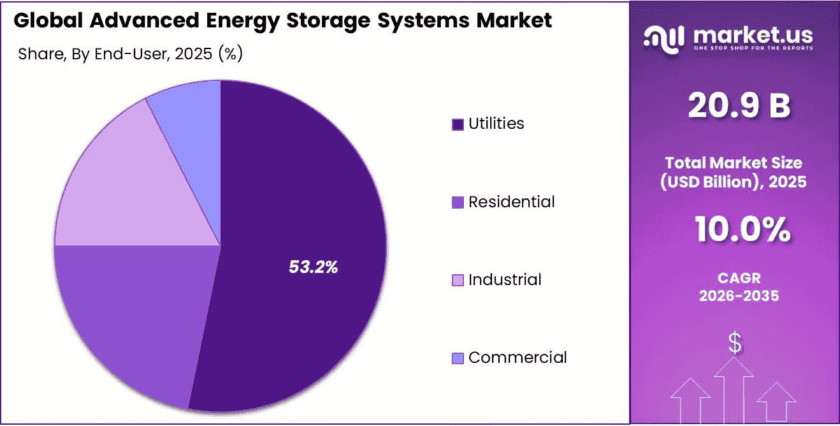
New York, NY – Nov 17, 2026 – The global Advanced Energy Storage Systems Market is gaining importance as governments, utilities, and industries increase investments in renewable energy, grid modernization, and electricity reliability. The market was valued at USD 20.9 billion in 2025 and is projected to reach USD 54.2 billion by 2035, registering a compound annual growth rate (CAGR) of 10.0% during 2026–2035.
In 2025, electrochemical storage dominated the technology segment with a 52.11% share, while transportation accounted for 63.45% of application demand. Utilities held a leading 53.23% share among end users.
Europe dominated the regional market with 34.23%, generating USD 5.0 billion in revenue. Growing electric vehicle adoption, renewable power installations, and demand for grid flexibility are supporting market development. Battery technologies, pumped hydro, thermal storage, and other advanced solutions are becoming important for balancing electricity supply and demand.
Key Takeaways
- Market valuation: The global market reached USD 20.9 billion in 2025.
- Future outlook: Revenue is projected to reach USD 54.2 billion by 2035.
- Growth rate: The market is expected to expand at a 10.0% CAGR during 2026–2035.
- Leading technology: Electrochemical storage captured 52.11% of the market in 2025.
- Leading application: Transportation accounted for 63.45% of total market demand.
- Leading end user: Utilities held a dominant 53.23% share.
- Dominating region: Europe captured 34.23%, generating USD 5.0 billion in revenue.
Regional Analysis
Europe – Dominating Region
Europe dominated the Advanced Energy Storage Systems Market in 2025, accounting for 34.23% of global revenue, equivalent to USD 5.0 billion. Regional growth is supported by renewable energy expansion, grid modernization, electric vehicle adoption, and government-backed decarbonization policies.
Germany, Italy, the United Kingdom, and France are important contributors to regional storage deployment. According to the International Energy Agency (IEA), solar photovoltaic and wind power together accounted for 30% of electricity generation in the European Union in 2025, exceeding fossil fuel generation for the first time. This increasing renewable electricity contribution is strengthening the need for storage systems that can balance intermittent generation and maintain grid stability.
North America – Strong Growth Opportunity
North America represents an important growth market due to rising electricity demand, utility-scale battery installations, renewable energy projects, and investments in grid reliability. The United States is a major contributor, supported by large-scale battery storage projects and increasing solar-plus-storage installations.
According to the US Energy Information Administration (EIA), operational utility-scale battery storage capacity in the United States reached 43.6 GW by the end of 2025. During the first six months of 2026, another 8.3 GW was added, taking capacity to nearly 52 GW. These developments demonstrate the growing role of advanced storage systems in electricity supply management, peak-load support, and renewable energy integration.
Market Dynamics
1. Driver – Increasing Integration of Renewable Energy
The growing installation of solar and wind power is a major driver of the Advanced Energy Storage Systems Market. Renewable electricity generation changes according to weather conditions, creating a need for storage technologies that can balance supply and demand.
According to the IEA, global renewable electricity capacity additions reached a record 800 GW in 2025, with solar contributing approximately 75%. Advanced storage systems help utilities store excess electricity and release it during periods of higher demand or lower generation. This supports grid stability, improves renewable energy utilization, and reduces dependence on conventional power generation.
2. Trend – Rapid Growth of Battery Storage Technologies
Battery storage is becoming a leading technology trend as manufacturers improve energy density, charging performance, safety, and operating life. Lithium iron phosphate batteries are gaining adoption because of their cost advantages and suitability for frequent charging cycles.
According to the IEA, global battery storage additions reached 108 GW in 2025, representing a 40% increase compared with 2024. Lithium iron phosphate technology accounted for approximately 90% of battery deployments during the year. These developments are encouraging utilities, transportation companies, and industrial users to adopt advanced battery systems for renewable integration, electricity management, and backup power applications.
3. Restraint – High Installation Costs and Material Dependence
High initial investment remains a major challenge for advanced energy storage projects. Battery installations require cells, power conversion systems, thermal management, safety equipment, and grid connection infrastructure. The availability and cost of lithium, graphite, nickel, and other battery materials can also affect project economics.
According to the US Department of Energy, long-duration energy storage technologies continue to face cost and commercialization challenges, particularly when competing with established power generation and grid infrastructure. Project developers must also consider replacement costs, recycling, and system performance over time. These financial and technical requirements can delay adoption among smaller utilities and industrial operators.
4. Opportunity – Expansion of Utility-Scale and Long-Duration Storage
The expansion of utility-scale and long-duration energy storage offers strong opportunities for market participants. Utilities require larger storage systems to manage renewable electricity generation, peak demand, and grid congestion. According to the EIA, US developers plan to add 24 GW of utility-scale battery storage capacity in 2026, compared with approximately 15 GW added in 2025.
These investments create opportunities for battery manufacturers, system integrators, and energy technology providers. Companies developing high-capacity storage, improved battery management, and long-duration solutions can benefit from growing demand for flexible electricity infrastructure and reliable renewable energy integration.
Emerging Trends in the Advanced Energy Storage Systems Market
1. Lithium Iron Phosphate Battery Adoption: Lithium iron phosphate batteries are gaining popularity because of their cost advantages and suitability for frequent charging. According to the IEA, this technology accounted for approximately 90% of global battery storage deployments in 2025.
2. Utility-Scale Battery Expansion: Large battery installations are becoming important for grid management and renewable integration. Global battery storage additions reached 108 GW in 2025, approximately 40% higher than in 2024, according to the IEA.
3. Solar-Plus-Storage Projects: Energy companies are increasingly combining solar power installations with battery storage. The US EIA reported that more than 16% of new utility-scale solar capacity added through September 2026 was connected with operational battery storage.
4. Longer-Duration Battery Systems: Storage projects are increasingly designed to provide electricity for longer periods. The IEA reported that the average duration of newly commissioned utility-scale battery projects reached 3 hours in 2025, compared with around 2 hours in 2023.
Use Cases of Advanced Energy Storage Systems
1. Renewable Energy Integration: Advanced storage systems help solar and wind operators store excess electricity and release it when generation decreases. Global renewable capacity additions reached 800 GW in 2025, highlighting the increasing requirement for flexible storage infrastructure.
2. Electric Vehicle Applications: Battery storage supports electric cars, buses, and commercial vehicles by providing energy for transportation. The IEA reported that global electric car sales exceeded 20 million units in 2025, strengthening demand for advanced battery technologies.
3. Electricity Grid Stabilization: Utilities use large-scale storage systems to balance electricity supply, manage peak demand, and support grid reliability. The United States had 43.6 GW of operational utility-scale battery storage capacity by the end of 2025.
4. Industrial Energy Management: Manufacturing facilities use energy storage to manage peak electricity consumption, maintain backup power, and improve energy efficiency. Battery systems can support production equipment and help industrial users manage electricity costs during periods of high demand.
5. Commercial and Residential Backup Power: Businesses and households use battery storage to maintain electricity during grid interruptions and improve solar power utilization. US developers planned 24 GW of additional utility-scale battery capacity for 2026, reflecting growing investment in storage infrastructure.
Frequently Asked Questions on Advanced Energy Storage Systems
1. What are Advanced Energy Storage Systems?
Advanced Energy Storage Systems are technologies that store electricity or energy for later use. They include lithium-ion batteries, flow batteries, pumped hydro, thermal storage, and other solutions used for electricity management.
2. What was the global Advanced Energy Storage Systems Market value in 2025?
The global Advanced Energy Storage Systems Market was valued at USD 20.9 billion in 2025. It is projected to reach USD 54.2 billion by 2035, registering a CAGR of 10.0%.
3. Which region dominated the Advanced Energy Storage Systems Market in 2025?
Europe dominated the market in 2025, accounting for 34.23% of global revenue, equivalent to USD 5.0 billion. Renewable energy expansion and grid modernization supported its leading position.
4. Which technology segment dominated the market in 2025?
The electrochemical energy storage segment dominated the technology category in 2025, capturing 52.11% of the market. Battery-based solutions support flexible electricity storage, renewable integration, and reliable power management.
5. Which application segment held the largest market share?
Transportation dominated the application segment in 2025, accounting for 63.45% of the market. Electric cars, buses, commercial vehicles, and expanding charging infrastructure are supporting battery storage demand.
Conclusion
The Advanced Energy Storage Systems Market is expected to experience strong growth as renewable energy installations, electric vehicle adoption, and electricity demand increase worldwide. The market is projected to expand from USD 20.9 billion in 2025 to USD 54.2 billion by 2035, registering a CAGR of 10.0%.
Europe maintains its leading regional position, while electrochemical technology, transportation, and utilities remain important market segments. Growing investment in utility-scale batteries, solar-plus-storage projects, and grid modernization will create further opportunities. Companies focusing on battery efficiency, long-duration storage, cost reduction, and advanced energy management are expected to strengthen their market presence.
Discuss your needs with our analyst
Please share your requirements with more details so our analyst can check if they can solve your problem(s)