Overview
New York, NY – Nov 18, 2026 – The global Cooling Tower Rental Market is witnessing steady growth as industrial facilities increasingly require flexible cooling solutions for maintenance, equipment replacement, emergency shutdowns, and production expansion. The market was valued at USD 1.4 billion in 2025 and is projected to reach USD 2.7 billion by 2035, registering a compound annual growth rate (CAGR) of 6.8% during 2026–2035. In 2025, North America held a dominant market position, capturing more than 36.00% of global revenue, equivalent to approximately USD 0.5 billion.
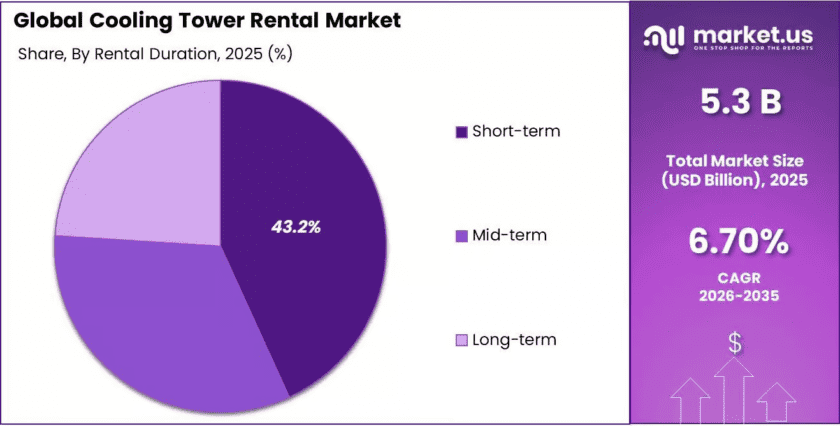
By tower type, Evaporative Cooling Towers dominated with a 64.34% share, while the 5 to 20 MW capacity segment accounted for 44.21%. Short-term rentals of less than six months represented 43.00%, reflecting demand for temporary cooling during industrial maintenance and unexpected equipment failures.
Oil and Gas led the application segment with a 29.67% share. Increasing investment in industrial infrastructure, power generation, chemical processing, and data centers is creating new opportunities for rental providers. Flexible equipment availability and reduced upfront investment are expected to support market expansion through 2035.
Key Takeaways
- Market Valuation: The global Cooling Tower Rental Market was valued at USD 1.4 billion in 2025.
- Market Forecast: The market is expected to reach USD 2.7 billion by 2035.
- Growth Rate: The market is projected to register a CAGR of 6.8% during 2026–2035.
- Dominating Region: North America led the global market with a 36.00% share, valued at approximately USD 0.5 billion.
- Leading Tower Type: Evaporative Cooling Towers accounted for 64.34% of the market.
- Leading Capacity Range: The 5 to 20 MW segment captured 44.21%.
- Leading Rental Duration: Short-term rentals of less than six months held a 43.00% share.
- Leading Application: Oil and Gas dominated the application segment with a 29.67% share.
Regional Analysis
North America – Dominating Region
North America dominated the Cooling Tower Rental Market in 2025, accounting for 36.00% of global revenue, equivalent to approximately USD 0.5 billion. The region benefits from established industrial infrastructure, extensive oil and gas operations, chemical processing facilities, and power generation capacity.
The United States is an important contributor because of its large refining and manufacturing industries. Rental cooling towers are used to support industrial facilities during scheduled maintenance, equipment replacement, unexpected breakdowns, and production expansion.
According to the U.S. Geological Survey, thermoelectric power generation withdrew approximately 59,889 million gallons of freshwater per day in 2020 across the lower 48 states. This demonstrates the substantial scale of water-dependent power generation operations that require reliable cooling infrastructure. Demand for temporary cooling equipment is also supported by the need to maintain operations while permanent systems undergo repairs or upgrades.
Market Dynamics of the Cooling Tower Rental Market
1. Driver: Increasing Industrial Demand for Temporary Cooling Solutions
Growing industrial activity is driving demand for temporary cooling equipment across oil and gas, chemical processing, power generation, and manufacturing. Cooling towers remove heat from industrial processes and help maintain stable operating conditions.
The U.S. Environmental Protection Agency identifies petroleum refineries, chemical manufacturing, primary metals, glass, and rubber production as important industrial users of process cooling towers. Rental systems allow these facilities to maintain cooling operations during planned maintenance, equipment breakdowns, and plant expansion. They also reduce the need for permanent capital investment when cooling requirements are temporary. This flexibility is supporting demand for mobile and modular cooling equipment.
2. Trend: Growing Focus on Water-Efficient Cooling Technologies
Water-efficient cooling technology is becoming an important trend in the rental market. Industrial operators are increasingly focusing on water treatment, automated chemical dosing, filtration, and controlled blowdown to manage operating costs. The U.S. Department of Energy recommends automated chemical feed systems for large cooling towers exceeding 100 tons.
These systems regulate chemical dosing according to makeup water flow or real-time water monitoring. The approach helps control scale, corrosion, and biological growth while reducing unnecessary chemical consumption. Rental providers adopting improved water-management equipment can offer customers better operational support and more efficient temporary cooling solutions.
3. Restraint: High Operating and Water Management Costs
High operating costs remain a challenge for cooling tower rental providers and customers. Temporary installations require transportation, equipment setup, pumps, piping, electricity, water supply, and regular maintenance. Water treatment also adds operational expenses because evaporation increases dissolved solids in circulating water, requiring controlled blowdown and makeup water.
The U.S. Department of Energy explains that higher cycles of concentration can reduce makeup water demand but must be carefully managed to prevent scale and corrosion. In addition, cooling towers require regular cleaning and disinfection to control biological growth. These requirements can increase rental costs and make temporary cooling less attractive for smaller facilities.
4. Opportunity: Expansion of Data Centers and Industrial Infrastructure
Expansion of data centers and industrial infrastructure is creating opportunities for cooling tower rental companies. Data centers require dependable heat-removal systems to maintain operating conditions for servers and supporting equipment. Industrial facilities also need temporary cooling during construction, commissioning, equipment replacement, and production expansion.
The U.S. Environmental Protection Agency identifies cooling towers as important equipment in several process industries, including petroleum refining and chemical manufacturing. Rental providers can benefit by offering modular systems, different capacity ranges, and flexible contract durations. Advanced water treatment, remote monitoring, and rapid equipment deployment can further improve service offerings and support demand from infrastructure-intensive industries.
Emerging Trends in the Cooling Tower Rental Market
1. Modular and Mobile Cooling Tower Systems
Modular cooling towers are gaining attention because they can be transported and installed according to temporary industrial requirements. The market’s 5 to 20 MW segment held 44.21% share in 2025, reflecting demand for substantial temporary cooling capacity.
2. Water-Efficient Cooling Technologies
Rental providers are adopting improved water treatment, filtration, and automated chemical dosing. The U.S. Department of Energy recommends automated chemical feed systems for cooling towers exceeding 100 tons to manage scale, corrosion, and biological growth.
3. Growing Demand for Short-Term Rentals
Short-term rental contracts are gaining importance among industrial operators requiring cooling during repairs and equipment failures. In 2025, rentals lasting less than six months accounted for 43.00% of the global market.
4. Advanced Water Quality Monitoring
Cooling tower operators are increasingly using automated monitoring to manage disinfectant levels, water temperature, and system cleanliness. CDC recommends operating outside the favorable Legionella growth range of 25–45°C, wherever possible.
5. Growing Demand from Data Centers
Data center expansion is creating demand for dependable temporary cooling infrastructure. Rental towers can support maintenance and additional cooling capacity. Closed-circuit cooling towers can also operate in dry mode under suitable conditions without water or aerosol generation.
Use Cases of Cooling Tower Rental Systems
1. Oil and Gas Refineries
Refineries rent cooling towers during maintenance, equipment replacement, and production expansion. The U.S. EPA estimates that a refinery processing 100,000 barrels of crude oil per day may use approximately 170 million gallons of cooling water daily.
2. Chemical and Petrochemical Plants
Chemical plants use rental cooling towers to remove heat from processing equipment, condensers, and heat exchangers. EPA identifies chemical manufacturing as a major cooling tower application. Temporary equipment helps maintain cooling during maintenance and industrial upgrades.
3. Power Generation Facilities
Power plants use cooling towers to remove heat and support steam condensation. USGS reports that thermoelectric power generation withdrew approximately 59,889 million gallons of freshwater daily in 2020 across the lower 48 states, highlighting the importance of cooling infrastructure.
4. Data Centers and Commercial HVAC
Data centers and commercial facilities use cooling towers to manage heat from chillers and other equipment. Rental systems can provide temporary cooling during maintenance or capacity expansion. DOE identifies cooling towers as important heat-rejection equipment for chillers and air-conditioning systems.
5. Industrial Maintenance and Emergency Cooling
Manufacturing facilities rent cooling towers during unexpected breakdowns and scheduled shutdowns. CDC recommends cooling tower cleaning and disinfection at least once annually. Rental systems can provide temporary cooling while permanent equipment undergoes inspection, cleaning, or repair.
Frequently Asked Questions on Cooling Tower Rental and Cooling Tower Rental Market
1. What is the Cooling Tower Rental Market?
The Cooling Tower Rental Market includes companies providing temporary cooling equipment to industrial and commercial facilities. These systems remove excess heat during maintenance, equipment replacement, emergency breakdowns, construction, and production expansion.
2. What is the global Cooling Tower Rental Market size in 2025?
The global Cooling Tower Rental Market was valued at approximately USD 1.4 billion in 2025. Demand is supported by industrial maintenance, temporary cooling requirements, and the need for flexible equipment without permanent capital investment.
3. What is the expected market size by 2035?
The market is projected to reach approximately USD 2.7 billion by 2035, registering a CAGR of 6.8% during 2026–2035. Industrial infrastructure expansion and temporary cooling requirements are supporting this growth outlook.
4. Which region dominates the Cooling Tower Rental Market?
North America dominated the global market in 2025, accounting for 36.00% of revenue, equivalent to approximately USD 0.5 billion. Its established oil and gas, manufacturing, chemical, and power generation industries support demand.
5. Which tower type holds the largest market share?
Evaporative Cooling Towers dominated the tower type segment with a 64.34% share in 2025. Their heat-removal performance and widespread industrial applications support demand across manufacturing, power generation, and process industries.
6. Which capacity range dominates the market?
The 5 to 20 MW capacity segment led the market with a 44.21% share in 2025. This capacity range serves industrial facilities requiring substantial temporary cooling during maintenance, expansion, and equipment replacement.
Conclusion
The Cooling Tower Rental Market is expected to maintain steady growth as industries increasingly require flexible and reliable cooling infrastructure. The market is projected to increase from USD 1.4 billion in 2025 to USD 2.7 billion by 2035, registering a CAGR of 6.8%. North America remains the leading regional market, supported by established oil and gas, chemical processing, and power generation industries.
Evaporative cooling towers, 5 to 20 MW capacity systems, and short-term rental contracts represent important market segments. Increasing data center investments, industrial modernization, and water-efficient technologies will create further opportunities for rental service providers.
Discuss your needs with our analyst
Please share your requirements with more details so our analyst can check if they can solve your problem(s)