Overview
New York, NY – Oct 05, 2026 – The Cut Flowers Market continues to expand as fresh flowers remain widely used for gifting, weddings, festivals, hospitality, corporate decoration, funerals, and household decoration. Roses, chrysanthemums, carnations, gerberas, lilies, and other flowers move through a highly connected supply chain involving growers, auctions, wholesalers, supermarkets, florists, online platforms, refrigerated transport, and last-mile delivery.
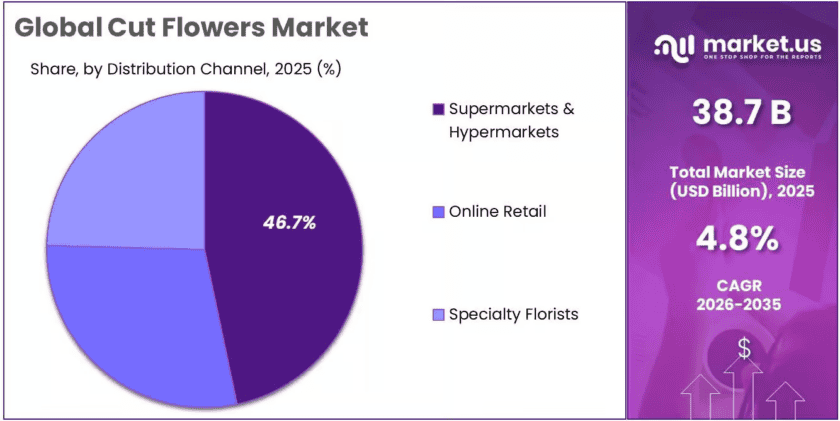
The global Cut Flowers Market is projected to reach USD 62.1 billion by 2035, increasing from USD 38.7 billion in 2025 at a 4.8% CAGR from 2026 to 2035.
Demand is supported by a large production and retail base. USDA reported U.S. floriculture sales of USD 8.41 billion in 2025 across 11,728 operations, while larger operations generated USD 389 million from cut flowers.
In 2025, Roses held 38.78% market share, Commercial applications accounted for 67.43%, and Supermarkets & Hypermarkets captured 46.78%. Europe led globally with 37.67% share and USD 14.5 billion in revenue.
Key Takeaways
- The global Cut Flowers Market was valued at USD 38.7 billion in 2025 and is expected to reach around USD 62.1 billion by 2035, expanding at a 4.8% CAGR.
- Rose held more than 38.78% share in 2025, supported by year-round demand across gifting, weddings, anniversaries, hospitality, celebrations, and event decoration.
- Commercial applications captured more than 67.43% share, reflecting recurring purchases from florists, hotels, restaurants, event organizers, offices, wedding businesses, and institutional buyers.
- Supermarkets & Hypermarkets accounted for more than 46.78% of distribution demand, supported by high customer traffic, convenient purchases, standardized bouquets, and regular product replenishment.
- Europe led the Cut Flowers Market with more than 37.67% share and USD 14.5 billion in revenue during 2025, supported by strong production, auction, trading, and logistics infrastructure.
- USDA reported USD 8.41 billion in U.S. floriculture sales during 2025, with 11,728 floriculture operations supporting domestic production and distribution.
Regional Analysis
Europe Leads with 37.67% Share and USD 14.5 Billion Market Value
In 2025, Europe held a dominant position in the Cut Flowers Market, capturing more than 37.67% share and generating approximately USD 14.5 billion in revenue.
Europe benefits from established flower auctions, greenhouse production, refrigerated distribution, extensive supermarket networks, specialist florists, and strong international trade. The Netherlands remains a major hub for European flower distribution. Statistics Netherlands reported that Dutch exports of flowers and plants reached €15.3 billion in 2025, while export value increased 5.3% and volume rose 4% from the previous year.
The United Kingdom also shows strong imported-flower demand. Government statistics reported cut-flower imports worth £680 million in 2025, up from £636 million in 2024, while exports increased from £23 million to £35 million.
Europe also receives significant flower supplies from Africa. Kenya exported 32,463.44 metric tonnes of flowers during April–June 2025, generating about KES 25.49 billion.
Market Dynamics
Driver – Strong Gifting, Event, and Commercial Demand
Gifting, celebrations, weddings, hospitality, and commercial decoration continue to drive cut-flower demand. Roses alone represented more than 38.78% of the market in 2025, while Commercial applications accounted for 67.43%. USDA reported USD 8.41 billion in U.S. floriculture sales during 2025 across 11,728 operations, showing the scale of consumer and business demand.
Operations generating at least USD 100,000 annually recorded USD 389 million in cut-flower sales. Weddings, birthdays, anniversaries, corporate events, hospitality decoration, funerals, and seasonal gifting create recurring demand throughout the year and encourage growers and retailers to maintain diverse flower assortments.
Trend – International Flower Trade and Centralized Distribution
International trade is becoming increasingly important because major consumer markets depend on flowers grown in different climates. Statistics Netherlands reported €15.3 billion in Dutch flower and plant exports in 2025, with export value rising 5.3% and volume increasing 4%. The UK imported £680 million of cut flowers in 2025, compared with £636 million in 2024.
Kenya’s flower exports reached 32,463.44 tonnes during April–June 2025 and represented 50% of national horticultural export value during the quarter. These flows support auctions, cold storage, refrigerated transport, supermarkets, wholesalers, and specialist florists.
Restraint – High Production, Energy, and Logistics Costs
Perishability and rising operating costs remain major restraints for cut-flower businesses. Flowers require careful temperature, humidity, packaging, storage, and transportation management from farm to consumer. UK government statistics reported that ornamental production value declined 2.0% to £1.616 billion in 2025, while flowers and bulbs dropped 7.5% to £158 million.
Authorities linked conditions to higher labour, energy, fuel, transport, plant-protection, and other input costs. Long-distance flower supply chains also depend heavily on refrigerated handling and fast transportation. Delays, temperature variation, spoilage, and freight costs can reduce product quality and margins because unsold flowers have a short commercial life.
Opportunity – Online Sales and Broader Consumer Access
Digital ordering provides an opportunity to reach consumers beyond traditional flower shops. Online platforms can combine bouquet selection, payment, personalized messages, scheduled delivery, subscriptions, and event reminders. Meanwhile, supermarkets remain the largest distribution segment, accounting for more than 46.78% of the Cut Flowers Market in 2025.
A broader production base also supports new channels. USDA counted 11,728 U.S. floriculture operations in 2025, including 8,478 operations with hired workers, up 13% from 2024. Connecting growers with digital marketplaces, supermarkets, local florists, subscription services, and same-day delivery can create additional sales opportunities.
Emerging Trends
1. Growth of Cross-Border Flower Trade
European flower trade continues to expand. Dutch flowers and plants reached an export value of €15.3 billion in 2025, while export volume increased 4%, highlighting the growing role of international production and centralized distribution networks.
2. Stronger Supermarket Flower Sales
Supermarkets and hypermarkets accounted for more than 46.78% of Cut Flowers Market distribution in 2025. Convenient grocery-store purchases, standardized bouquets, frequent replenishment, and refrigerated retail infrastructure continue to strengthen this channel.
3. Expansion of Domestic Flower Production
USDA reported that about 10,800 commercial farms produced cut flowers and florist greens in 2022, over 50% more than in 2017. Open-field flower production also exceeded 31,000 acres, increasing 33%.
4. Increasing African Export Supply
Kenya’s flower exports reached 32,463.44 metric tonnes during April–June 2025, compared with 24,408.63 tonnes one year earlier. Flowers generated about KES 25.49 billion, showing Africa’s growing importance in international flower supply.
5. Growing Protected Cultivation
Protected flower cultivation supports year-round quality and production. USDA reported more than 158 million square feet of protected flower and green production in the United States during 2022, demonstrating the scale of greenhouse and controlled-environment cultivation.
Use Cases
1. Weddings and Event Decoration
Cut flowers are heavily used for weddings, receptions, corporate events, and celebrations. Commercial applications accounted for more than 67.43% of market demand in 2025, reflecting recurring professional purchases for venues, hotels, planners, restaurants, and decorators.
2. Personal Gifting
Flowers remain popular gifts for birthdays, anniversaries, Valentine’s Day, Mother’s Day, congratulations, and other occasions. Roses captured more than 38.78% of the market in 2025, showing their strong position across emotional and occasion-based gifting.
3. Supermarket Bouquet Sales
Supermarkets sell ready-made bouquets alongside everyday grocery purchases. This channel accounted for more than 46.78% of global market distribution in 2025, reflecting the convenience of impulse purchases, accessible locations, regular replenishment, and standardized flower assortments.
4. Hospitality and Commercial Decoration
Hotels, restaurants, offices, luxury stores, and event venues use fresh flowers to improve interior presentation. Commercial applications represented more than 67.43% of Cut Flowers Market demand in 2025, making professional decoration an important recurring application.
5. International Flower Distribution
Cut flowers move rapidly between producing and consuming countries. The UK imported £680 million of cut flowers in 2025, while Kenya exported 32,463.44 tonnes during April–June 2025, demonstrating the importance of refrigerated cross-border distribution.
Frequently Asked Questions on Cut Flowers and Cut Flowers Market
What are Cut Flowers?
Cut flowers are blooms harvested from plants for bouquets, decoration, gifting, events, ceremonies, hospitality, and household use. Common commercial varieties include roses, chrysanthemums, carnations, gerberas, lilies, tulips, and several seasonal or specialty flowers.
How large is the Cut Flowers Market?
The global Cut Flowers Market was valued at approximately USD 38.7 billion in 2025 and is projected to reach around USD 62.1 billion by 2035, expanding at a 4.8% CAGR.
Which flower type dominates the Cut Flowers Market?
Roses held the dominant market position in 2025, accounting for more than 38.78% share. Their leadership reflects widespread use in weddings, anniversaries, romantic gifting, celebrations, hospitality arrangements, and other commercial floral applications.
Which application dominates the Cut Flowers Market?
Commercial applications accounted for more than 67.43% share in 2025. Demand comes from florists, event companies, hotels, restaurants, offices, wedding businesses, hospitality establishments, and institutions requiring fresh flowers and regularly replaced arrangements.
Which distribution channel leads the Cut Flowers Market?
Supermarkets and Hypermarkets held more than 46.78% market share in 2025. Their leadership is supported by convenient locations, strong customer traffic, ready-made bouquets, competitive pricing, regular replenishment, and access alongside normal grocery shopping.
Which region leads the Cut Flowers Market?
Europe dominated the Cut Flowers Market in 2025 with more than 37.67% share and USD 14.5 billion in revenue, supported by strong consumption, Dutch trading infrastructure, flower auctions, refrigerated logistics, greenhouse production, and imports.
Why is Europe important in the global flower trade?
Europe combines strong consumption with major trading infrastructure. Statistics Netherlands reported Dutch flower and plant exports worth €15.3 billion in 2025, while the United Kingdom imported £680 million of cut flowers during the year.
Why are roses so important in the Cut Flowers Market?
Roses work across many occasions, including weddings, anniversaries, birthdays, Valentine’s Day, luxury events, and everyday gifting. Their broad color range, established cultivation, strong consumer recognition, and year-round availability support sustained commercial demand.
What factors limit growth in the Cut Flowers Market?
Major challenges include short shelf life, airfreight costs, refrigeration requirements, energy prices, labor costs, crop disease, weather risks, packaging costs, and product waste. Temperature or transportation problems can quickly reduce flower quality and selling time.
What is creating future opportunities for Cut Flowers?
Future opportunities include online gifting, flower subscriptions, sustainable packaging, locally grown flowers, controlled-environment production, improved cold chains, supermarket bouquets, premium varieties, and direct grower-to-consumer sales supported by digital ordering and scheduled delivery.
Conclusion
The Cut Flowers Market is expected to grow steadily as gifting, events, hospitality, supermarket sales, and international flower trade support recurring demand. The market is projected to rise from USD 38.7 billion in 2025 to USD 62.1 billion by 2035 at a 4.8% CAGR.
Roses lead with 38.78% share, Commercial applications hold 67.43%, and Supermarkets & Hypermarkets account for 46.78%. Europe remains the leading region with 37.67% share and USD 14.5 billion revenue. Future growth will be supported by digital gifting, international trade, greenhouse technology, cold-chain improvements, and wider retail access.
Discuss your needs with our analyst
Please share your requirements with more details so our analyst can check if they can solve your problem(s)