Overview
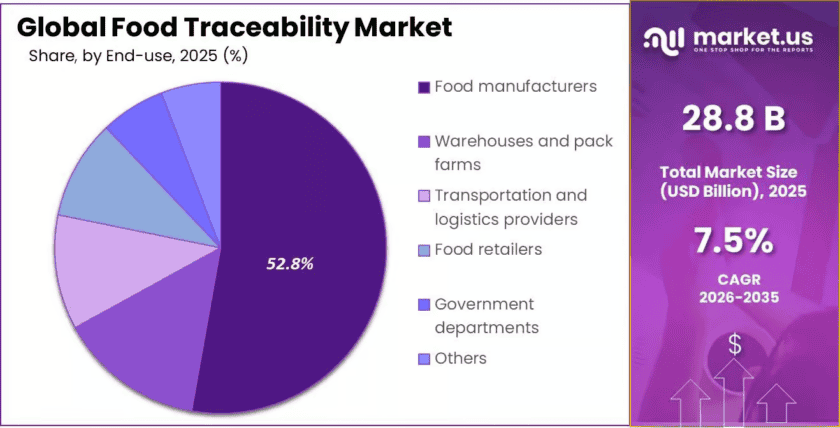
New York, NY – Oct 06, 2026 – The global Food Traceability Market is gaining importance as food manufacturers, processors, retailers, logistics companies, and regulators seek faster ways to identify products across increasingly complex supply chains. The market was valued at USD 28.8 billion in 2025 and is projected to reach approximately USD 59.5 billion by 2035, expanding at a 7.5% CAGR during 2026–2035.
Food traceability systems link information such as product origin, batch numbers, processing activities, storage locations, shipment movements, and delivery records. Digital systems using barcodes, RFID, software platforms, QR codes, sensors, and cloud databases are helping companies improve visibility from production through retail.
Regulatory pressure is also encouraging wider adoption. The U.S. FDA Food Traceability Rule requires covered businesses handling products on the Food Traceability List to maintain Key Data Elements linked to Critical Tracking Events and provide requested traceability information to FDA within 24 hours.
The growing economic burden of foodborne illness further supports investment. USDA estimated foodborne illnesses cost the United States approximately USD 74.7 billion in 2023 dollars, strengthening demand for systems that enable faster investigations, targeted recalls, improved supplier control, and reliable lot-level tracking.
Key Takeaways
- The global Food Traceability Market was valued at USD 28.8 billion in 2025 and is expected to reach USD 59.5 billion by 2035, growing at a 7.5% CAGR.
- By technology, Barcode systems led the market in 2025 with more than a 44.80% share, supported by their simple identification and widespread supply-chain use.
- By equipment, Tags and Labels held more than a 42.00% share in 2025.
- By component, Software dominated with more than a 49.60% share, reflecting growing adoption of digital records and supply-chain visibility platforms.
- By application, Livestock accounted for more than a 34.00% share during 2025.
- By end user, Food Manufacturers captured more than a 52.80% share, supported by increasing requirements for production, batch, supplier, and recall records.
- North America remained the leading regional market with more than a 35.90% share, representing approximately USD 10.3 billion in 2025.
Regional Analysis
North America Leads with 35.90% Market Share and USD 10.3 Billion Revenue
In 2025, North America held a dominant position in the Food Traceability Market, accounting for more than a 35.90% share and generating approximately USD 10.3 billion in revenue. The region benefits from established food processing infrastructure, large retail and distribution networks, and increasing use of digital product identification systems.
Regulation is an important factor behind adoption. The U.S. FDA Food Traceability Rule requires covered businesses to connect Key Data Elements with Critical Tracking Events and maintain lot-level information for designated foods. Requested records must generally be supplied to FDA within 24 hours.
The implementation timeline has also created a longer technology investment window. The original compliance date was January 20, 2026, while Congress directed FDA not to enforce the rule before July 20, 2028.
Market Dynamics
Driver – Rising Food-Safety and Recall Requirements
Growing pressure to identify unsafe food quickly is a major driver for food traceability systems. In the United States, USDA estimated about 47.78 million foodborne illness cases with an economic cost of approximately USD 74.7 billion in 2023 dollars. Illnesses linked to 31 major pathogens alone represented nearly USD 44.74 billion in costs.
These figures make rapid source identification increasingly valuable for manufacturers and regulators. FDA rules also require traceability information for specific foods to be linked to Critical Tracking Events and made available within 24 hours when requested, encouraging investment in digital tracking infrastructure.
Trend – Movement Toward Lot-Level Digital Records
Lot-level digital tracking is becoming a stronger industry trend as companies replace disconnected paper records with databases, machine-readable identifiers, QR codes, and standardized electronic information. FDA requires Traceability Lot Codes to remain linked with relevant Key Data Elements as food passes through covered Critical Tracking Events.
The agency held a dedicated public meeting on June 15, 2026, focused on lot-level food traceability and implementation challenges. At the same time, the Food Traceability Market’s software segment captured more than 49.60% of the market in 2025, highlighting the growing commercial importance of digital record management.
Restraint – Supply-Chain Coordination and Implementation Cost
The main restraint is the difficulty of connecting data across farms, processors, distributors, logistics providers, retailers, and foreign suppliers using different systems. FDA originally established January 20, 2026 as the compliance date but proposed a 30-month extension to July 20, 2028, reflecting implementation concerns across the supply chain.
FDA’s economic analysis estimated the extension could generate annualized cost savings with a primary estimate of about USD 54 million using a 3% discount rate. Smaller suppliers may particularly face challenges related to software integration, data quality, training, and standardized information exchange.
Opportunity – Automated Traceability and Waste Reduction
Digital traceability creates opportunities beyond regulatory compliance by improving inventory control, shelf-life management, cold-chain monitoring, and waste reduction. FAO estimated that approximately 13.3% of food was lost globally between post-harvest and retail stages in 2023, compared with 13.0% in 2015.
Better visibility into production dates, shipment status, storage conditions, and product location can help businesses identify losses earlier. At the same time, the global Food Traceability Market is projected to increase from USD 28.8 billion in 2025 to approximately USD 59.5 billion by 2035, creating room for cloud platforms, sensor integration, automated alerts, and interoperable data services.
Emerging Trends
1. Lot-Level Digital Tracking
Lot-level traceability is becoming more important across food supply chains. FDA requires traceability lot codes to remain connected to relevant Key Data Elements. Its Food Traceability Rule includes 7 major Critical Tracking Event categories, covering activities from harvesting and cooling through shipping, receiving, and transformation.
2. Rapid Regulatory Data Retrieval
Food companies are investing in systems that can retrieve supply-chain records quickly during investigations. FDA requires covered firms to provide specified traceability information within 24 hours of a request, increasing demand for searchable digital databases instead of fragmented paper-based records.
3. Growth of Software-Based Traceability
Software is becoming central to connecting production, shipment, supplier, and lot information. In 2025, software accounted for more than 49.60% of the Food Traceability Market, reflecting increased use of digital platforms to manage records and communicate traceability information.
4. QR Codes and Machine-Readable Identification
Machine-readable product identification continues to expand. FDA permits Traceability Lot Code information to be communicated through records and can allow information to be embedded within QR codes, supporting faster transfer of lot information between supply-chain partners.
5. Traceability Supporting Food-Loss Reduction
Traceability is increasingly being linked with better inventory and loss management. FAO estimated 13.3% of food was lost globally before the retail stage in 2023, compared with 13.0% in 2015, increasing interest in improved supply-chain visibility.
Use Cases
1. Faster Food Recall Management
Traceability systems help companies determine which lots, facilities, and customers are involved when contamination occurs. USDA estimated 47.78 million U.S. foodborne illness cases in its latest cost assessment, creating strong incentives for faster identification and targeted product removal.
2. Supplier and Shipment Verification
Manufacturers can record suppliers, shipping dates, product quantities, lot codes, and receiving locations to verify product movement. FDA’s receiving requirements contain multiple Key Data Elements, including quantity, product description, receipt date, previous source, and Traceability Lot Code information.
3. Tracking Fresh Produce
Fresh produce supply chains use traceability to connect harvesting, packing, shipping, and receiving information. In the EU, fruits and vegetables accounted for 1,057 RASFF notifications during 2025 out of 5,344 total RASFF notifications, showing the importance of identifying product origin quickly.
4. Tracking Seafood and Animal Products
Traceability systems help connect seafood and livestock products with processing and distribution records. FDA’s framework specifically includes first land-based receiving of food from fishing vessels as a Critical Tracking Event, while livestock represented more than 34.00% of Food Traceability Market applications in 2025.
5. Inventory and Food-Loss Management
Digital records can help identify products nearing expiry and improve stock rotation across warehouses and distribution centers. This is increasingly relevant because FAO estimated global food losses at approximately 13.3% between post-harvest and retail stages during 2023.
Frequently Asked Questions on Food Traceability and Food Traceability Market
What is food traceability?
Food traceability is the ability to track food, ingredients, and related information through production, processing, transportation, storage, and distribution. It helps businesses identify product origins, suppliers, batches, destinations, and potentially affected lots during food-safety investigations.
How large was the Food Traceability Market in 2025?
The global Food Traceability Market was valued at approximately USD 28.8 billion in 2025. It is projected to reach around USD 59.5 billion by 2035, representing a forecast 7.5% CAGR.
Which technology leads the Food Traceability Market?
Barcode technology led the Food Traceability Market in 2025, holding more than a 44.80% share. Barcodes remain widely used because they provide a simple way to connect physical products with batch, shipment, production, and inventory records.
Which component dominates the Food Traceability Market?
Software was the leading component in 2025 and accounted for more than a 49.60% share. Software platforms support centralized record management, supplier information exchange, lot-level searches, compliance documentation, recall management, and supply-chain visibility.
Which equipment category has the largest market share?
Tags and labels held the dominant position in the equipment segment during 2025, accounting for more than a 42.00% share. These tools connect physical products, cartons, pallets, and logistics units with digital traceability records.
Which end user leads the Food Traceability Market?
Food manufacturers held the leading end-user position in 2025 with more than a 52.80% share. Manufacturers depend heavily on traceability to manage raw materials, production lots, supplier records, quality controls, shipments, and recall investigations.
Which region dominates the Food Traceability Market?
North America led the global Food Traceability Market in 2025, accounting for more than a 35.90% share and approximately USD 10.3 billion in revenue, supported by digital adoption and strong food-safety regulation.
Why is food traceability becoming more important?
Food traceability is increasingly important because supply chains are more complex and regulators expect faster identification of contaminated products. USDA estimated foodborne illness costs in the United States at approximately USD 74.7 billion.
What does the FDA Food Traceability Rule require?
The FDA rule requires covered entities handling designated foods to maintain Key Data Elements connected with Critical Tracking Events. When requested, relevant traceability information generally must be supplied to FDA within 24 hours.
What is the future opportunity in food traceability?
Growth opportunities include cloud-based traceability platforms, RFID, QR codes, IoT sensors, automated recalls, cold-chain monitoring, and standardized data exchange. The market is forecast to reach USD 59.5 billion by 2035, indicating continued digital investment.
Conclusion
The Food Traceability Market is moving toward more connected, digital, and lot-level supply-chain management. Valued at USD 28.8 billion in 2025, the market is expected to reach approximately USD 59.5 billion by 2035, supported by a 7.5% CAGR. Regulatory requirements, food-safety concerns, and costly foodborne illnesses are encouraging manufacturers, retailers, and logistics providers to improve product visibility.
Technologies such as barcodes, QR codes, RFID, sensors, and software platforms will play a larger role in linking supply-chain records. Stronger traceability can ultimately support faster recalls, improved supplier control, reduced food loss, and safer global food distribution.
Discuss your needs with our analyst
Please share your requirements with more details so our analyst can check if they can solve your problem(s)