Overview
The Global Powder Metallurgy Market was valued at US$3.1 billion in 2025 and is expected to grow at a CAGR of 12.6% between 2026 and 2035, reaching approximately US$15.2 billion by 2035. In 2025, North America held the leading market position, accounting for more than 35.2% of the global market and generating USD 1.09 billion in revenue. Powder metallurgy is an essential part of the advanced manufacturing value chain, enabling the efficient production of precision-engineered metal components through the compaction and sintering of metal powders.
According to the Metal Powder Industries Federation (MPIF, 2025), powder metallurgy converts more than 97% of the starting raw material into finished components, substantially lowering scrap generation compared with machining-intensive manufacturing methods. Likewise, the European Powder Metallurgy Association (EPMA, 2025) reported that, when manufacturing truck-transmission components, the powder metallurgy process consumed only around 43% of the energy required for conventional forging and machining. These material and energy efficiencies continue to reinforce the process as a preferred manufacturing solution for high-volume automotive and industrial component production.
According to the Japan Powder Metallurgy Association, the average weight of sintered components used per vehicle reached 14.8 kilograms in the United States and 8.4 kilograms in Europe during 2024, highlighting the growing importance of powder metallurgy components in modern vehicle systems and precision mechanical assemblies.
According to the American Metal Powder Industries Federation, approximately 70% of iron powder shipments in North America are utilized by the passenger vehicle segment, underscoring the strong integration of powder metallurgy within automotive manufacturing supply chains.
Key Takeaways
- The global powder metallurgy market was valued at USD 3.1 billion in 2025.
- The market is projected to grow at a CAGR of 12.6% and is estimated to reach USD 15.2 billion by 2035.
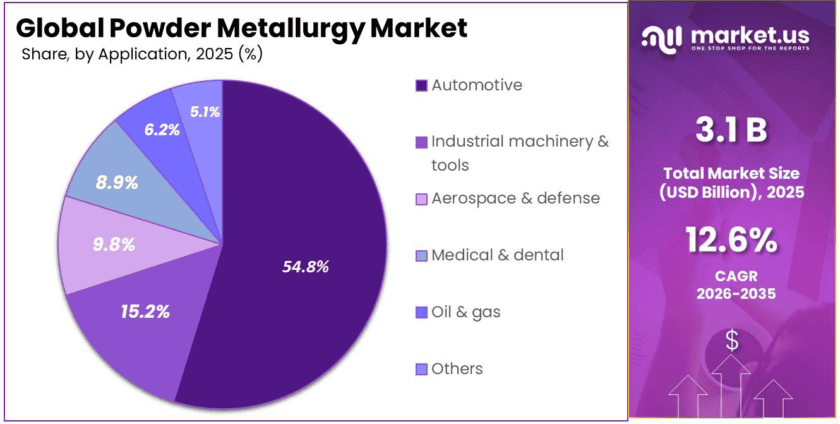
- On the basis of application, the automotive segment dominated the market, constituting 54.8% of the total market share.
- Based on the process, press and sinter dominated the powder metallurgy market, with a substantial market share of around 44.2%.
- Based on the material type, ferrous materials led the market, comprising 74.7% of the total market.
- In 2025, North America was the most dominant region in the powder metallurgy market, accounting for 35.2% of the total global consumption.
Application Analysis
Automotive Represents the Dominant Segment in the Market
The Automotive segment accounted for the largest share of the global powder metallurgy market, capturing 54.8% of total revenue. Its dominance is driven by the widespread use of powder metallurgy in manufacturing thousands of precision-engineered metal components required for modern vehicles. Components such as gears, bearings, bushings, connecting rods, and valve seat inserts are produced efficiently through powder metallurgy, offering superior production consistency, lower material waste, and cost-effective high-volume manufacturing compared with many conventional processes.
Process Analysis
Press & Sinter Represents the Dominant Segment in the Market
The Press & Sinter process led the global powder metallurgy market with a 44.2% share, maintaining its position as the industry’s most established and widely adopted manufacturing method. Its leadership is supported by proven reliability, production scalability, and cost efficiency, making it the preferred solution for high-volume manufacturing across automotive, industrial, and consumer product applications.
Material Type Analysis
Ferrous Materials Represent the Dominant Segment in the Market
Ferrous Materials dominated the powder metallurgy market with a 74.7% share, supported by their cost-effectiveness, broad availability, and reliable performance across a wide range of applications. Iron and steel powders remain the preferred material choice because they are produced on a massive global scale, offer lower costs than non-ferrous alternatives, and are compatible with virtually all major powder metallurgy manufacturing processes. These advantages make them the primary material for automotive, industrial machinery, and general engineering applications.
Key Market Segments
By Application
- Automotive
- Industrial machinery & tools
- Aerospace & defense
- Medical & dental
- Oil & gas
- Others
By Process
- Press & sinter
- Metal injection molding (MIM)
- Additive manufacturing
- Hot isostatic pressing (HIP)
By Material Type
- Ferrous materials
- Non‑ferrous materials
Emerging Trends
Automotive Production Trends Continue to Shape Ferrous Powder Demand
Vehicle manufacturing volumes remain the primary swing factor for conventional press-and-sinter powder metallurgy, since sintered gears, bearings, and structural parts are concentrated in passenger and commercial vehicle platforms. According to the European Automobile Manufacturers’ Association (ACEA), global car manufacturing totalled 75.5 million units in 2024, while China further solidified its position as the world’s largest car producer with a 35.4% market share after a 5.2% production increase that year.
North American Metal Powder Shipments Stabilize, With MIM and Additive Manufacturing Outpacing Conventional Ferrous Powder
Industry reporting on data presented by the Metal Powder Industries Federation (MPIF) at the WorldPM2026 congress shows total estimated 2025 North American metal powder shipments held nearly flat, rising 0.6% to 327,379 metric tons. Within that total, iron and steel powder — the material base for conventional press-and-sinter production — declined 1.6% to 268,880 metric tons, while aluminum powder shipments rose 12.1% to 29,478 metric tons, reflecting inventory correction rather than pure demand growth.
Tungsten Supply Concentration Remains a Structural Risk for Hard-Material Powder Metallurgy
Supply-side concentration in refractory metal powders continues to be a defining trend for the hard-material segment of powder metallurgy, particularly tungsten carbide used in cutting tools, wear parts, and defense components. According to the U.S. Geological Survey (USGS), tungsten sits on the agency’s 2018 and 2022 critical mineral lists in large part because China produces almost 83% of the world’s mined tungsten, representing one of the highest production concentrations of any strategic metal.
Use Cases
Orthopedic and Dental Implants Represent a High-Value, Fast-Growing Application
Powder metallurgy and metal injection molding are central to the production of titanium and cobalt-chromium components used in joint replacement surgery, where dimensional precision and biocompatibility are non-negotiable requirements. According to the American Academy of Orthopaedic Surgeons (AAOS), the American Joint Replacement Registry (AJRR) surpassed 4 million captured hip and knee arthroplasty procedures in its database as of March 2024, with the 2024 Annual Report analyzing more than 3.7 million of those procedures submitted by 1,447 institutions across all 50 states and the District of Columbia — marking 18% growth in procedures from the prior year. Ambulatory surgery centers alone reported 62,110 procedural cases, a 70% increase since 2022, while approximately 92% of patients are now discharged home rather than to a skilled nursing facility following elective primary hip replacement.
Aerospace Engine Components Demonstrate Powder-Based Manufacturing at Production Scale
Metal powder-based additive manufacturing has moved beyond prototyping into full-rate aerospace production, most visibly in jet engine fuel nozzles built up layer by layer from fine metal powder rather than machined from solid stock. GE Aerospace reports that its Auburn, Alabama facility — the industry’s first mass-manufacturing site for additively produced aircraft engine parts — began production in 2015 and had shipped its 30,000th 3D-printed fuel nozzle tip by October 2018, using more than 40 metal powder printers and employing 230 workers, with staffing projected to reach 300 by 2019. The additive process consolidated a component previously assembled from about 20 separate welded and brazed pieces into a single printed part, cutting its weight by roughly 25%, and supports the CFM LEAP engine, for which total orders and commitments exceeded 16,300 engines, each fitted with 18 or 19 fuel nozzles depending on the model.
Electric Vehicle Traction Motors Are Emerging as a Structural Growth Application for Soft Magnetic Powder Components
Pressed and sintered soft magnetic composites, made from insulated iron powder particles, are gaining traction as automakers push electric traction motors toward higher speeds and power densities without relying on heavy rare-earth magnets. Research funded by the U.S. Department of Energy’s Vehicle Technologies Office, conducted at Sandia National Laboratories, notes that industry roadmap targets for 2025 call for traction motors to reach 100 kW of peak power, 50 kW/L of specific power, and a cost of 3.3 dollars per kW, while operating at speeds of 20,000 rpm or higher — conditions under which conventional silicon steel laminations lose efficiency to eddy current losses. Soft magnetic composite powder materials are reported to achieve electrical resistivity values between 10⁻³ and 10⁻¹ microohm-meters, versus roughly 0.05 microohm-meters for standard 3% silicon steel, a property that suppresses eddy currents at high rotational speeds.
Frequently Asked Questions
What is powder metallurgy?
Powder metallurgy is a manufacturing process that transforms fine metal powders into solid parts through compaction and heating, known as sintering, rather than melting and casting. It produces precise, near-net-shape components with minimal material waste, making it popular across automotive, aerospace, and industrial manufacturing sectors.
How does the powder metallurgy process work?
The process begins with blending metal powders, compacting them under high pressure into a die-shaped form, and then sintering the compact at temperatures below the metal’s melting point. This bonds particles together, creating a dense, strong component ready for secondary finishing or direct use.
What materials are commonly used in powder metallurgy?
Iron and steel powders dominate due to automotive demand, while copper, aluminum, stainless steel, titanium, nickel, and tungsten powders serve specialized applications. Material choice depends on required strength, corrosion resistance, magnetic properties, or biocompatibility, particularly for medical and aerospace components.
What is metal injection molding, and how does it relate to powder metallurgy?
Metal injection molding, or MIM, combines fine metal powder with a polymer binder, injects it into a mold like plastic, then removes the binder and sinters the part. It enables complex, small, high-precision components unsuited to conventional pressing methods.
What is metal additive manufacturing’s role in powder metallurgy?
Metal additive manufacturing, or metal 3D printing, builds parts layer by layer directly from metal powder using lasers or electron beams. It complements traditional powder metallurgy by enabling complex geometries, rapid prototyping, and low-volume production runs previously impossible.
Which industries rely most heavily on powder metallurgy?
Automotive remains the largest consumer, using sintered components in engines, transmissions, and structural parts. Aerospace, medical devices, electronics, defense, and industrial machinery also depend heavily on powder metallurgy for precision parts, lightweight components, and biocompatible implants.
Why is powder metallurgy considered environmentally friendly?
The process generates minimal scrap since parts form directly to near-final shape, unlike machining, which removes significant material. It also consumes less energy than melting and casting, supporting circular manufacturing principles through efficient material and energy utilization.
What factors are driving growth in the powder metallurgy market?
Rising vehicle production, expanding electric vehicle drivetrains, growing medical implant demand, and increasing adoption of metal additive manufacturing across aerospace and defense are the primary growth drivers, alongside continued cost and material-efficiency advantages over conventional manufacturing.
What challenges does the powder metallurgy market currently face?
Raw material supply concentration, particularly for tungsten and rare-earth-dependent alloys, creates pricing volatility and sourcing risk. Tariff uncertainty, labor shortages, and competition from alternative manufacturing technologies also pressure margins across conventional and advanced powder metallurgy segments.
Is powder metallurgy expected to remain relevant amid additive manufacturing’s rise?
Yes, conventional press-and-sinter powder metallurgy remains cost-effective for high-volume parts, while additive manufacturing serves complex, low-volume, or prototype applications. The two approaches increasingly coexist, addressing different production scales and design requirements within the same industry.
Conclusion
Powder metallurgy is settling into a period of steady, application-led growth rather than uniform expansion across every end market. The automotive sector remains the anchor demand base, with global car manufacturing at 75.5 million units in 2024 and continued reliance on sintered gears, bearings, and structural parts, even as regional output diverges between resilient Asia-Pacific volumes and softer European and North American production.
Discuss your needs with our analyst
Please share your requirements with more details so our analyst can check if they can solve your problem(s)