Report Overview
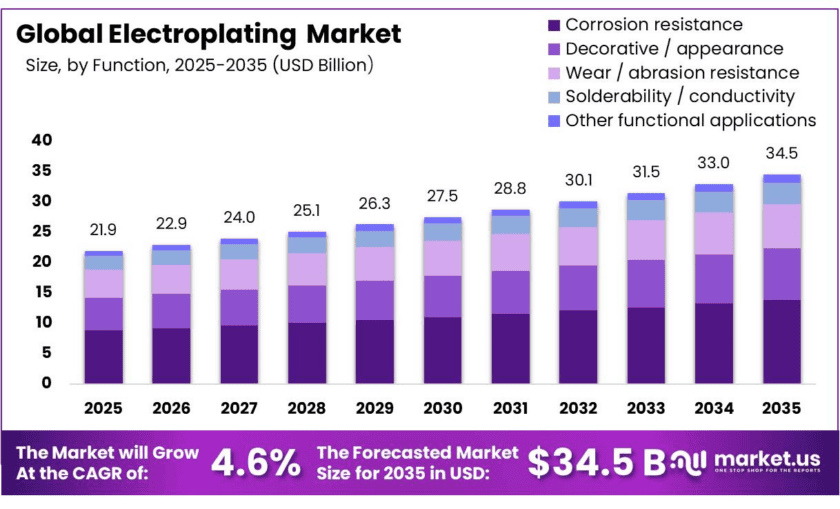
The Electroplating Market was valued at USD 21.9 billion in 2025 and is projected to expand at a CAGR of 4.6% between 2026 and 2035, reaching approximately USD 34.5 billion by 2035. Asia Pacific dominated the global market in 2025, accounting for more than 44.8% of the total market share and generating USD 9.82 billion in revenue.
Electroplating is an advanced surface treatment process that deposits a thin metallic coating onto another material through an electrochemical reaction powered by an electric current. This process enhances both functional and aesthetic characteristics of components by improving corrosion resistance, electrical conductivity, surface appearance, durability, and wear resistance. Commonly used plating materials include nickel, zinc, copper, chromium, gold, and silver, with each metal offering specific advantages depending on the intended application.
According to the International Energy Agency (IEA), Global EV Outlook 2025, global electric vehicle sales are expected to surpass 20 million units in 2025, reflecting more than 25% growth compared with 2024. The rapid adoption of electric vehicles is increasing demand for electroplated components such as battery terminals, electrical connectors, charging system parts, and precision metal components that require enhanced performance and reliability.
The importance of electroplating in modern manufacturing is supported by its flexibility, durability, and economic efficiency. The technology can be applied to various metal substrates and serves critical applications across industries including automotive, electronics, aerospace, medical devices, industrial machinery, and consumer goods. By improving component performance while maintaining suitability for high-volume production, electroplating has remained a fundamental manufacturing process for nearly two centuries and continues to support industrial advancement.
The aerospace industry is also contributing to market expansion. According to the International Air Transport Association (IATA), 2025, global passenger demand measured in revenue passenger kilometers (RPK) increased by 5.3% in 2025, while international passenger traffic grew by 7.1% compared with 2024. Increasing air travel activity is supporting aircraft production and maintenance requirements, boosting demand for electroplated fasteners, landing gear components, electrical connectors, and engine parts that require superior corrosion resistance and durability.
The growth of the Electroplating Market is supported by the expansion of high-value manufacturing sectors, rising demand for corrosion-resistant and high-performance components, and ongoing developments in precision engineering. Increasing production of consumer electronics, electric vehicles (EVs), semiconductors, aerospace equipment, and medical devices is creating significant demand for electroplated components that provide enhanced conductivity, strength, and long-term reliability.
According to the Semiconductor Industry Association (SIA), global semiconductor sales reached a record USD 795.6 billion in 2025, registering a 26.2% increase compared with 2024. This semiconductor industry growth is strengthening demand for electroplating materials such as copper, nickel, gold, silver, and palladium, which are extensively used in semiconductor chips, printed circuit boards (PCBs), electrical contacts, and advanced packaging technologies.
Furthermore, industries are increasingly adopting environmentally sustainable plating chemicals, low-emission production methods, and resource-efficient technologies to comply with evolving environmental regulations. These advancements are creating opportunities for innovation, improved process efficiency, and expanded production capabilities. As manufacturing systems become increasingly technology-driven and performance standards continue to rise, electroplating remains a vital process for producing reliable, durable, and high-performance components across diverse end-use industries.
Key Market Segmentation
- The global electroplating market was valued at USD 21.9 billion in 2025.
- The market is projected to grow at a CAGR of 4.6% and is estimated to reach USD 34.5 billion by 2035.
- On the basis of material type, nickel dominated the market, constituting 30.2% of the total market share.
- Based on the function, corrosion resistance dominated the electroplating market, with a substantial market share of around 40.1%.
- Based on the end-use industry, electrical and electronics led the market, comprising 30.1% of the total market.
- In 2025, Asia-Pacific was the most dominant region in the electroplating market, accounting for 44.8% of the total global consumption.
Material Type Analysis
Nickel Represents the Dominant Segment in the Market
Nickel dominates the electroplating material segment with a 30.2% market share, supported by its exceptional combination of performance characteristics and extensive industrial applications. Nickel plating provides excellent corrosion resistance, hardness, and surface uniformity, making it a preferred solution for automotive components, electronic connectors, industrial parts, and consumer products where durability, reliability, and appearance are critical requirements.
Nickel also serves as an effective base coating beneath other plating materials, particularly chromium and gold, by improving adhesion and increasing the overall service life of plated components. The strong adoption of nickel plating across the automotive and electronics industries, which represent major end-use sectors within the electroplating market, continues to strengthen its leading position.
Zinc remains a widely preferred material for corrosion protection, particularly in automotive and construction applications involving steel components exposed to outdoor environments. Its ability to provide dependable protection at a cost-effective price point makes zinc plating suitable for large-scale industrial production.
In February 2026, the U.S. Geological Survey reported that U.S. primary nickel consumption reached 120,000 metric tons in 2025. The agency identified electroplating as one of the major applications for primary nickel, along with alloys and steels, highlighting continued industrial demand for nickel-based protective and decorative coatings.
Function Analysis
Corrosion Resistance Represents the Dominant Functional Segment in the Market
Corrosion resistance represents the largest functional segment in the electroplating market, accounting for 40.1% of total demand. The dominance of this segment is driven by the critical need to protect metal components from damage caused by moisture, oxygen, chemicals, and environmental exposure. Across industries, electroplating provides a reliable and cost-effective method to extend component lifespan and maintain performance compared with alternative surface treatment technologies.
Industries such as automotive, marine, industrial machinery, and electronics rely heavily on corrosion-resistant electroplated coatings. Automotive components exposed to road salt and weather conditions, marine equipment exposed to seawater, industrial systems operating in harsh environments, and electronic connectors exposed to humidity all require advanced corrosion protection to ensure long-term reliability.
According to the Association for Materials Protection and Performance in April 2025, corrosion contributes to more than USD 2.5 trillion in global economic losses annually, while established corrosion-control technologies and practices have the potential to prevent up to 35% of these costs.
End-Use Industry Analysis
Electrical & Electronics Represents the Dominant End-Use Segment in the Market
The electrical and electronics sector represents the leading end-use segment in the electroplating market, accounting for 30.1% of total demand. The segment’s dominance is driven by the increasing reliance of modern electronic products on precision electroplated components that enhance electrical conductivity, reliability, and product durability.
Electroplated surfaces are essential components in various electronic products, including smartphones, laptops, tablets, circuit boards, semiconductor packages, and electrical connectors. The continuous development of 5G infrastructure, IoT applications, artificial intelligence hardware, and miniaturized electronic devices is increasing demand for advanced electroplating solutions throughout the electronics supply chain.
India represented a significant share of global smartphone shipments in 2024, ranking second only to China. This highlights the scale of regional electronics manufacturing activity supporting electroplating capacity expansion across Asia-Pacific.
The aerospace and defense sector represents one of the highest-value application areas for electroplating due to strict performance requirements, extended qualification processes, and demanding quality standards. Although technically challenging, this segment provides attractive opportunities for electroplating companies with specialized capabilities and required certifications.
For example, in 2025, Sharretts Plating Company provided gold and nickel plating solutions for electrical contacts, connectors, printed circuit boards, and semiconductor components. The company stated that approximately 0.8 micron of hard gold over 1.3 microns of nickel provides adequate durability for most electronic connector applications, improving conductivity, wear resistance, and signal reliability.
Emerging Trends
Demand for electroplating capacity in electronics manufacturing is closely tracked through printed circuit board order flow, a strong proxy for copper-plating volume across the sector. According to the Global Electronics Association (IPC), North American PCB shipments in February 2025 rose 11.3% compared with the same month a year earlier, while year-to-date shipments were up 15.5% year-over-year. Bookings climbed even faster, rising 17.8% year-over-year and pushing the industry’s book-to-bill ratio to 1.33, described by the association’s chief economist as an all-time high for that metric. Because every layer of copper added to a rigid or flexible circuit board depends on electrolytic or electroless plating, this order surge points directly to sustained investment in plating line capacity among North American fabricators.
Advanced semiconductor packaging, which relies heavily on copper pillar and through-silicon-via plating, is emerging as one of the strongest growth vectors pulling capital into precision electroplating equipment. SEMI, the global semiconductor industry association, reported that worldwide semiconductor equipment billings reached $36.55 billion in the first quarter of 2026, up 14% year-over-year and 1% sequentially, marking a record quarter. SEMI’s president and CEO attributed the surge to continued AI-driven investment in capacity expansion and technology upgrades supporting leading-edge logic, DRAM, and advanced packaging, a category in which copper electroplating is a core process step for interconnects and bump formation.
Regulatory phase-outs of hexavalent chromium continue to be one of the clearest forces pushing platers toward trivalent chromium and other alternative chemistries. California’s Air Resources Board finalized its amended Airborne Toxic Control Measure for Chromium Electroplating and Chromic Acid Anodizing Operations in 2023, effective January 1, 2024. Under the rule, decorative chrome plating facilities must stop using hexavalent chromium by January 1, 2027, or by January 1, 2030 if they meet additional building enclosure requirements, while functional chrome plating operations, including hard chrome plating, have until January 1, 2039. To ease the transition, California allocated $10,000,000 in its 2023–2024 budget specifically to help operators convert to trivalent chromium plating or an equally protective alternative, with at least 50% of that funding reserved for small businesses.
Use Cases
Vehicle manufacturing remains one of the single largest end markets pulling demand through electroplating lines, since nearly every wheel, trim piece, connector, and fastener produced for a vehicle passes through a plating bath at some stage. According to the International Organization of Motor Vehicle Manufacturers (OICA), global vehicle production climbed from 92.7 million units in 2024 to 96.4 million units in 2025, a year-on-year increase of 3.9%, while global vehicle sales rose even faster, from 95.3 million to 99.8 million units, up 4.7%. The Asia-Pacific region alone produced roughly 59.2 million vehicles in 2025, a 7.6% increase that pushed the region’s share of global output above 61%, with China adding approximately 3.25 million vehicles in a single year to reach 34.53 million units produced. Every one of these vehicles requires plated components for corrosion protection, wear resistance, and decorative trim, making automotive output one of the most direct volume indicators available for electroplating demand.
Aerospace and defense manufacturing represents a smaller but higher-value use case for electroplating, where plated coatings on landing gear, fasteners, and structural components must meet exacting corrosion-resistance and wear-tolerance specifications. The Aerospace Industries Association reports that the U.S. aerospace and defense industry generated nearly $989 billion in total sales revenue in 2025 and supported more than 2.1 million workers across the country, with average wages exceeding $127,000, about 40% above the national average.
The industry also invested $45 billion in total capital expenditures in 2025, up 13% from 2024, with original equipment manufacturers and related machinery subsectors accounting for $34.3 billion of that spending, an increase of nearly 17% year-over-year. Because plated fasteners, hydraulic components, and landing-gear parts must withstand extreme mechanical and environmental stress, this level of sustained capital investment translates directly into demand for precision plating processes such as hard chrome and cadmium alternatives used throughout the supply chain.
Electronics manufacturing continues to rely on gold electroplating for connectors, contacts, and printed circuit boards, where stable conductivity and corrosion resistance are critical for device reliability. According to the World Gold Council’s Gold Demand Trends report, gold demand in the electronics sector rose 9% in 2024 to 270.6 tonnes, up from 248.7 tonnes in 2023, with the fourth quarter alone seeing electronics demand climb 3% year-over-year to 70 tonnes.
This recovery was driven largely by AI-related applications and growing demand for printed circuit boards used in servers and data center infrastructure, alongside renewed satellite and wireless equipment production. The report also notes that broader technology-sector gold demand, which includes electronics, other industrial coatings, and dentistry, reached 326.1 tonnes for the full year, a 7% increase, underscoring how thin, precisely controlled gold-plated layers remain essential wherever high-reliability electrical contacts are required.
Frequently Asked Questions
What is electroplating?
Electroplating is a process that uses electric current to deposit a thin metal layer onto a conductive surface. It works by placing the object in an electrolyte solution containing dissolved metal ions, which bond to the object’s surface as current passes through the bath.
Why is electroplating used in manufacturing?
Manufacturers use electroplating to improve corrosion resistance, wear resistance, and electrical conductivity of metal parts. It also enhances appearance through decorative finishes like chrome or gold, making components more durable and visually appealing for automotive, aerospace, and electronics applications.
What metals are commonly used in electroplating?
Common plating metals include nickel, chromium, zinc, copper, gold, and silver. Each metal offers distinct properties: nickel and chromium provide durability and shine, zinc protects against rust, and gold ensures reliable electrical conductivity in connectors.
What is the difference between electroplating and electroless plating?
Electroplating requires an external electric current to deposit metal onto a surface, while electroless plating relies on a chemical reduction reaction without electricity. Electroless methods are often used for non-conductive materials or when uniform coating thickness is required.
What industries rely most on electroplating?
The automotive, aerospace, electronics, and industrial equipment sectors are the largest users of electroplating. These industries depend on plated components for corrosion protection, structural durability, and reliable electrical performance across vehicles, aircraft, and consumer devices.
What is the “Electroplating Market”?
The Electroplating Market refers to the global industry encompassing plating chemicals, equipment, and services used to apply metallic coatings to metal and plastic substrates. It spans automotive, aerospace, electronics, jewelry, and industrial manufacturing applications worldwide.
Why is hexavalent chromium being phased out in electroplating?
Hexavalent chromium is classified as a human carcinogen, prompting regulators in the United States, European Union, and elsewhere to restrict its use. Many platers are transitioning to trivalent chromium or other alternative chemistries to meet updated environmental and worker-safety standards.
How does electroplating differ from anodizing?
Electroplating deposits a separate metal layer onto a substrate using external current, while anodizing electrochemically thickens the natural oxide layer on metals like aluminum. Anodizing modifies the base metal itself, whereas electroplating adds an entirely new material.
What factors are driving growth in the electroplating market?
Growth is driven by rising vehicle production, expanding electronics manufacturing, and increased demand for corrosion-resistant coatings in industrial equipment. Advanced packaging in semiconductors and stricter environmental regulations are also reshaping investment in modern plating technologies.
What challenges does the electroplating industry face?
Key challenges include tightening environmental regulations, wastewater treatment costs, and pressure to replace hexavalent chromium with safer alternatives. Facilities must also manage rising compliance costs while maintaining coating quality and performance standards required by demanding end markets.
Conclusion
Electroplating remains a foundational process across global manufacturing, sitting at the intersection of automotive production, aerospace manufacturing, and electronics assembly. With global vehicle production reaching 96.4 million units in 2025, up 3.9% year-over-year according to OICA, and semiconductor equipment billings hitting a record $36.55 billion in the first quarter of 2026 per SEMI, demand for plated components continues to track closely with output growth in these core end markets. The Aerospace Industries Association’s finding that the U.S. aerospace and defense sector generated nearly $989 billion in sales in 2025, alongside the World Gold Council’s report of 270.6 tonnes of gold used in electronics in 2024, further confirms that precision plating remains indispensable wherever corrosion resistance, durability, or reliable conductivity is required.
At the same time, the industry is being reshaped by regulatory pressure: California’s Air Resources Board has set 2027 and 2039 phase-out deadlines for hexavalent chromium, while the EPA and ECHA continue tightening discharge and authorization requirements tied to the same chemistry. Taken together, these trends point to an industry that is growing in scale even as it transitions toward safer, more sustainable plating chemistries, with automotive, aerospace, and electronics manufacturers driving the bulk of near-term demand while compliance costs and chemistry substitution reshape the competitive landscape for plating suppliers over the next decade.
Discuss your needs with our analyst
Please share your requirements with more details so our analyst can check if they can solve your problem(s)