Overview
New York, NY – Oct 05, 2026 – The Rapid Food Testing Market is expanding as food manufacturers, laboratories, retailers, and regulators seek faster ways to identify pathogens, chemical residues, allergens, toxins, and other food-safety risks. Rapid methods such as PCR, immunoassays, biosensors, chromatography, and automated molecular testing can shorten detection time and help businesses make quicker product-release decisions.
The global Rapid Food Testing Market is expected to reach USD 44.6 billion by 2035, up from USD 19.4 billion in 2025, growing at a CAGR of 8.7% from 2026 to 2035.
Foodborne disease remains a major reason for faster testing. CDC estimates that around 48 million Americans become sick from foodborne illness each year, 128,000 are hospitalized, and 3,000 die.
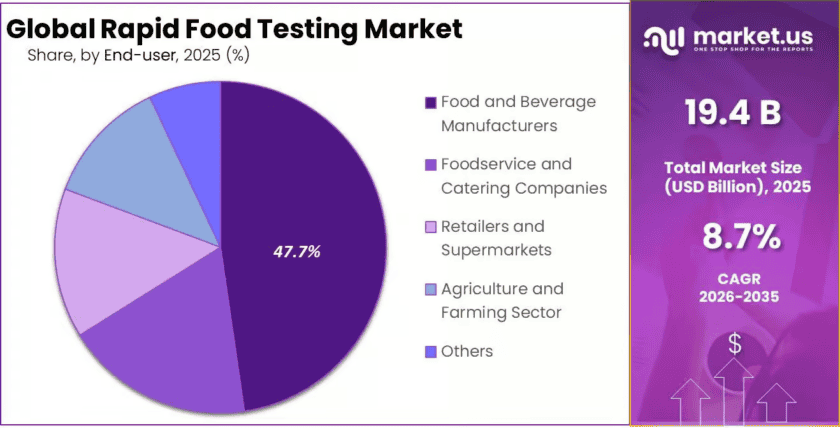
In 2025, pathogens held more than 42.30% of the market, while meat, poultry, and seafood accounted for 32.50%. PCR-based testing captured over 38.00%, and food and beverage manufacturers represented more than 47.00% of end-user demand.
Key Takeaways
- The Rapid Food Testing Market was valued at USD 19.4 billion in 2025 and is forecast to reach approximately USD 44.6 billion by 2035, growing at an 8.7% CAGR.
- Pathogens held more than 42.30% share in 2025, supported by strong testing requirements for Salmonella, Listeria, E. coli, Campylobacter, and other foodborne microorganisms.
- Meat, Poultry and Seafood captured more than 32.50% share, reflecting continuous microbial, residue, sanitation, and quality testing across animal-protein processing operations.
- PCR-Based Testing accounted for more than 38.00% of the market in 2025, supported by sensitive DNA-based detection of several important foodborne microorganisms.
- Food and Beverage Manufacturers represented more than 47.00% of end-user demand, as rapid methods are increasingly used at raw-material, sanitation, production, and finished-product checkpoints.
- North America dominated with more than 47.50% share and USD 9.2 billion in revenue during 2025.
Regional Analysis
North America Leads with 47.50% Share and USD 9.2 Billion Market Value
In 2025, North America held a dominant position in the Rapid Food Testing Market, capturing more than 47.50% share and generating approximately USD 9.2 billion in revenue.
The region’s leadership is supported by established food-testing laboratories, large-scale food processing, strong regulatory oversight, and frequent pathogen surveillance. CDC estimates that foodborne illness affects around 48 million people annually in the United States, resulting in 128,000 hospitalizations and 3,000 deaths.
Imported food also creates a large testing requirement. FDA states that imports account for approximately 15% of the U.S. food supply, including around 32% of fresh vegetables, 55% of fresh fruit, and 94% of seafood. Food arrives from more than 200 countries or territories and roughly 125,000 foreign food facilities and farms, increasing demand for sampling, verification, and rapid contaminant screening.
Europe remains important because cross-border food trade, pathogen surveillance, allergen controls, pesticide monitoring, and food-safety regulations continue to support advanced laboratory testing.
Market Dynamics
Driver – Growing Need for Faster Pathogen Detection
Foodborne illness and stricter preventive controls are major drivers for rapid food testing. CDC estimates approximately 48 million illnesses, 128,000 hospitalizations, and 3,000 deaths each year in the United States from foodborne disease. FDA’s agricultural-water rules are adding another testing need, with pre-harvest requirements applying to large farms from April 7, 2025, small farms from April 6, 2026, and very small farms from April 5, 2027. These requirements encourage faster microbial screening of water, produce, equipment, ingredients, and processing environments before contaminated foods move further through the supply chain.
Trend – PCR and Molecular Methods Gain Wider Use
Rapid molecular testing is becoming more important because processors need results faster than conventional culture-only workflows. In 2025, PCR-based testing represented more than 38.00% of the Rapid Food Testing Market. USDA-FSIS updated its validated pathogen-testing guidance in April 2025, covering test kits for Salmonella, Campylobacter, Listeria species, Listeria monocytogenes, E. coli O157, and non-O157 STEC. Molecular screening is increasingly being combined with whole-genome sequencing, helping investigators connect contaminated food or environmental samples with human illness during outbreak investigations.
Restraint – Validation and Confirmation Requirements
Rapid tests reduce turnaround time, but they do not eliminate traditional laboratory work. FDA explains that rapid methods producing results within hours may still require enrichment, culturing, isolation, or confirmation because food ingredients can interfere with molecular or biochemical testing. Positive rapid-test results may therefore need another test for confirmation. This creates additional labor, equipment, consumable, and training costs for smaller food processors and laboratories. Different food matrices also behave differently during testing, meaning a method that performs well in one product may require additional validation before being used confidently for meat, dairy, produce, seafood, or highly processed food.
Opportunity – Testing-as-a-Service and Connected Laboratory Networks
The growing complexity of food supply chains creates opportunities for outsourced and testing-as-a-service models. FDA states that approximately 15% of the U.S. food supply is imported, with suppliers spread across more than 200 countries or territories and roughly 125,000 facilities and farms. Food manufacturers that lack large internal laboratories can use accredited third-party testing, mobile sample collection, connected laboratory platforms, and rapid-to-WGS workflows. FDA already uses whole-genome sequencing to identify links between food, environmental samples, and outbreaks. Combining rapid screening with centralized confirmation can therefore expand testing access while helping processors manage product-release decisions and contamination investigations.
Emerging Trends
1. PCR-Based Testing Expansion
PCR technology continues to move deeper into routine pathogen screening because it can identify target genetic material faster than many conventional workflows. PCR-based methods held more than 38.00% of the market in 2025.
2. Rapid Testing Followed by Whole-Genome Sequencing
Rapid screening is increasingly paired with WGS for outbreak confirmation. In a 2025 cucumber outbreak, FDA reported 69 illnesses across 21 states, with WGS matching Salmonella from cucumber samples to the outbreak strain.
3. More Testing of Agricultural Water
Agricultural-water monitoring is becoming a larger food-safety priority. FDA’s pre-harvest water compliance dates began on April 7, 2025 for large farms and April 6, 2026 for small farms, encouraging risk-based microbial assessments.
4. Imported Food Screening Gains Importance
International sourcing is increasing rapid-testing requirements. Imported products make up about 15% of the U.S. food supply, while imports provide approximately 94% of seafood, 55% of fresh fruit, and 32% of fresh vegetables.
5. Pathogen Testing Remains the Main Target
Pathogens remained the largest testing target, accounting for more than 42.30% of Rapid Food Testing Market demand in 2025. CDC estimates around 48 million U.S. foodborne illnesses annually.
Use Cases
1. Meat and Poultry Pathogen Screening
Processors use rapid testing for Salmonella, Campylobacter, Listeria, and E. coli across raw materials and production facilities. Meat, poultry, and seafood represented more than 32.50% of the market in 2025.
2. Poultry Verification Testing
Rapid methods support continuous pathogen control in poultry plants. USDA-FSIS can sample large poultry establishments up to five times per month for Salmonella and uses a 52-week moving window to evaluate establishment performance.
3. Fresh Produce Testing
Rapid food tests can screen produce, wash water, and agricultural water for microbial hazards. A 2025 cucumber outbreak affected 69 people across 21 states, with 22 hospitalizations, showing why fast detection remains important for fresh produce.
4. Imported Seafood and Produce Verification
Importers can use rapid testing before releasing high-risk shipments. FDA says foreign suppliers provide about 94% of U.S. seafood, 55% of fresh fruit, and 32% of fresh vegetables, making import verification a major application.
5. Ready-to-Eat Food Environmental Monitoring
Testing helps detect Listeria in production areas before contaminated ready-to-eat food reaches consumers. In May 2025, FDA reported 10 cases across two states, with all 10 patients hospitalized, in a Listeria investigation linked to ready-to-eat foods.
Frequently Asked Questions on Rapid Food Testing
What is Rapid Food Testing?
Rapid food testing uses faster analytical methods to detect pathogens, allergens, residues, toxins, chemicals, or other contaminants in food. PCR, immunoassays and related technologies help processors obtain results faster than many traditional laboratory workflows.
How large is the Rapid Food Testing Market?
The Rapid Food Testing Market was valued at approximately USD 19.4 billion in 2025 and is projected to reach USD 44.6 billion by 2035, expanding at an 8.7% CAGR.
Which testing target dominates the Rapid Food Testing Market?
Pathogen testing held the largest position in 2025, capturing more than 42.30% share. Food companies frequently screen for Salmonella, Listeria, E. coli, Campylobacter, and other microorganisms that can cause foodborne illness.
Which food category has the largest market share?
Meat, Poultry and Seafood led food-tested applications in 2025 with more than 32.50% share, reflecting extensive pathogen, residue, sanitation, and quality-control requirements throughout animal-protein processing and distribution.
Which technology leads the Rapid Food Testing Market?
PCR-Based Testing held more than 38.00% share in 2025. Its strong position is supported by sensitive genetic detection and its ability to identify important foodborne microorganisms within faster laboratory workflows.
Which end users dominate Rapid Food Testing?
Food and beverage manufacturers represented more than 47.00% of market demand in 2025 because testing is needed across ingredients, production lines, sanitation programs, processing environments, and finished-product release.
Which region leads the Rapid Food Testing Market?
North America held more than 47.50% share in 2025, representing approximately USD 9.2 billion in revenue, supported by established laboratories, strict food-safety requirements, large processing operations, and extensive imported-food testing.
Why is rapid pathogen testing important?
Rapid testing can identify potential contamination earlier, allowing companies to hold products, investigate production areas, and begin corrective action faster. CDC estimates foodborne disease causes approximately 48 million U.S. illnesses annually.
What foods commonly require rapid testing?
Rapid testing is commonly applied to meat, poultry, seafood, dairy foods, processed products, fruits, vegetables, ingredients, and ready-to-eat foods. Testing requirements depend on product risk, processing methods, contaminants, customers, and regulatory requirements.
What is limiting wider adoption of rapid food testing?
Important barriers include equipment investment, method validation, sample preparation, trained laboratory staff, matrix interference, confirmation requirements, and consumable costs. FDA notes that positive rapid-method results may still require traditional confirmatory testing.
Conclusion
The Rapid Food Testing Market is set for strong expansion as food manufacturers and regulators demand quicker contamination decisions. The market is projected to increase from USD 19.4 billion in 2025 to USD 44.6 billion by 2035 at an 8.7% CAGR.
Pathogens, meat and seafood testing, PCR technology, and food manufacturers remain major demand areas. North America leads with 47.50% share and USD 9.2 billion in revenue. Growing pathogen surveillance, imported-food verification, agricultural-water controls, molecular testing, and WGS-supported investigations should continue strengthening rapid testing adoption.
Discuss your needs with our analyst
Please share your requirements with more details so our analyst can check if they can solve your problem(s)