Overview
New York, NY – Sep 29, 2026 – The global Food Automation Market is expanding as food manufacturers adopt automated processing, robotics, motor controls, machine vision, digital monitoring, sorting, packaging, and traceability systems. The market is projected to grow from USD 22.6 billion in 2025 to approximately USD 58.4 billion by 2035, registering a 9.9% CAGR during 2026–2035.
Food automation helps manufacturers improve production consistency, reduce repetitive manual work, strengthen hygiene controls, and monitor critical processing conditions. The potential user base is large. The U.S. Department of Energy reports that food and beverage manufacturing includes more than 30,000 facilities and represents around 6% of total U.S. industrial energy use.
Labor and productivity pressures are also encouraging investment. U.S. food manufacturing employed approximately 1.76 million workers in July 2026, while average hourly earnings reached USD 28.87. In 2025, labor productivity declined 2.1%, while unit labor costs increased 5.6%.
Food safety is another important factor. FDA preventive-control rules require covered food facilities to identify hazards, implement controls, monitor performance, verify effectiveness, and maintain records, creating opportunities for sensors, automated controls, and digital production systems.
Key Takeaways
- The global Food Automation Market was valued at USD 22.6 billion in 2025 and is projected to reach approximately USD 58.4 billion by 2035, growing at a 9.9% CAGR.
- Motor Controls held a dominant market position in 2025, capturing more than a 33.20% share by type.
- Fully Automatic systems led the operation category with more than a 61.20% share in 2025, reflecting increasing use of integrated processing and packaging systems.
- By function, Processing held the largest market position, accounting for more than a 28.40% share in 2025.
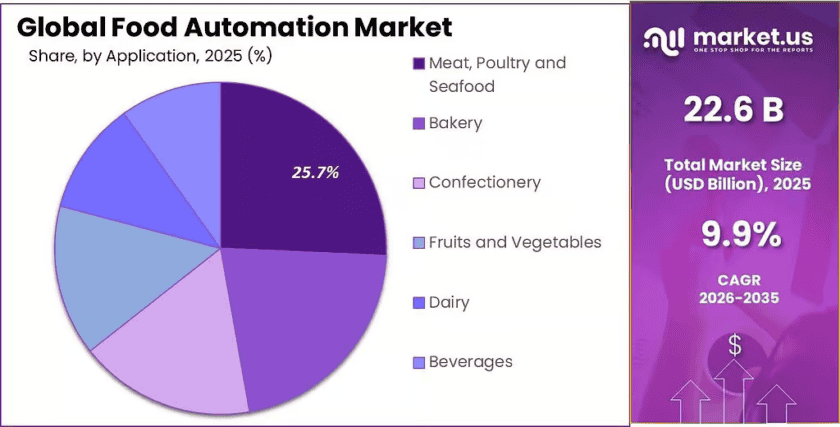
- Meat, Poultry and Seafood represented the leading application category, capturing more than a 25.00% share in 2025.
- Asia Pacific dominated the global market with more than a 38.64% share, representing approximately USD 8.73 billion in 2025.
Regional Analysis
Asia Pacific Leads with 38.64% Share and USD 8.73 Billion
In 2025, Asia Pacific held a dominant Food Automation Market position, capturing more than 38.64% of global revenue and generating approximately USD 8.73 billion. The region benefits from a large food-processing base, expanding packaged-food production, manufacturing investment, and increasing adoption of automated processing, inspection, packaging, and material-handling systems.
North America is also an important automation market because of its established food-manufacturing sector and rising operating costs. U.S. food manufacturing had approximately 43,328 private establishments in the fourth quarter of 2025, while employment reached about 1.76 million workers in July 2026. Average hourly earnings reached USD 28.87, reinforcing the commercial case for automation in repetitive and labor-intensive production tasks.
The U.S. Department of Energy identifies more than 30,000 food and beverage manufacturing facilities across the country and estimates that the sector consumes around 6% of total industrial energy. Automation of motors, refrigeration, heating, conveyors, pumps, and process equipment therefore offers opportunities for both productivity and energy management.
Market Dynamics
Driver – Rising Labor Costs and Productivity Pressure
Labor economics are creating a strong reason for food manufacturers to automate repetitive processing, filling, packaging, and material-handling work. U.S. food manufacturing employed about 1.76 million people in July 2026, with average hourly earnings reaching USD 28.87. Production and nonsupervisory workers earned approximately USD 24.67 per hour. At the same time, food-manufacturing labor productivity declined 2.1% in 2025, while unit labor costs increased 5.6%. These conditions encourage processors to use robots, automated conveyors, filling systems, palletizers, machine vision, and controls to improve output consistency and reduce dependence on repetitive manual operations.
Trend – Smarter Motor Controls and Energy Management
Smart motor controls are becoming more important because automated food plants depend heavily on conveyors, pumps, mixers, compressors, fans, grinders, refrigeration systems, and processing equipment. The U.S. Department of Energy estimates that electric motors used for machine drives account for around 54% of electricity consumption in U.S. manufacturing. Food and beverage manufacturing itself accounts for around 6% of total industrial energy use, and roughly two-thirds of the sector’s end-use energy is consumed by manufacturing processes. This is encouraging wider use of variable-frequency drives, sensors, automated scheduling, process controls, and condition-monitoring systems.
Restraint – Investment, Integration and Skills Requirements
Automation requires more than purchasing robots or processing machines. Plants must integrate controls, sensors, software, safety systems, sanitation procedures, maintenance programs, and trained workers. This can be difficult across the approximately 43,328 private U.S. food-manufacturing establishments recorded in Q4 2025, which vary widely in size and production methods. The European Commission has also identified changing skills requirements as food manufacturing adopts robotics, artificial intelligence, IoT, and machine learning. Smaller manufacturers may therefore adopt automation gradually because capital investment, technical skills, integration with older equipment, sanitation validation, and workforce training can slow full-factory automation.
Opportunity – Automated Traceability and Food-Safety Monitoring
Digital traceability creates a major opportunity for food automation. FDA’s Food Traceability Rule requires covered companies handling foods on the Food Traceability List to maintain Key Data Elements linked to defined Critical Tracking Events. When requested, covered records generally must be supplied to FDA within 24 hours, or another reasonable time agreed by the agency. Enforcement is currently directed not to begin before July 20, 2028. This framework creates opportunities for barcode and QR systems, automated lot-code capture, connected production records, warehouse tracking, sensors, machine vision, and integrated manufacturing software that can improve product tracking and speed investigations.
Emerging Trends
1. AI and Machine Vision Inspection
Machine vision is moving into automated food handling. A USDA-supported project developed 3D vision, deep-learning recognition, and robotic picking technology for food manufacturing, showing how cameras and AI can automate orientation, loading, inspection, and handling of variable products.
2. Automated Food Traceability
FDA rules require covered food businesses to maintain Key Data Elements associated with Critical Tracking Events and provide requested traceability information within 24 hours. This is encouraging digital lot tracking, barcode scanning, sensor networks, automated records, and connected production systems.
3. Energy-Efficient Motor Automation
Electric motors powering pumps, conveyors, compressors, fans, mixers, and grinders represent about 54% of U.S. manufacturing electricity use. Smart motor controls and variable-speed systems can therefore become important tools for lowering energy use while improving processing control.
4. Automated Monitoring for Food Safety
FDA preventive-control requirements call for documented monitoring, corrective actions, verification, and calibration where appropriate. Automated temperature sensors, alarms, control systems, and electronic production records can help plants continuously manage cooking, refrigeration, sanitation, allergen, and other process-control requirements.
5. Industry 4.0 Skills Development
Food automation increasingly combines robotics, AI, IoT, machine learning, and digital manufacturing technologies. European Commission-supported work identifies these technologies as important parts of Industry 4.0 while emphasizing new workforce skills and training requirements for modern food plants.
Use Cases
1. Automated Processing Lines
Food manufacturers use automation for mixing, cooking, cutting, conveying, cooling, and other processing activities. U.S. food and beverage manufacturing includes more than 30,000 facilities, providing a large installed base where automated process control can improve consistency and plant efficiency.
2. Packaging and Filling
Packaging automation can reduce repetitive handling across filling, sealing, labeling, and case-packing lines. BLS counted about 168,370 packaging and filling machine operators and tenders in food manufacturing during 2025, illustrating the significant scale of packaging activity across U.S. food plants.
3. Robotic Picking and Loading
Machine-vision-guided robots can locate irregular food items, calculate their position, and pick or load them automatically. USDA-supported research developed 3D laser vision and deep-learning methods specifically for automated food-line loading, with technology designed for wider food-manufacturing applications.
4. Automated Safety and Quality Control
FDA requires covered food facilities to monitor preventive controls and document corrective actions and verification activities. Sensors and automated systems can continuously record temperature, processing conditions, equipment performance, and other parameters, improving consistency compared with entirely manual monitoring.
5. Automated Lot and Product Tracking
Food processors can connect scanners, labels, databases, and warehouse systems to build automated product histories. FDA requires covered firms to maintain traceability information for certain foods and make requested records available within 24 hours, increasing the value of digital tracking systems.
Frequently Asked Questions on Food Automation and Food Automation Market
What is food automation?
Food automation involves using robots, sensors, control systems, machine vision, software, conveyors, automated processing equipment, and digital technologies to perform or monitor food production, processing, sorting, packaging, inspection, palletizing, and material-handling operations.
How large is the Food Automation Market?
The global Food Automation Market was valued at approximately USD 22.6 billion in 2025 and is projected to reach around USD 58.4 billion by 2035, expanding at a 9.9% CAGR during 2026–2035.
Which type dominates the Food Automation Market?
Motor Controls held the dominant position by type in 2025, capturing more than a 33.20% share. They regulate motors operating conveyors, pumps, mixers, compressors, refrigeration equipment, processing machines, and automated production lines.
Which operation segment leads the Food Automation Market?
Fully Automatic systems dominated the operation category with more than a 61.20% share in 2025. These systems support continuous processing, filling, inspection, packaging, sorting, material handling, and palletizing with lower levels of direct manual intervention.
Which function holds the largest market share?
Processing held the largest functional share of the Food Automation Market in 2025 at more than 28.40%. Automation is applied to mixing, cutting, cooking, conveying, temperature control, refrigeration, portioning, and other manufacturing operations.
Which application dominates the Food Automation Market?
Meat, Poultry and Seafood held the leading application position in 2025 with more than a 25.00% share. Automation is used for cutting, handling, inspection, portioning, weighing, packaging, freezing, and sanitary production operations.
Which region leads the Food Automation Market?
Asia Pacific led the global Food Automation Market in 2025 with more than a 38.64% share, representing approximately USD 8.73 billion in revenue, supported by manufacturing expansion and increasing adoption of automated production systems.
Why are food manufacturers adopting automation?
Processors are seeking improved productivity, consistency, safety, and labor efficiency. U.S. food-manufacturing unit labor costs increased 5.6% in 2025, while labor productivity declined 2.1%, strengthening the business case for process and handling automation.
How does automation support food safety?
Automation can record processing temperatures, monitor preventive controls, inspect products, identify deviations, and maintain electronic records. FDA requires covered food facilities to monitor preventive controls, document corrective actions, conduct verification, and maintain appropriate food-safety records.
What opportunities will support future Food Automation Market growth?
Major opportunities include AI inspection, robotics, automated packaging, motor optimization, predictive maintenance, warehouse automation, and traceability. FDA’s current traceability enforcement timeline extends to July 20, 2028, encouraging further investment in digital record and tracking systems.
Conclusion
The Food Automation Market is positioned for strong expansion as manufacturers increase investment in robotics, motor controls, automated processing, packaging, inspection, and digital traceability. The market is projected to grow from USD 22.6 billion in 2025 to USD 58.4 billion by 2035, at a 9.9% CAGR.
Asia Pacific remains the leading regional market with a 38.64% share. Labor pressure, food-safety requirements, energy management, and digital manufacturing are expected to support adoption. With U.S. food manufacturing unit labor costs rising 5.6% in 2025, automation offers processors an important route toward stronger productivity and operational control.
Discuss your needs with our analyst
Please share your requirements with more details so our analyst can check if they can solve your problem(s)