Overview
New York, NY – Oct 01, 2026 – The global Fish Processing Market is expanding as seafood companies invest in freezing, filleting, preservation, automation, refrigeration, packaging, and waste-recovery systems. The market was valued at USD 330.6 billion in 2025 and is projected to reach around USD 596.9 billion by 2035, expanding at a 6.1% CAGR from 2026 to 2035.
Fish processing converts harvested aquatic animals into frozen seafood, fillets, canned products, dried products, fishmeal, fish oil, and other value-added products. FAO estimates global fisheries and aquaculture production reached a record 235 million tonnes in 2024, including 195 million tonnes of aquatic animals. Aquaculture produced 103 million tonnes of aquatic animals, representing 53% of aquatic animal production.
Seafood remains important to global nutrition. Around 89% of aquatic animal production is used for human consumption, while aquatic foods provide at least one-fifth of animal protein intake for 3.1 billion people.
Processing investment is increasingly focused on cold chains, automation, traceability, hygiene, and waste reduction. FAO estimates as much as 35% of fisheries and aquaculture production can be lost or wasted, creating opportunities for improved preservation and by-product utilization.
Key Takeaways
- The global Fish Processing Market was valued at USD 330.6 billion in 2025 and is projected to reach USD 596.9 billion by 2035, growing at a 6.1% CAGR.
- Frozen products held a dominant market position in 2025, capturing more than 62.40% share, supported by longer shelf life and international cold-chain distribution.
- Filleting led the processing-technique segment with more than 30.00% share, reflecting consumer preference for convenient, portion-ready seafood.
- Fish dominated the species category, accounting for more than 63.20% share of the market in 2025.
- Food applications represented more than 83.00% share, demonstrating the importance of seafood processing for direct human consumption.
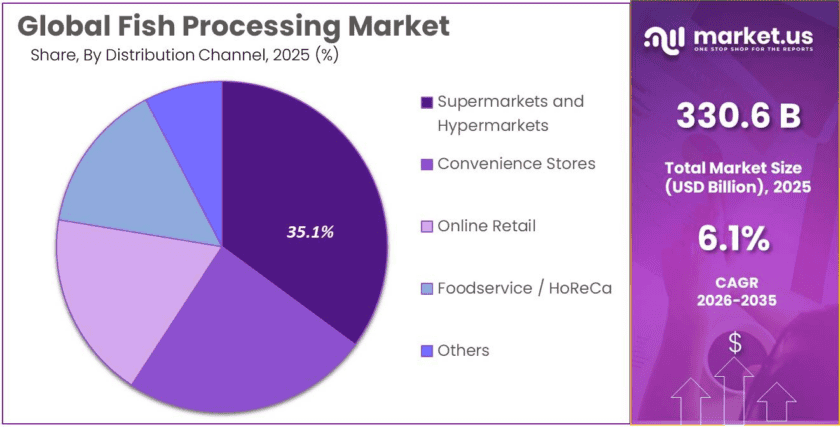
- Supermarkets and Hypermarkets captured more than 35.00% share of distribution, supported by broad frozen, chilled, canned, and ready-to-cook seafood offerings.
- Asia Pacific dominated the global Fish Processing Market with more than 46.58% share, representing approximately USD 154.0 billion in 2025.
Regional Analysis
In 2025, Asia Pacific held a dominant Fish Processing Market position, capturing more than 46.58% share and generating approximately USD 154.0 billion. The region benefits from large aquaculture output, extensive marine fisheries, strong seafood exports, growing domestic consumption, and established processing infrastructure.
The supply base continues to strengthen. FAO reports that global aquaculture production of aquatic animals reached 103 million tonnes in 2024, surpassing the 100-million-tonne level for the first time and accounting for 53% of aquatic animal output. Capture fisheries contributed another 92 million tonnes.
Global aquatic-product trade also supports Asian processing operations. FAO places international aquatic-animal trade at around USD 184 billion, with more than one-third of production entering international trade channels.
Rising processing volumes support investment in freezing, filleting, cold storage, inspection, packaging, and traceability. Strong aquaculture growth is particularly important because farmed species can provide processors with more predictable volumes and standardized raw materials than seasonal wild catches.
Market Dynamics
Driver – Rising Aquaculture and Seafood Supply
Growing aquatic-food production is a major driver for fish processing. FAO reports that global fisheries and aquaculture output reached 235 million tonnes in 2024, including 195 million tonnes of aquatic animals. Aquaculture alone produced 103 million tonnes, accounting for 53% of aquatic animal production. This expanding supply requires slaughtering, gutting, filleting, freezing, preservation, packaging, cold storage, and transport capacity. Aquatic foods are also increasingly important for human diets, with 89% of aquatic animal production directed to human consumption. These volumes strengthen demand for efficient processing plants capable of converting large raw-material flows into safe, convenient, export-ready seafood products.
Trend – Automation, Traceability and Value-Added Processing
Fish processors are increasingly investing in automation, portioning, digital traceability, quality control, and value-added seafood formats. NOAA’s seafood processor survey tracks product quantities, values, employment, and product types across U.S. processing facilities every year, showing the growing importance of standardized industry data. FAO also emphasizes upgraded aquatic-food value chains that improve traceability, transparency, market access, and waste reduction. Europe illustrates the scale of value-added processing: around 3,390 fish-processing companies generated approximately €36 billion in turnover in 2024, while the industry employed about 107,000 people in 2023.
Restraint – Raw-Material Volatility and Fish Loss
Processors remain exposed to seasonal landings, changing quotas, climate impacts, and rapid product deterioration. FAO estimates that up to 35% of fisheries and aquaculture production can be lost or wasted across the value chain. Raw-material availability can also change sharply by species. For example, recommended Northeast Atlantic mackerel catches fell to 174,000 tonnes from 570,000 tonnes in 2025, while North Sea cod restrictions also tightened. Such shifts can leave processing plants with lower utilization, increase procurement costs, and complicate supply planning. Maintaining ice, refrigeration, hygienic handling, skilled labour, and reliable cold chains further adds to operating costs.
Opportunity – By-Product Recovery and Circular Processing
Fish-processing residues represent a major opportunity for processors to increase revenue while reducing waste. FAO states that processing can generate by-products equal to as much as 70% of processed fish, depending on species and processing method. Heads can represent 9–12% of fish weight, viscera 12–18%, bones 9–15%, and skin around 1–3%. These materials can be transformed into fishmeal, fish oil, animal feed, fertilizers, bioactive ingredients, pharmaceuticals, biogas, and other products. FAO reports that by-products already provide around 27% of global fishmeal production and 48% of fish oil production, demonstrating growing commercial potential.
Emerging Trends
1. Aquaculture-Based Processing Growth
Aquaculture is becoming a larger source of raw material for processors. Global farmed aquatic-animal output reached 103 million tonnes in 2024, representing 53% of total aquatic animal production and supporting more predictable processing volumes.
2. Greater Use of Fish Processing By-Products
Processors are recovering more heads, bones, skins, and viscera instead of discarding them. By-products can represent up to 70% of processed fish, creating opportunities in fishmeal, oils, feed, fertilizers, bioactives, and energy.
3. Expansion of Frozen Seafood
Frozen seafood remains central to long-distance trade and storage. It held more than 62.40% of the Fish Processing Market in 2025, supported by improved freezing, refrigeration, cold storage, and international logistics networks.
4. Increasing Traceability Requirements
Digital traceability is becoming important for verifying origin, processing conditions, and legal sourcing. More than one-third of global aquatic production enters international trade, increasing the need for reliable documentation and transparent processing records.
5. Stronger Focus on Food-Loss Reduction
FAO estimates that as much as 35% of fisheries and aquaculture production can be lost or wasted. Processors are therefore investing in refrigeration, improved handling, packaging, cold chains, and by-product recovery to preserve value.
Use Cases
1. Frozen Seafood Production
Freezing helps processors extend shelf life and move seafood across international markets. Frozen products represented more than 62.40% of the market in 2025, making freezing the leading fish-processing category globally.
2. Fillet Production
Filleting converts whole fish into convenient portions for retail and foodservice. Filleting captured more than 30.00% market share in 2025, supported by demand for boneless, portion-controlled, ready-to-cook seafood products.
3. Seafood for Human Consumption
Food remains the main destination for processed seafood, accounting for more than 83.00% market share. FAO also reports that 89% of global aquatic animal production is used directly for human consumption.
4. Fishmeal and Fish Oil Production
Processing residues can be converted into feed ingredients and oils. FAO reports that by-products account for about 27% of fishmeal production and 48% of global fish oil production, reducing waste while creating additional value.
5. Pharmaceutical and Bioactive Ingredients
Fish skins, bones, oils, and viscera can supply omega-3 oils, collagen-related materials, chitosan, and other industrial compounds. Depending on processing methods, by-products can represent up to 70% of whole fish weight.
Frequently Asked Questions on Fish Processing and Fish Processing Market
What is the Fish Processing Market size?
The global Fish Processing Market was valued at approximately USD 330.6 billion in 2025 and is projected to reach around USD 596.9 billion by 2035, growing at a 6.1% CAGR.
What is fish processing?
Fish processing includes slaughtering, gutting, filleting, deboning, skinning, freezing, chilling, drying, smoking, canning, packaging, and by-product recovery. These activities convert harvested aquatic animals into safe, convenient, longer-lasting, and higher-value products.
Which processing category dominates the Fish Processing Market?
Frozen seafood led the market in 2025 with more than 62.40% share. Freezing helps maintain quality, extend storage life, reduce deterioration, and support long-distance seafood distribution through international cold-chain networks.
Filleting held a dominant position with more than 30.00% share in 2025. Fillets are convenient for consumers and foodservice operators and can be easily frozen, portioned, packaged, seasoned, or processed further.
Which species category dominates the market?
The Fish category dominated the species segment with more than 63.20% market share in 2025, supported by large global volumes of salmon, tuna, pollock, tilapia, cod, pangasius, sardines, and other commercial species.
Which application dominates fish processing?
Food applications accounted for more than 83.00% market share in 2025. This is consistent with FAO data showing that approximately 89% of aquatic animal production is used for direct human consumption.
Which distribution channel leads the Fish Processing Market?
Supermarkets and Hypermarkets captured more than 35.00% share in 2025, supported by large selections of frozen fillets, chilled seafood, canned fish, ready-to-cook products, and other packaged seafood items.
Which region leads the Fish Processing Market?
Asia Pacific led the global market with more than 46.58% share and approximately USD 154.0 billion in 2025, supported by large fisheries, aquaculture production, processing capacity, exports, and seafood consumption.
How large is global fisheries and aquaculture production?
FAO estimates global fisheries and aquaculture production reached a record 235 million tonnes in 2024, including 195 million tonnes of aquatic animals and substantial additional production of algae.
What is the future outlook for fish processing?
Future growth will be supported by aquaculture, frozen seafood, automation, traceability, cold-chain expansion, value-added products, and waste recovery. The global market is forecast to reach approximately USD 596.9 billion by 2035.
Conclusion
The Fish Processing Market is expected to expand as global seafood production, aquaculture, frozen-food demand, and value-added processing increase. The market is projected to rise from USD 330.6 billion in 2025 to USD 596.9 billion by 2035, at a 6.1% CAGR. Asia Pacific leads with 46.58% share and USD 154.0 billion. Meanwhile, FAO reports record fisheries and aquaculture production of 235 million tonnes in 2024. Future investment is expected to focus on freezing, automated filleting, traceability, cold storage, efficient packaging, and circular processing. With as much as 35% of aquatic production potentially lost or wasted, better preservation and by-product recovery offer substantial opportunities.
Discuss your needs with our analyst
Please share your requirements with more details so our analyst can check if they can solve your problem(s)