Overview
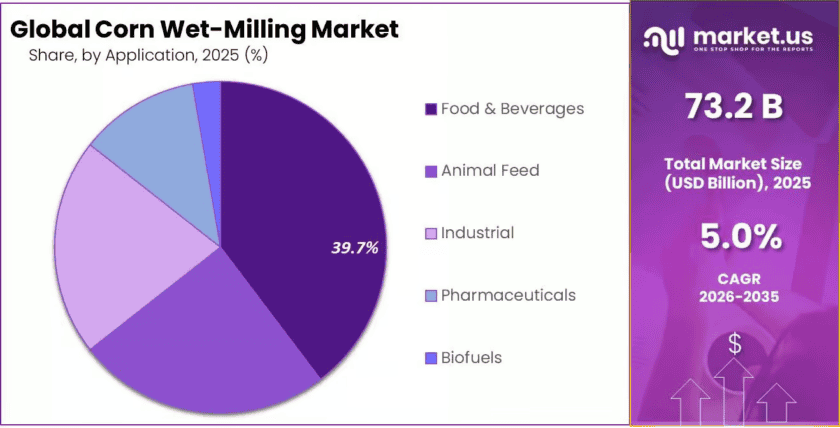
New York, NY – Sep 30, 2026 – The global Corn Wet-Milling Market continues to expand as food, beverage, feed, pharmaceutical, fermentation, and industrial manufacturers increase their use of corn-derived ingredients. The market was valued at USD 73.2 billion in 2025 and is projected to reach approximately USD 119.7 billion by 2035, expanding at a 5.0% CAGR during 2026–2035.
Corn wet-milling separates kernels into valuable components including starch, germ, fiber, and protein. These streams are further processed into starches, glucose, dextrose, corn oil, sweeteners, alcohol, corn gluten feed, and other ingredients.
The raw-material base remains strong. USDA estimated U.S. corn production at a record 17.0 billion bushels in 2025, up 14% from 2024. Average yield reached a record 186.5 bushels per acre, while harvested area totaled 91.3 million acres.
USDA also reports that corn represents more than 95% of U.S. feed-grain production and use, while food, seed, and industrial applications account for close to 60% of domestic corn use. Wet milling therefore remains strategically important for converting large corn supplies into higher-value food and industrial products.
Key Takeaways
- The global Corn Wet-Milling Market was valued at USD 73.2 billion in 2025 and is projected to reach USD 119.7 billion by 2035, growing at a 5.0% CAGR.
- Milling Equipment dominated the equipment category in 2025 with more than a 30.00% share.
- Starches held the leading end-product position, accounting for more than 48.70% of the market.
- Food & Beverages captured more than a 39.00% share, supported by starch, glucose, dextrose, and sweetener applications.
- Food Grade products led the grade category with more than a 62.00% share in 2025.
- North America dominated the regional market with a 38.00% share, representing approximately USD 27.82 billion in 2025.
Regional Analysis
North America Leads with 38.00% Share and USD 27.82 Billion
In 2025, North America held a dominant Corn Wet-Milling Market position, capturing more than a 38.00% share and generating approximately USD 27.82 billion. The region benefits from abundant corn production, mature processing infrastructure, established food manufacturing, strong feed demand, and broad industrial use of starches and sweeteners.
The United States remains a major foundation for regional processing. USDA estimated U.S. corn production at a record 17.0 billion bushels in 2025, with harvested area reaching 91.3 million acres and average yields of 186.5 bushels per acre. This large domestic feedstock base supports continuous wet-milling operations and reduces dependence on imported raw material.
USDA also states that food, seed, and industrial uses account for close to 60% of domestic corn consumption. Wet millers produce high-fructose corn syrup, glucose, dextrose, starch, corn oil, beverage alcohol, industrial alcohol, and fuel ethanol.
Asia-Pacific is emerging as an important expansion area due to growing processed-food manufacturing, fermentation industries, feed consumption, and starch demand. Increasing downstream use of corn derivatives in food, paper, pharmaceuticals, adhesives, and bio-based manufacturing is expected to broaden regional wet-milling opportunities.
Market Dynamics
Driver – Large Corn Supply Supports Processing Capacity
Strong corn availability remains one of the most important drivers for wet-milling operations. USDA reported record U.S. corn production of 17.0 billion bushels in 2025, representing a 14% increase from 2024. Average yield reached 186.5 bushels per acre, while harvested area increased to 91.3 million acres. A larger feedstock base supports higher operating rates for steeping, milling, centrifugation, washing, and starch separation systems. USDA also notes that corn accounts for more than 95% of U.S. feed-grain production and use, giving processors a highly established agricultural supply chain for food ingredients, sweeteners, feed co-products, ethanol, and industrial derivatives.
Trend – Higher Value Extraction from Every Corn Kernel
Wet millers are increasingly focused on extracting more value from each bushel by producing several commercial streams rather than relying on one main product. USDA identifies wet-milled outputs including starch, high-fructose corn syrup, glucose, dextrose, corn oil, beverage alcohol, industrial alcohol, and ethanol. Co-products such as corn gluten feed and corn gluten meal further improve raw-material utilization. USDA defines corn gluten feed as material remaining after removal of much of the starch, gluten, and germ during wet milling. This integrated processing model supports stronger plant economics while reducing waste and expanding food, feed, fermentation, and industrial revenue streams.
Restraint – Water and Effluent Management Requirements
Corn wet-milling requires significant water use across steeping, starch washing, separation, refining, and equipment cleaning, making wastewater management an important operating challenge. EPA specifically regulates wet corn milling under 40 CFR Part 406 and identifies principal wastewater streams including modified-starch washing, steepwater evaporation condensate, and syrup refining. Regulated pollutants include BOD5, total suspended solids, and pH. Compliance requires treatment systems, monitoring, process controls, and capital investment. Water-intensive facilities can therefore face higher operating costs when production expands. Plants are increasingly encouraged to improve water recycling, concentrate valuable process streams, optimize cleaning operations, and reduce wastewater loads before discharge.
Opportunity – Growing Food and Industrial Starch Applications
Starch offers significant growth opportunities because one wet-milling stream can serve many downstream industries. FDA recognizes cornstarch for technical functions including stabilizing or thickening, texturizing, formulation aid, humectant, and sweetening applications. Modified food starch is also recognized for functions including stabilizing, thickening, emulsifying, and moisture management. USDA forecasts U.S. food, seed, and industrial corn use at 6.96 billion bushels in 2025/26, although expectations for HFCS, glucose, and dextrose were reduced slightly during the year. Continued innovation in functional starches, fermentation inputs, bio-based chemicals, and specialty food ingredients can create higher-value opportunities for wet-milling companies.
Emerging Trends
1. Record Corn Supply Supports Higher Processing Potential
U.S. corn production reached a record 17.0 billion bushels in 2025, up 14% from 2024. This larger agricultural base provides wet millers with greater feedstock availability for starch, sweeteners, oils, feed ingredients, and fermentation products.
2. Starch Remains Central to Product Innovation
Starches captured 48.70% of the Corn Wet-Milling Market in 2025. FDA recognizes cornstarch for several functions, including thickening, stabilizing, texturizing, formulation, and sweetening, supporting continued product development across packaged foods and industrial applications.
3. Multi-Product Biorefining Gains Importance
USDA identifies at least 7 major wet-milled product streams, including HFCS, glucose, dextrose, starch, corn oil, beverage alcohol, and industrial alcohol. Producers are increasingly optimizing plants to obtain greater value from several outputs from each processed bushel.
4. Wastewater Efficiency Becomes a Processing Priority
EPA regulates wet corn milling under 40 CFR Part 406, covering pollutants such as BOD5, suspended solids, and pH. This is encouraging plants to improve water reuse, evaporation systems, process recovery, and wastewater treatment as production capacities increase.
5. Feed Co-Product Utilization Continues Expanding
Corn wet milling generates valuable feed streams instead of treating protein and fiber as waste. USDA formally identifies corn gluten feed and corn gluten meal as wet-milling co-products, supporting their continued use across livestock feeding and integrated processing economics.
Use Cases
1. Food Thickening and Texture Control
Cornstarch is widely used to control viscosity and texture in sauces, bakery fillings, soups, desserts, and prepared foods. FDA recognizes cornstarch for stabilizer or thickener and texturizer functions, supporting broad commercial use in food manufacturing.
2. Sweeteners and Beverage Ingredients
Wet millers convert corn starch into glucose, dextrose, and high-fructose corn syrup for beverages and processed foods. USDA forecasts total U.S. food, seed, and industrial corn use at 6.96 billion bushels for 2025/26.
3. Livestock Feed Ingredients
Corn wet-milling produces gluten feed and gluten meal for animal nutrition. USDA defines corn gluten feed as the material remaining after substantial removal of starch, gluten, and germ, helping processors create additional value from the original corn kernel.
4. Industrial and Fermentation Applications
Wet-milled corn supports industrial alcohol, fermentation, starch, adhesives, and other manufacturing uses. USDA states that food, seed, and industrial applications together account for close to 60% of domestic U.S. corn use, demonstrating the scale of downstream industrial demand.
5. Modified Food Starch Production
Wet-milled starch can be further modified for specialized functionality. FDA recognizes modified food starch under 21 CFR 172.892, including uses as a stabilizer, thickener, emulsifier, humectant, and formulation ingredient in processed-food applications.
Frequently Asked Questions on Corn Wet-Milling Market
What is the Corn Wet-Milling Market size?
The global Corn Wet-Milling Market was valued at approximately USD 73.2 billion in 2025 and is projected to reach around USD 119.7 billion by 2035, expanding at a 5.0% CAGR.
What is corn wet milling?
Corn wet milling is an industrial process that separates soaked corn kernels into starch, germ, fiber, and protein. These components are further processed into starches, sweeteners, corn oil, alcohol, feed ingredients, and industrial products.
Which equipment segment dominates the Corn Wet-Milling Market?
Milling Equipment held the dominant equipment position in 2025, accounting for more than a 30.00% share. Milling systems help break conditioned kernels and prepare starch, germ, fiber, and protein for downstream separation.
Which end product dominates the market?
Starches held the largest end-product share in 2025, capturing more than 48.70%. Corn starch is widely used in food processing, paper, adhesives, fermentation, pharmaceuticals, sweetener production, and several other industrial applications.
Which application leads the Corn Wet-Milling Market?
Food & Beverages accounted for more than a 39.00% share in 2025. Starches, glucose, dextrose, and corn-based sweeteners are widely used in bakery products, beverages, confectionery, sauces, dairy products, and processed foods.
Which grade dominates Corn Wet-Milling demand?
Food Grade products represented more than a 62.00% share in 2025. Their leading position reflects extensive consumption of food starch, glucose, dextrose, corn syrup, and other corn-derived ingredients across commercial food and beverage manufacturing.
Which region dominates the Corn Wet-Milling Market?
North America dominated the global market in 2025 with more than a 38.00% share, representing approximately USD 27.82 billion. Large corn production and established processing infrastructure support the region’s leading position.
How much corn did the United States produce in 2025?
USDA estimated U.S. corn production at a record 17.0 billion bushels in 2025, up 14% from 2024. Average yield reached 186.5 bushels per acre, while harvested area totaled 91.3 million acres.
What products are produced through corn wet milling?
USDA identifies wet-milled outputs including starch, high-fructose corn syrup, glucose, dextrose, corn oil, beverage alcohol, industrial alcohol, and fuel ethanol. Corn gluten feed and gluten meal are also produced as useful feed co-products.
What factors are supporting future market growth?
Growth is supported by high corn availability, food starch applications, sweetener demand, feed co-product utilization, fermentation, and bio-based industrial uses. U.S. food, seed, and industrial corn use is forecast at 6.96 billion bushels in 2025/26.
Conclusion
The Corn Wet-Milling Market remains an important part of the food, feed, and industrial manufacturing value chain. Valued at USD 73.2 billion in 2025, the market is projected to reach USD 119.7 billion by 2035, expanding at a 5.0% CAGR. North America leads with a 38.00% share and USD 27.82 billion in revenue.
Record U.S. corn production, broad starch applications, feed co-product utilization, and industrial demand continue to support processing activity. Future opportunities are expected from functional starches, fermentation, improved co-product recovery, water-efficient processing, and greater value extraction from each corn kernel.
Discuss your needs with our analyst
Please share your requirements with more details so our analyst can check if they can solve your problem(s)