Overview
New York, NY – Nov 27, 2026 – The global Textured Soy Protein Market is gaining importance as food manufacturers seek affordable, protein-rich ingredients for meat alternatives, prepared meals, snacks, and other processed foods. Textured soy protein, also known as textured vegetable protein, is mainly produced from defatted soy flour, soy protein concentrate, or soy protein isolate through an extrusion process.
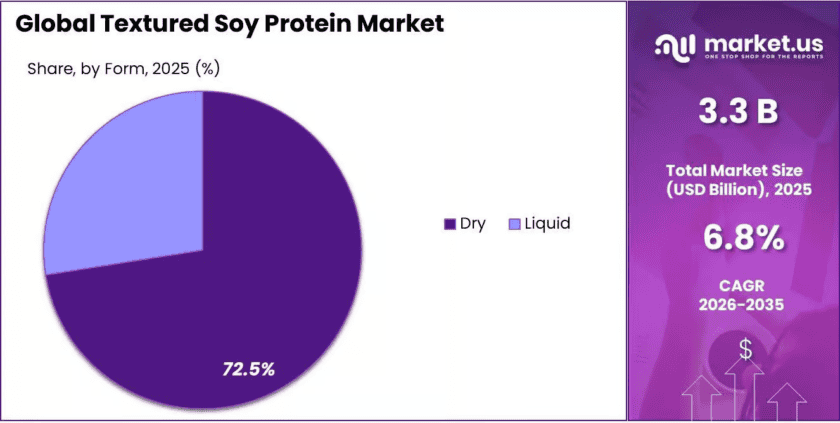
According to Market.us, the global Textured Soy Protein Market was valued at USD 3.3 billion in 2025 and is projected to reach USD 6.3 billion by 2035, registering a CAGR of 6.8% from 2026 to 2035. Europe led the market in 2025 with a 36.33% share, representing approximately USD 1.1 billion in revenue.
The market is supported by the ingredient’s ability to provide a meat-like structure, absorb moisture and seasoning, and work across different food applications. Market.us identifies conventional products, food and beverages, dry formats, and distributors/retailers as the leading segments. Product innovation, consistent raw-material quality, and wider use in affordable protein formulations are expected to remain important factors shaping market development.
Key Takeaways
- Market size: The Textured Soy Protein Market is estimated at USD 3.3 billion in 2025 and is projected to reach USD 6.3 billion by 2035.
- Growth outlook: The market is expected to expand at a 6.8% CAGR during 2026–2035.
- Leading region: Europe dominated in 2025 with a 36.33% share, equivalent to approximately USD 1.1 billion.
- Leading nature segment: Conventional textured soy protein accounted for 86.34% of the market in 2025.
- Leading application: Food and beverages represented 78.33% of market revenue.
- Leading product form: Dry textured soy protein held a 72.56% share.
- Leading distribution channel: Distributors and retailers accounted for 67.32% of the market.
Regional Analysis
Europe held the leading position in the Textured Soy Protein Market in 2025, accounting for 36.33% of global revenue, or approximately USD 1.1 billion. Its position reflects an established food-processing sector and the use of plant proteins in meat alternatives, prepared foods, and other processed products.
The European Commission reports that the European Union produces 67 million tonnes of plant-based protein from arable and fodder crops, while using around 80 million tonnes for feed, food, and industrial purposes. The Commission also reports that only 25% of protein from oilseeds and protein crops used in the EU in 2025 was sourced domestically.
Market Dynamics
Driver: Demand for Affordable Protein Ingredients
The demand for affordable protein ingredients is supporting the use of textured soy protein in processed foods and meat-extension products. Its fibrous structure allows manufacturers to add texture and protein to burgers, fillings, sauces, and prepared meals. The Food and Agriculture Organization (FAO) describes textured soy products as suitable for meat extension, with recommended hydration levels varying by raw material.
For example, soy-flour-based products have a recommended hydration ratio of 2:1, while soy-concentrate products use 3:1. These functional properties help food processors manage recipe costs and product texture. Wider use in convenient, protein-rich foods is likely to support demand.
Trend: Improved Protein Functionality and Food Formulation
Food manufacturers are increasingly focused on improving the taste, texture, solubility, and processing performance of soy-based ingredients. USDA Agricultural Research Service research involving 20 genetically diverse soybean lines identified differences in protein solubility, hydrophobicity, emulsifying capacity, and foaming performance. These properties can influence how soy protein performs in food products.
Better-performing soybean varieties may help ingredient producers develop textured soy protein with more consistent functionality for different applications. This research direction supports product development in meat alternatives, bakery products, snacks, and prepared foods, where manufacturers require dependable ingredient performance across production batches.
Restraint: Soy Allergen Labelling and Consumer Restrictions
Soy allergen concerns can limit the use of textured soy protein in products intended for consumers who avoid soy. Food manufacturers must also manage ingredient declarations and prevent unintended allergen cross-contact during production.
The United States Food and Drug Administration (FDA) requires food labels to identify major food allergens, including soy, when they are used as ingredients. This creates additional requirements for product formulation, manufacturing controls, packaging, and labelling. Manufacturers may need separate production procedures or alternative ingredients to serve soy-free product categories. These requirements can increase operational complexity and restrict textured soy protein use in selected food applications.
Opportunity: Development of New Soy Protein Applications
New applications in snacks, bakery products, prepared meals, and hybrid meat products offer opportunities for textured soy protein manufacturers. The USDA identifies soy ingredients as useful in nutrition bars, cereals, snacks, processed meat products, and plant-based meat alternatives. This variety allows suppliers to serve food categories beyond conventional meat substitutes.
Research into soybean protein functionality may also help manufacturers develop ingredients with improved water retention, emulsification, and texture. The USDA’s work on 20 soybean lines highlights the potential to improve raw-material characteristics for food processing. Companies that develop application-specific grades and reliable supply arrangements may gain access to a wider customer base.
Emerging Trends
1. Hybrid meat formulations: Food manufacturers are using textured soy protein to combine plant ingredients with animal protein in selected products. This approach can improve texture and manage formulation costs. FAO technical guidance lists soy-flour-based textured products for meat extension at 15–20% of the hydrated formulation.
2. Improved soybean varieties: Research is focusing on soybean varieties with better protein functionality. USDA Agricultural Research Service researchers evaluated 20 genetically diverse soybean lines to study solubility, emulsifying performance, and foaming capacity. These findings can support improved ingredients for food processing.
3. Dry ingredient convenience: Dry textured soy protein remains useful because it can be stored and hydrated before food preparation. FAO reports that shelf-stable dry textured soy products are usually marketed at around 8% moisture, supporting easier storage and handling.
4. Broader food applications: Soy ingredients are being used in more than meat alternatives, including nutrition bars, cereals, snacks, and bakery products. The U.S. Soybean Export Council lists these applications for soy ingredients, showing opportunities for product development across multiple food categories.
5. More attention to ingredient sourcing: Food producers are examining the reliability and origin of plant-protein supplies. The European Commission reports that the EU produces 67 million tonnes of plant protein but uses around 80 million tonnes across feed, food, and industrial purposes, highlighting the importance of supply planning.
Use Cases
1. Meat alternatives: Textured soy protein is used in burgers, nuggets, sausages, and minced-meat alternatives. Its fibrous structure helps create a meat-like bite. FAO guidance identifies hydration ratios of 2:1 to 4:1, depending on whether the ingredient is made from flour, concentrate, or isolate.
2. Meat extension: Food processors can combine hydrated textured soy protein with meat to increase product volume and modify texture. FAO lists recommended use levels of 15–20% for soy-flour-based textured products and higher levels for certain concentrate- and isolate-based products.
3. Soups and prepared meals: Granules and chunks can be added to soups, stews, sauces, and ready meals. They absorb liquid and seasoning during preparation, making them suitable for convenient food products. Dry products are commonly marketed at approximately 8% moisture, according to FAO.
4. Snacks and nutrition bars: Soy ingredients can be used in cereals, nutrition bars, and snack products to add protein and texture. The U.S. Soybean Export Council identifies soy ingredients for these applications, giving manufacturers options to develop protein-focused products for different consumer groups.
5. Bakery and cereal products: Soy flour and other soy ingredients can be incorporated into breads, crackers, cookies, and cereal-based foods. The U.S. Soybean Export Council identifies soy flour with approximately 50–60% protein for baking applications. This is a soy-flour specification, not a universal textured-soy protein value.
Frequently Asked Questions
1. What is textured soy protein?
Textured soy protein is a plant-based ingredient generally made from defatted soy flour, soy protein concentrate, or soy protein isolate. It is processed through extrusion to create a fibrous structure used in different food products.
2. What is textured soy protein also called?
Textured soy protein is also known as textured vegetable protein or TVP. It is commonly sold as granules, chunks, flakes, or crumbles and is used in meat alternatives, prepared meals, snacks, and other food applications.
3. What is the global Textured Soy Protein Market size?
According to Market.us, the global market was valued at USD 3.3 billion in 2025. It is projected to reach USD 6.3 billion by 2035, reflecting a forecast CAGR of 6.8% from 2026 to 2035.
4. Which region leads the Textured Soy Protein Market?
Europe led the market in 2025, accounting for 36.33% of global revenue, or approximately USD 1.1 billion, according to Market.us. The region benefits from an established food-processing industry and demand for plant-based ingredients.
5. Which application dominates the market?
Food and beverages was the leading application segment in 2025, with a reported 78.33% share. Textured soy protein is used in meat substitutes, prepared meals, soups, snacks, and other processed foods because of its texture and hydration properties.
6. What are the main forms of textured soy protein?
Textured soy protein is available in dry and liquid forms. Dry products are commonly supplied as granules, chunks, flakes, and crumbles. FAO reports that shelf-stable dry textured soy products are usually marketed at approximately 8% moisture.
7. Is textured soy protein suitable for meat products?
Yes. Food manufacturers use textured soy protein in meat alternatives and as an ingredient in selected meat-extension formulations. Its structure helps add bulk and texture. The appropriate inclusion level depends on the product recipe and the specific soy ingredient.
Conclusion
The Textured Soy Protein Market is expected to maintain steady growth as food manufacturers expand the use of plant-based ingredients across meat alternatives, prepared meals, snacks, and other processed foods. Market.us estimates that the market will increase from USD 3.3 billion in 2025 to USD 6.3 billion by 2035, at a 6.8% CAGR.
Europe currently holds the leading regional position, while conventional products and food and beverage applications account for the largest market segments. Future opportunities will depend on better ingredient functionality, reliable soybean sourcing, product innovation, and wider food applications. Manufacturers that address allergen management and consumer preferences will be better positioned to compete.
Discuss your needs with our analyst
Please share your requirements with more details so our analyst can check if they can solve your problem(s)