Overview
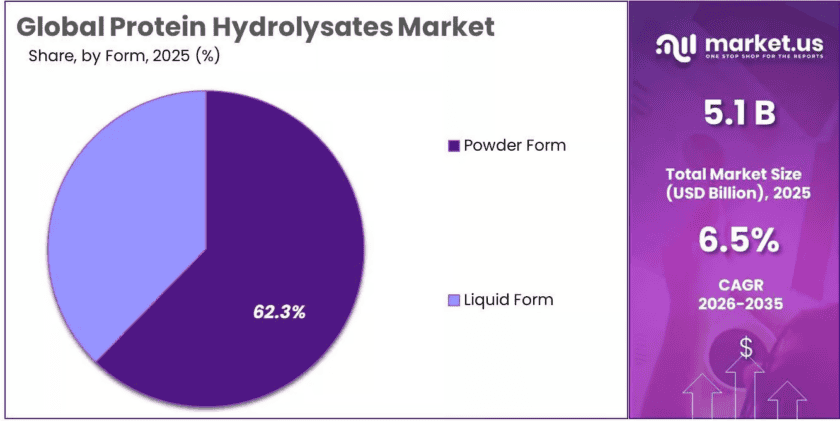
New York, NY – November 25, 2026 – The global Protein Hydrolysates Market is witnessing steady expansion as food manufacturers, nutrition companies, and healthcare providers increasingly incorporate specialized protein ingredients into their products. According to Market.us, the market is valued at USD 5.1 billion in 2025 and is projected to reach USD 9.5 billion by 2035, growing at a CAGR of 6.5% during 2026–2035. Protein hydrolysates are produced by breaking proteins into smaller peptides and amino acids through enzymatic or chemical processes.
Their digestibility, solubility, and functional properties support applications in infant nutrition, sports nutrition, clinical nutrition, dairy products, and specialized food formulations. Animal-derived proteins remain an important raw material, while plant-based hydrolysates are gaining attention as manufacturers diversify ingredient sources. Asia-Pacific leads the market, supported by expanding food processing activities and demand for nutritional products. Product innovation, controlled enzymatic processing, and the recovery of valuable proteins from food-processing by-products are expected to create further commercial opportunities.
Key Takeaways
- Market Growth: The global Protein Hydrolysates Market is projected to increase from USD 5.1 billion in 2025 to USD 9.5 billion by 2035, registering a CAGR of 6.5%.
- Leading Source: Animal protein dominated the source segment with a 67.89% share in 2025, supported by established dairy, whey, casein, and collagen ingredient applications.
- Leading Product Form: Powder form accounted for 62.23% of the market in 2025, supported by convenient storage, transportation, and formulation flexibility.
- Application Leadership: Dairy products represented 42.00% of the application segment in 2025, reflecting the use of hydrolysates in protein-enriched dairy formulations.
- Regional Leadership: Asia-Pacific dominated the global market with a 38.00% share, generating approximately USD 1.9 billion in 2025.
Regional Analysis
Asia-Pacific Dominates the Protein Hydrolysates Market with a 38.00% Share
In 2025, Asia-Pacific held a dominant market position, capturing more than a 38.00% share, equivalent to approximately USD 1.9 billion. The region benefits from expanding food manufacturing, growing demand for nutritional products, and increasing use of specialized protein ingredients.
China, Japan, South Korea, and Australia contribute to regional demand through food processing, dairy production, sports nutrition, and clinical nutrition applications. Manufacturers are also exploring plant-derived and marine-derived protein ingredients to diversify their product portfolios. The region’s established food supply chains and expanding consumer nutrition industry support its leading position.
Market Dynamics
Driver: Increasing Demand for Specialized Nutrition
Demand for specialized nutrition is supporting the adoption of protein hydrolysates in infant nutrition, sports supplements, and clinical food formulations. These ingredients contain smaller peptides and amino acids that can offer useful formulation properties.
The European Food Safety Authority (EFSA) requires manufacturers seeking authorization for infant formulas made from protein hydrolysates to provide information about composition, manufacturing, nutritional safety, and suitability. This regulatory framework encourages product characterization and quality improvements. Growing interest in easily formulated protein ingredients, together with expanding medical nutrition applications, is supporting investment in hydrolysis technologies and specialized protein products.
Trend: Development of Plant-Based Protein Hydrolysates
Manufacturers are increasingly exploring plant-derived protein hydrolysates from fava beans, soy, peas, and other crops. This development allows ingredient producers to diversify their raw material sources and create alternatives to conventional dairy and animal proteins.
An important example is the U.S. Food and Drug Administration’s GRAS Notice 1166 for fava bean protein hydrolysate, which received a no-questions response on November 13, 2024. The notice covers specified food applications, including protein powders, sports drinks, meal replacement products, and protein bars. This regulatory development demonstrates growing commercial interest in plant-based hydrolyzed ingredients.
Restraint: Processing Costs and Regulatory Requirements
High processing costs remain a challenge for protein hydrolysate manufacturers. Enzymatic hydrolysis requires controlled operating conditions, specialized enzymes, filtration, purification, and drying equipment. Additional expenses can arise when manufacturers target specific peptide sizes, taste profiles, or nutritional characteristics.
Regulatory requirements also increase development costs, particularly for infant and medical nutrition applications. EFSA requires manufacturers to provide detailed information about the hydrolysate’s characteristics, production process, stability, and nutritional suitability. These requirements can extend product development timelines and create additional barriers for smaller ingredient manufacturers entering specialized nutritional markets.
Opportunity: Recovery of Protein from Food-Processing By-Products
Protein recovery from food-processing by-products offers an important opportunity for hydrolysate manufacturers. Fish, poultry, dairy, and plant-processing operations generate protein-rich materials that can be converted into useful ingredients through controlled hydrolysis. This approach can improve raw material utilization while creating additional revenue streams from processing residues.
The Food and Agriculture Organization (FAO) identifies different animal-derived protein ingredients for aquaculture feed, including hydrolyzed feather meal. Manufacturers can further explore enzymatic processing and filtration technologies to develop standardized ingredients for animal nutrition, food processing, and specialized protein formulations.
Emerging Trends in the Protein Hydrolysates Market
1. Plant-Based Protein Hydrolysates
Fava bean, soy, and pea proteins are gaining attention as alternative hydrolysate sources. FDA Notice GRN 1166 received a no-questions response in November 2024, covering specified food applications. This supports commercial exploration of plant-derived hydrolyzed ingredients.
2. Enzymatic Processing Innovation
Manufacturers are improving enzymatic hydrolysis to control peptide composition, solubility, and product functionality. Research on poultry processing by-products has demonstrated protein concentrations of 79–86% after optimized processing, highlighting the potential of recovered protein ingredients.
3. Specialized Infant Nutrition
Hydrolyzed proteins remain important ingredients in specialized infant formula development. EFSA requires scientific information covering nutritional safety, suitability, and manufacturing characteristics, encouraging manufacturers to improve product documentation and consistency.
4. Sustainable Protein Recovery
Protein recovery from poultry, fish, and other food-processing residues is attracting interest. Enzymatic hydrolysis can convert underutilized materials into protein ingredients, while recycling hydrolysis broth up to 3 times has been reported as a way to reduce enzyme consumption in a specific poultry-processing study.
5. Application-Specific Peptide Development
Manufacturers are exploring hydrolysates with defined peptide characteristics for specialized nutritional and functional food applications. FDA Notice GRN 1166 specifies maximum use levels across 14 food categories, demonstrating the range of potential applications for an individual plant protein hydrolysate.
Use Cases of Protein Hydrolysates
1. Infant Nutrition Products
Protein hydrolysates are used in specialized infant formula formulations where partially or extensively hydrolyzed proteins are required. EFSA evaluates the safety and suitability of specific formulas, including their composition and processing characteristics.
2. Sports Nutrition Supplements
Hydrolyzed whey and other protein ingredients are incorporated into sports nutrition powders, beverages, and nutritional bars. FDA’s GRN 1166 notice specifies a maximum use level of 7% for fava bean protein hydrolysate in sports drink powders.
3. Clinical and Medical Nutrition
Protein hydrolysates are used in selected specialized nutritional formulations designed for people with particular nutritional requirements. Their peptide composition can support formulation development, while product suitability must be evaluated for the intended patient population.
4. Dairy and Functional Food Manufacturing
Manufacturers incorporate protein hydrolysates into dairy-based beverages, protein-enriched products, and specialized food formulations. FDA’s GRN 1166 includes a maximum use level of 1% for fava bean protein hydrolysate in milk analogs and ready-to-drink protein shakes.
5. Animal Feed and Aquaculture Nutrition
Hydrolyzed animal proteins can be used in animal nutrition formulations, including selected aquaculture feed applications. FAO feed guidance identifies hydrolyzed feather meal with inclusion ranges of approximately 2–7% across the listed fish and shrimp feed formulations.
Frequently Asked Questions on Protein Hydrolysates
Q1. What are protein hydrolysates?
Protein hydrolysates are ingredients produced by breaking larger proteins into smaller peptides and amino acids through enzymatic or chemical hydrolysis. They are used in food, sports nutrition, infant nutrition, and specialized nutritional formulations.
Q2. What is the global Protein Hydrolysates Market size?
According to Market.us, the global Protein Hydrolysates Market was valued at USD 5.1 billion in 2025. It is projected to reach USD 9.5 billion by 2035, registering a CAGR of 6.5%.
Q3. Which region dominates the Protein Hydrolysates Market?
Asia-Pacific dominated the global market in 2025, accounting for a 38.00% share and approximately USD 1.9 billion in revenue. Demand is supported by food processing, nutritional products, and expanding protein ingredient applications.
Q4. Which protein source dominates the market?
Animal protein dominated the source segment with a 67.89% share in 2025. Dairy-derived proteins, including whey and casein, are important ingredients because of their established applications in specialized nutrition and food manufacturing.
Q5. Why is powder-form protein hydrolysate popular?
Powder-form protein hydrolysates held a 62.23% share in 2025. Their convenient storage, transportation, longer shelf life, and compatibility with dry ingredient blending make them suitable for commercial food and nutritional product manufacturing.
Q6. What are the major applications of protein hydrolysates?
Protein hydrolysates are used in infant nutrition, sports supplements, clinical and medical nutrition, dairy products, specialized beverages, animal feed, and personal care products. Their applications depend on protein source, processing method, and product specifications.
Q7. What factors are driving the Protein Hydrolysates Market?
Increasing demand for specialized nutrition, protein-enriched foods, sports supplements, and functional ingredients supports market expansion. Manufacturers are also investing in enzymatic processing, plant-derived proteins, and improved ingredient recovery technologies.
8. Conclusion
The Protein Hydrolysates Market is expected to maintain steady growth as food manufacturers and nutritional ingredient suppliers expand their use of specialized proteins. With a projected value of USD 9.5 billion by 2035, the industry offers opportunities across sports nutrition, clinical nutrition, infant formula, dairy products, and animal feed.
Asia-Pacific currently leads the market, while plant-based hydrolysates and sustainable protein recovery are creating additional opportunities. Improvements in enzymatic processing, peptide characterization, and ingredient quality will influence future competition. Manufacturers focusing on cost-efficient production, regulatory compliance, and application-specific formulations are likely to strengthen their market positions.
Discuss your needs with our analyst
Please share your requirements with more details so our analyst can check if they can solve your problem(s)