Overview
New York, NY – Nov 26, 2026 – The global Protective Cultures Market is witnessing steady growth as food manufacturers increasingly adopt natural microbial solutions to improve food safety, maintain product quality, and extend shelf life. The market was valued at USD 1.3 billion in 2025 and is projected to reach USD 2.1 billion by 2035, expanding at a compound annual growth rate (CAGR) of 5.5% from 2026 to 2035.
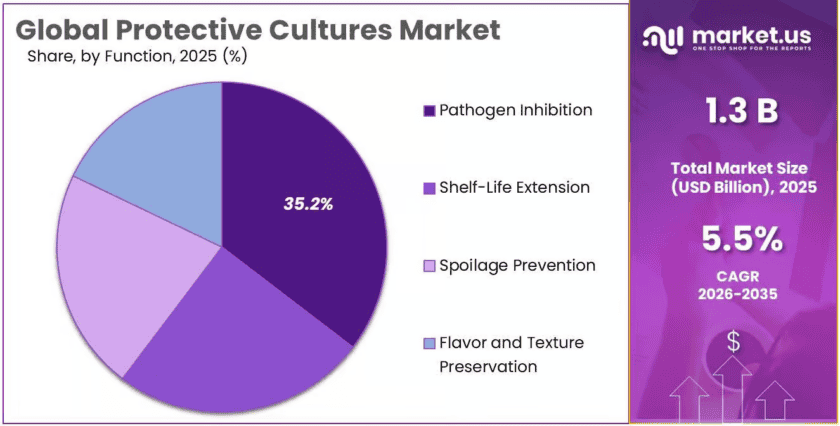
Demand is supported by the growing use of lactic acid bacteria, freeze-dried cultures, and specialized microorganisms across dairy, meat, seafood, bakery, and ready-to-eat food applications. In 2025, lactic acid bacteria accounted for 65% of the market, while freeze-dried cultures held 58%. Pathogen inhibition represented 35%, and dairy products contributed 42% of total market demand.
Europe remained the leading regional market with a 32% share, equivalent to approximately USD 0.4 billion in revenue. Increasing food safety requirements, clean-label product development, and efforts to reduce food spoilage are encouraging manufacturers to adopt protective cultures as an additional preservation solution. Continued microbial research and the development of application-specific formulations are expected to create new opportunities across the global food processing industry.
Key Takeaways
- Market Growth: The global Protective Cultures Market is projected to increase from USD 1.3 billion in 2025 to USD 2.1 billion by 2035, registering a CAGR of 5.5% during 2026–2035.
- Leading Microorganism: Lactic acid bacteria dominated the microorganism segment with a 65% share in 2025, supported by their antimicrobial properties and broad food-processing applications.
- Leading Product Form: Freeze-dried cultures accounted for 58% of the market, benefiting from convenient storage, transportation, and longer product stability.
- Leading Function: Pathogen inhibition held a 35% share, reflecting the importance of controlling harmful microorganisms in processed foods.
- Leading Application: Dairy products represented 42% of the market, supported by the widespread use of protective cultures in cheese, yogurt, and fermented milk.
- Regional Leadership: Europe dominated the global market with a 32% share, generating approximately USD 0.4 billion in 2025.
Regional Analysis
Europe: Dominating Region
Europe dominated the Protective Cultures Market in 2025, accounting for 32% of global revenue, equivalent to approximately USD 0.4 billion. The region benefits from its established dairy processing industry, strong food safety framework, and growing preference for naturally preserved food products.
According to Eurostat, European Union farms produced 161.8 million tonnes of raw milk in 2024, of which 150.8 million tonnes were delivered to dairies. Cheese and butter manufacturing represented major uses of this milk supply. Germany, France, Italy, the Netherlands, and Poland provide important markets for microbial cultures. The European Commission’s microbiological criteria also encourage food businesses to maintain effective hygiene and microbial control systems.
Market Dynamics
1. Driver: Increasing Demand for Food Safety and Shelf-Life Extension
Food manufacturers are increasingly adopting protective cultures to improve microbiological quality and reduce spoilage during processing, storage, and transportation. These beneficial microorganisms produce organic acids and antimicrobial compounds that help control unwanted bacteria, yeasts, and molds.
According to the United Nations Environment Programme, approximately 1.05 billion tonnes of food were wasted in 2022, representing 19% of food available to consumers. This highlights the importance of better food preservation. Protective cultures offer manufacturers an additional preservation method for dairy, meat, seafood, and ready-to-eat products, supporting longer shelf life and improved product quality.
2. Trend: Growing Preference for Clean-Label Food Preservation
The food industry is increasingly moving toward natural ingredients and simpler product labels. Protective cultures are gaining attention because they use selected beneficial microorganisms rather than relying exclusively on conventional chemical preservatives. Lactic acid bacteria can produce organic acids and other antimicrobial substances that help control unwanted microorganisms.
This approach is relevant to cheese, yogurt, packaged meat, and plant-based foods. Manufacturers are also developing specialized microbial combinations that maintain product taste and texture while supporting preservation. This trend is creating opportunities for ingredient suppliers to develop application-specific cultures that meet changing consumer expectations and food-processing requirements.
3. Restraint: High Development Costs and Microbial Performance Limitations
The adoption of protective cultures can be restricted by the cost of strain development, laboratory testing, storage, and application validation. Microbial performance varies depending on food composition, pH, salt concentration, temperature, packaging, and storage conditions.
A culture that performs effectively in cheese may not deliver the same results in meat or seafood products. Manufacturers must therefore conduct product-specific testing before commercial implementation. The European Commission also emphasizes that microbiological testing alone cannot guarantee food safety and that businesses must maintain appropriate hygiene and manufacturing practices. These requirements can increase development time and operational expenditure.
4. Opportunity: Expansion of Plant-Based and Ready-to-Eat Food Applications
The increasing production of plant-based foods and ready-to-eat meals is creating new opportunities for protective culture manufacturers. These products often require effective microbial control because they may contain moisture-rich ingredients and undergo extended storage and distribution. Selected lactic acid bacteria and other beneficial microorganisms can help control spoilage organisms while maintaining product characteristics.
Manufacturers can develop specialized formulations for plant-based cheese, meat alternatives, fresh salads, and packaged seafood. The opportunity is supported by the wider food-processing industry and the need to improve food stability without significantly changing taste, texture, or appearance.
Emerging Trends
1. Development of Multi-Strain Protective Cultures
Manufacturers are developing combinations of different beneficial microorganisms to improve preservation performance. Multi-strain formulations can provide several antimicrobial mechanisms, including acid production and microbial competition. This approach supports specialized applications in dairy, meat, seafood, and plant-based foods.
2. Growth of Freeze-Dried Culture Technology
Freeze-dried cultures accounted for 58% of the Protective Cultures Market in 2025. Their low moisture content supports convenient storage and transportation. Manufacturers are improving drying and stabilization processes to maintain microbial viability and consistent performance during industrial food production.
3. Increasing Focus on Listeria Control
Food manufacturers are giving greater attention to Listeria monocytogenes control in ready-to-eat foods. European food microbiological regulations establish specific safety criteria for relevant food products. Protective cultures are being investigated as additional microbial-control measures alongside hygiene and temperature management.
4. Expansion into Plant-Based Food Products
Protective cultures are finding applications in plant-based cheese, fermented alternatives, and meat substitutes. Specialized microorganisms can support fermentation and help control unwanted microbial growth. This creates opportunities for suppliers to develop cultures suitable for different plant proteins and product formulations.
5. Advanced Microbial Strain Selection
Food biotechnology companies are increasingly using microbial screening and laboratory testing to identify strains with specific preservation properties. In a 2025 plant-based fermented sausage study, researchers screened 20 lactic acid bacteria strains and advanced five for product trials, demonstrating the importance of targeted strain selection.
Use Cases
1. Cheese and Yogurt Preservation
Dairy manufacturers use protective cultures to control unwanted bacteria, yeasts, and molds during cheese and yogurt production. These cultures help maintain product quality and freshness. The dairy application accounted for 42% of the global Protective Cultures Market in 2025.
2. Processed Meat and Poultry Products
Meat processors use selected lactic acid bacteria to help manage spoilage organisms and improve product stability. Protective cultures can be incorporated into fermented sausages and other processed meat products, supporting microbial control during storage and distribution.
3. Ready-to-Eat Food Safety
Ready-to-eat salads, packaged meals, and chilled food products require effective microbial management. Protective cultures can provide an additional preservation hurdle when selected for the specific food matrix. Their use must be validated alongside sanitation, refrigeration, and food safety procedures.
4. Seafood Shelf-Life Management
Seafood manufacturers can investigate protective cultures to reduce spoilage caused by selected microorganisms during chilled storage. Application-specific strains may help maintain freshness and product quality. The approach is particularly relevant to fresh fish and packaged seafood products.
5. Plant-Based Food Fermentation
Plant-based cheese, fermented meat alternatives, and protein-based foods can use protective cultures to support fermentation and microbial stability. Selected strains can improve product characteristics while helping control unwanted microorganisms. This application creates opportunities for specialized cultures across alternative food categories.
Frequently Asked Questions on Protective Cultures Market
1. What is the Protective Cultures Market?
The Protective Cultures Market includes beneficial microorganisms used in food products to improve microbiological safety, prevent spoilage, maintain quality, and extend shelf life. These cultures are widely used in dairy, meat, seafood, and fermented foods.
2. What is the global Protective Cultures Market size?
The global Protective Cultures Market was valued at USD 1.3 billion in 2025. It is projected to reach approximately USD 2.1 billion by 2035, expanding at a CAGR of 5.5% during 2026–2035.
3. Which microorganism dominates the Protective Cultures Market?
Lactic acid bacteria dominated the market in 2025, accounting for 65% of total market share. Their ability to produce organic acids and antimicrobial compounds supports their widespread application in dairy, meat, seafood, and fermented food products.
4. Which region dominates the Protective Cultures Market?
Europe dominated the global Protective Cultures Market in 2025, accounting for 32% of total revenue, equivalent to approximately USD 0.4 billion. Its established dairy industry and food safety requirements support regional demand.
5. What are the major applications of protective cultures?
Major applications include dairy products, meat and poultry, seafood, bakery products, plant-based foods, and ready-to-eat meals. Dairy products represented the leading application segment with a 42% market share in 2025.
6. Why are freeze-dried protective cultures widely used?
Freeze-dried cultures offer convenient storage, transportation, and handling because of their reduced moisture content. They accounted for 58% of the market in 2025, supported by their suitability for industrial food processing.
Conclusion
The Protective Cultures Market is positioned for steady growth as food manufacturers increasingly prioritize food safety, natural preservation, and longer product shelf life. Valued at USD 1.3 billion in 2025, the market is projected to reach USD 2.1 billion by 2035, registering a CAGR of 5.5%. Lactic acid bacteria, freeze-dried formulations, and dairy applications remain important market segments.
Europe currently leads the industry, while Asia-Pacific offers additional growth opportunities through expanding food processing and packaged food consumption. Continued microbial innovation, plant-based food development, and demand for improved preservation solutions will strengthen the market’s long-term prospects.
Discuss your needs with our analyst
Please share your requirements with more details so our analyst can check if they can solve your problem(s)