Overview
New York, NY – Nov 23, 2026 – The global Oleoresins Market is witnessing steady growth as food manufacturers increasingly use concentrated natural extracts to improve flavour, aroma, colour, and product consistency. Oleoresins are obtained from spices, herbs, and other botanical materials through extraction processes.
According to Market.us, the global Oleoresins Market was valued at USD 2.1 billion in 2025 and is projected to reach USD 3.7 billion by 2035, registering a CAGR of 5.9% during 2026–2035. Asia-Pacific dominated the market in 2025 with a 38% share, equivalent to approximately USD 0.7 billion.
Growing interest in natural food ingredients, clean-label products, and consistent flavour formulations is supporting demand. However, raw spice price fluctuations, extraction costs, solvent management, and quality-control requirements remain important challenges. Manufacturers are increasingly focusing on advanced extraction technologies, product standardisation, and reliable raw-material sourcing to strengthen their market position.
Key Takeaways
- Market Valuation (2025): The global Oleoresins Market was valued at USD 2.1 billion.
- Market Forecast (2035): The market is expected to reach USD 3.7 billion.
- CAGR (2026–2035): The market is projected to expand at 5.9%.
- Dominant Region: Asia-Pacific accounted for 38%, representing approximately USD 0.7 billion in 2025.
- Leading Product Type: Paprika oleoresin dominated with a 24% share.
- Leading Form: Liquid oleoresins accounted for 67% of the market.
- Leading Extraction Method: Solvent extraction held a 72% share.
- Leading Application: Food and beverages accounted for 58%.
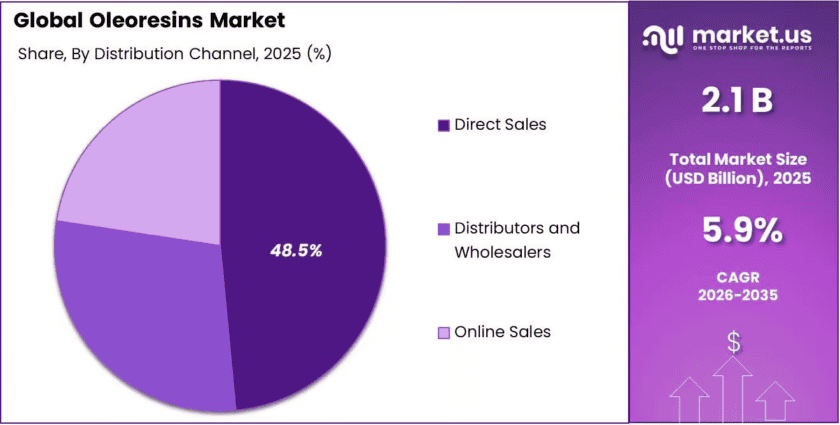
- Leading Distribution Channel: Direct sales captured 48% of the market.
Regional Analysis
Asia-Pacific dominated the global Oleoresins Market in 2025, accounting for 38% of the total market, valued at approximately USD 0.7 billion. Its leadership is supported by established spice-processing capabilities, access to botanical raw materials, and increasing demand for processed food ingredients.
China, Indonesia, Vietnam, and other Southeast Asian countries contribute to regional cultivation and extraction activities. Vietnam recorded 9.97% manufacturing growth in 2025, according to the regional information presented in the market report.
North America represents an important market, supported by demand for natural colours, concentrated flavours, and specialised food ingredients. Food manufacturers use paprika, capsicum, and black pepper oleoresins in sauces, snacks, seasonings, and processed food products.
Market Dynamics
1. Driver: Increasing Demand for Natural Colours and Flavours
The growing demand for natural food colours and flavours is a major driver of the Oleoresins Market. Food manufacturers are increasingly using paprika and turmeric oleoresins to provide colour, while black pepper, ginger, and capsicum extracts improve flavour.
The U.S. Food and Drug Administration lists paprika oleoresin under 21 CFR 73.345 for food-colouring applications. Its regulatory recognition supports established commercial use. In addition, food producers are reformulating products to reduce dependence on petroleum-based synthetic dyes. This shift is creating opportunities for suppliers offering standardised, concentrated, and food-grade botanical extracts.
2. Trend: Adoption of Advanced Extraction Technologies
Oleoresin manufacturers are increasingly exploring advanced extraction technologies to improve product quality, extraction efficiency, and consistency. Conventional solvent extraction remains widely used because it supports large-scale production. However, supercritical carbon dioxide extraction is gaining attention as processors seek better control over extraction conditions and solvent residues.
The use of carbon dioxide also provides an alternative processing approach for sensitive botanical compounds. The European Food Safety Authority highlights the importance of controlling extraction-solvent residues in food ingredients. These developments are encouraging manufacturers to invest in improved equipment, process monitoring, and quality-testing systems.
3. Restraint: Fluctuating Raw Material Prices and Quality Issues
Fluctuating prices of spices and herbs create cost-related challenges for oleoresin manufacturers. Raw materials such as paprika, black pepper, ginger, and turmeric are affected by seasonal production, weather conditions, agricultural yields, and transportation expenses. Changes in raw-material quality can also affect colour strength, aroma, pungency, and extraction yield.
Manufacturers must maintain consistent product specifications while managing changing procurement costs. Additionally, extraction solvents require careful control because residual substances may remain in finished ingredients. EFSA identifies extraction-solvent residues as a food-safety consideration and recommends evaluating their safety and maximum residue limits.
4. Opportunity: Expansion into Animal Feed and Specialised Ingredients
The animal feed industry offers an additional growth opportunity for oleoresin manufacturers. Paprika-derived extracts contain carotenoids that can support pigmentation applications in poultry feed. According to the European Food Safety Authority, evaluated saponified paprika extract preparations contain approximately 25–90 grams of total carotenoids per kilogram.
Its assessment identifies a recommended maximum of 40 milligrams of total carotenoids per kilogram of complete feed as safe for specified poultry categories under the assessed conditions. This creates opportunities for specialised feed ingredients, premixes, and customised formulations. However, manufacturers must meet applicable safety, efficacy, and authorisation requirements.
Emerging Trends in the Oleoresins Market
1. Natural Food Colour Replacement
Food manufacturers are exploring paprika and turmeric oleoresins as alternatives to selected synthetic colours. The FDA recognises paprika oleoresin under 21 CFR 73.345. This regulatory listing supports its established use in food-colouring applications.
2. Supercritical CO2 Extraction
Manufacturers are exploring supercritical carbon dioxide extraction to obtain concentrated botanical compounds. Carbon dioxide is listed under FDA regulation 21 CFR 184.1240 for food-related processing uses. This technology supports interest in alternative extraction processes.
3. Powder Oleoresin Development
Powder oleoresins are gaining attention among dry seasoning and instant-food manufacturers. The market report estimates that liquid products held 67% of the market in 2025, leaving opportunities for convenient powder formulations and improved encapsulation technologies.
4. Improved Solvent Safety
Food ingredient manufacturers are strengthening solvent management and residue testing. EFSA reviewed extraction solvents on 17 December 2025 and highlighted the need to assess possible residues in finished ingredients. This is encouraging improved processing controls.
5. Regulatory Changes in Colour Manufacturing
On November 9, 2026, the FDA announced the revocation of certain authorisations involving methylene chloride, ethylene dichloride, and trichloroethylene in manufacturing paprika and turmeric oleoresin colour additives. The changes take effect on January 11, 2027.
Use Cases of Oleoresins
1. Processed Food Manufacturing
Paprika and black pepper oleoresins are used in sauces, soups, snacks, and ready-to-eat meals. Their concentrated properties help manufacturers achieve consistent flavour and colour while reducing the need to handle large quantities of ground spices.
2. Meat and Poultry Products
Paprika oleoresin provides red and orange colouring in processed meat products, marinades, and seasonings. Its concentrated colour properties help food processors maintain product appearance across production batches while supporting standardised ingredient formulations.
3. Pharmaceutical Formulations
Turmeric, ginger, black pepper, and capsicum oleoresins are used as botanical ingredients in selected pharmaceutical and healthcare formulations. Their concentrated plant compounds support the development of specialised products requiring controlled ingredient composition and quality specifications.
4. Animal Feed Production
Paprika-derived carotenoid preparations are used in specialised poultry feed applications to support pigmentation. EFSA assessed preparations containing 25–90 g/kg total carotenoids, demonstrating the importance of controlled ingredient composition and species-specific safety evaluation.
5. Cosmetics and Personal Care
Capsicum, turmeric, and other botanical oleoresins can be incorporated into selected cosmetic and personal-care formulations. Their plant-derived colour and functional properties support specialised product development, provided manufacturers meet applicable cosmetic safety and formulation requirements.
Frequently Asked Questions on Oleoresins Market
1. What are oleoresins?
Oleoresins are concentrated natural extracts obtained from spices, herbs, and botanical materials. They contain the original plant’s flavour, aroma, colour, and active compounds and are widely used in food, pharmaceutical, cosmetic, and feed applications.
2. What is the global Oleoresins Market size in 2025?
According to Market.us, the global Oleoresins Market was valued at approximately USD 2.1 billion in 2025. Demand is supported by increasing applications of concentrated natural flavours and colours across food and industrial ingredient manufacturing.
3. What will be the Oleoresins Market size by 2035?
The global Oleoresins Market is projected to reach approximately USD 3.7 billion by 2035. Growing demand for natural ingredients, processed foods, botanical extracts, and specialised formulations is expected to support this expansion.
4. What is the expected CAGR of the Oleoresins Market?
The Oleoresins Market is expected to register a CAGR of 5.9% during 2026–2035. Increasing demand for natural food ingredients and improvements in extraction technologies are important factors supporting market growth.
5. Which region dominates the Oleoresins Market?
Asia-Pacific dominated the global Oleoresins Market in 2025, accounting for 38% of the total market, equivalent to approximately USD 0.7 billion. Its position is supported by spice-processing activities and food manufacturing demand.
6. Which product type dominates the Oleoresins Market?
Paprika oleoresin dominated the product type segment in 2025, accounting for approximately 24% of the market. Its popularity comes from its natural colouring properties and applications in sauces, snacks, seasonings, and processed foods.
Conclusion
The Oleoresins Market is expected to maintain steady growth as food manufacturers increasingly adopt concentrated natural flavours and colouring ingredients. The market is projected to increase from USD 2.1 billion in 2025 to USD 3.7 billion by 2035, registering a CAGR of 5.9%.
Asia-Pacific remains the leading regional market with a 38% share, supported by established spice-processing activities and expanding food manufacturing. Paprika oleoresin, liquid formulations, and solvent extraction continue to represent important market segments. Going forward, advanced extraction technologies, natural-colour reformulation, and specialised animal feed applications are expected to create additional business opportunities.
Discuss your needs with our analyst
Please share your requirements with more details so our analyst can check if they can solve your problem(s)