Overview
New York, NY – Sep 30, 2026 – The global Seed Processing Market is growing as commercial seed producers invest in cleaner, safer, and more automated systems for cleaning, grading, treatment, coating, drying, testing, and packaging. The market was valued at USD 15.8 billion in 2025 and is projected to reach approximately USD 30.1 billion by 2035, expanding at a 6.6% CAGR during 2026–2035.
Seed processing plays an important role between crop harvesting and commercial planting. It helps remove damaged seeds, foreign material, stones, weed seeds, and other impurities while improving uniformity and preparing seeds for treatment or storage.
Quality requirements are also supporting investment. USDA’s Federal Seed Act requires agricultural and vegetable seed sold across U.S. state lines to carry information including purity percentage, germination percentage, noxious weed-seed content, and chemical treatment information.
Global crop production provides a large operating base. FAO estimated world cereal production at approximately 2.98 billion tonnes in 2026, following the record 2025 harvest. As farms demand more uniform planting material, processors are increasingly adopting automatic cleaners, graders, optical sorting, coating, and treatment technologies.
Key Takeaways
- The global Seed Processing Market was valued at USD 15.8 billion in 2025 and is projected to reach USD 30.1 billion by 2035, growing at a 6.6% CAGR.
- Seed Treatment dominated the type category in 2025, capturing more than a 67.00% share.
- Cleaners & Pre-Cleaners held more than a 42.50% share, reflecting their essential role in removing foreign material before further processing.
- Automatic processing systems captured more than a 50.10% share as commercial processors moved toward higher throughput and consistent quality.
- Cereals and Grains accounted for more than 46.30% of the market because of their large global planting and production base.
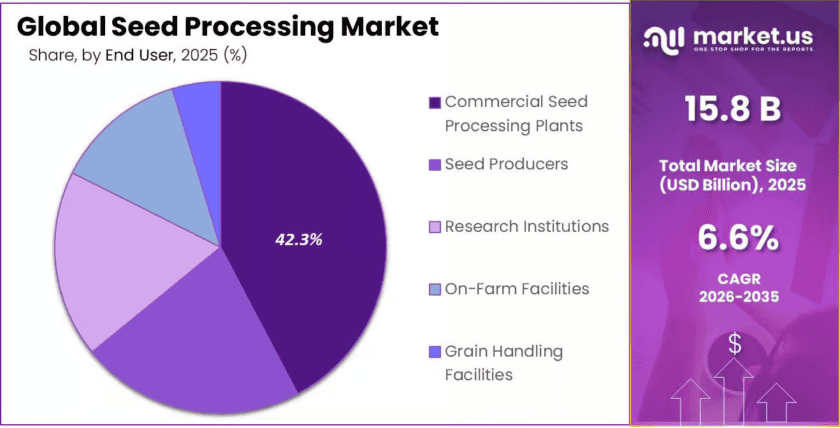
- Commercial Seed Processing Plants dominated end use with more than a 42.30% share in 2025.
- North America led the regional market with a 31.10% share, generating approximately USD 4.9 billion in 2025.
Regional Analysis
North America Leads with 31.10% Share and USD 4.9 Billion
In 2025, North America held a dominant position in the Seed Processing Market, capturing more than a 31.10% share and generating approximately USD 4.9 billion. The region benefits from commercial-scale farming, developed seed companies, strong crop research activity, established certification systems, and growing use of automated cleaning, grading, coating, and treatment equipment.
Seed quality regulation also supports processing investment. USDA’s Federal Seed Act regulates agricultural and vegetable seed moving in interstate commerce and requires labeling for purity, germination, noxious weed seeds, chemical treatment, crop identification, and shipper information. This encourages processors to maintain reliable cleaning, testing, documentation, and conditioning systems.
USDA also maintains 4 Accredited Seed Programs, covering field inspection, seed sampling, laboratory testing, and seed conditioning. The Accredited Seed Conditioning Program specifically applies to companies performing seed conditioning or blending operations.
International seed trade is also supported by recognized certification systems. The OECD Seed Schemes provide internationally harmonized procedures for seed certification, while their variety database was updated in July 2026. These structures support demand for processing equipment capable of delivering consistent purity, traceability, and varietal quality.
Market Dynamics
Driver – Rising Demand for High-Quality and Uniform Seed
Demand for higher physical purity and reliable germination is a major driver for seed processing equipment. USDA’s Federal Seed Act requires interstate seed shipments to disclose purity percentage, germination percentage, and noxious weed-seed content, making cleaning and quality control essential commercial activities. Cleaning, grading, density separation, and treatment allow processors to remove damaged material and produce more uniform planting lots. Global cropping activity further expands the processing base. FAO forecasts approximately 2.98 billion tonnes of cereal production in 2026, following a record 2025 season. Larger planting volumes create recurring demand for processed seed across cereals, oilseeds, pulses, and specialty crops.
Trend – Automation and High-Throughput Processing
Automation is becoming a major trend as commercial plants seek higher throughput, lower manual handling, and consistent seed quality. FAO reports that simple manually powered cleaning systems typically process around 150–300 kg per hour, whereas specialized motorized cleaners can process approximately 1–4 tonnes per hour with motors near 3 kW. This large productivity difference supports adoption of integrated cleaners, graders, conveyors, treaters, and packaging systems. Automatic equipment already accounted for 50.10% of the Seed Processing Market in 2025. Optical sorting and sensor-based inspection are also becoming more attractive where processors need higher consistency and reduced contamination.
Restraint – High Capital Cost and Specialized Skills
The cost of motorized and automated processing equipment can restrain adoption among smaller seed producers. FAO notes that mechanized cleaning systems require suitable infrastructure and specialist skills and can represent relatively high financial risk when equipment is used only during seasonal processing periods. Commercial facilities may also require multiple machines for cleaning, grading, treatment, conveying, testing, and packaging. Regulatory requirements can add further cost. For example, EPA’s fiscal 2025–2026 fee for one category of additional seed-treatment pesticide use requiring a tolerance is USD 83,538, highlighting the compliance costs surrounding treated-seed technologies.
Opportunity – International Certification and Seed Trade
Growing international seed certification creates opportunities for advanced conditioning, testing, and traceability systems. OECD maintains internationally recognized Seed Schemes covering major crop categories and regularly updates the varieties eligible for certification. USDA also operates 4 seed accreditation programs, including dedicated programs for seed conditioning and laboratories. These frameworks encourage processors to invest in equipment capable of producing consistent lots for domestic and export markets. Automated sampling, optical sorting, coating, traceability, and laboratory-connected processing systems can help companies manage increasingly detailed quality requirements while reducing variability between lots and supporting higher-value certified seed.
Emerging Trends
1. Automatic Seed Processing Expands
Automatic systems captured 50.10% of the market in 2025. FAO reports motorized cleaners can process 1–4 tonnes per hour, compared with about 150–300 kg per hour for simple manual systems, supporting continued automation.
2. Seed Treatment Remains a Core Processing Step
Seed Treatment held a 67.00% market share in 2025. EPA identifies corn, cereals, soybeans, sorghum, sunflower, cotton, flax, sugar beet, and vegetable seeds among crops commonly covered by pesticide seed-treatment practices.
3. Stronger Purity Control Supports Advanced Cleaning
USDA requires seed moving in interstate commerce to disclose purity and noxious weed-seed information. This requirement strengthens demand for cleaners, separators, optical sorters, and testing systems, with Cleaners & Pre-Cleaners already holding a 42.50% share.
4. Cereal Processing Remains the Largest Crop Application
Cereals and Grains represented 46.30% of the Seed Processing Market in 2025. FAO forecasts global cereal production at around 2.98 billion tonnes in 2026, maintaining a very large annual planting base requiring quality seed.
5. Certification and Traceability Gain Importance
OECD continues to maintain international seed certification schemes and updated its eligible variety list in July 2026. Greater attention to varietal identity and purity is encouraging processors to improve lot tracking, testing, documentation, and controlled conditioning.
Use Cases
1. Commercial Seed Cleaning
Seed processors use air-screen cleaners, pre-cleaners, and separators to remove chaff, stones, damaged seeds, and foreign material. FAO reports specialized motorized cleaners can handle approximately 1–4 tonnes per hour, supporting high-volume commercial operations.
2. Cereal and Grain Seed Processing
Wheat, maize, rice, barley, and other cereals require repeated cleaning, grading, testing, and treatment before planting. Cereals and Grains accounted for 46.30% of market demand in 2025, supported by their extensive global cultivation.
3. Commercial Seed Treatment
Processors apply pesticides or protective formulations using continuous-flow or batch machinery. EPA specifically evaluates commercial activities including chemical loading, seed treating, coating, equipment calibration, sampling, packaging, and storage as part of occupational seed-treatment assessments.
4. Seed Conditioning for Certification
Commercial facilities clean, blend, grade, and prepare seed lots before certification and distribution. USDA operates 4 Accredited Seed Programs, including an Accredited Seed Conditioning Program designed specifically for entities performing conditioning or blending operations.
5. Quality Testing and Interstate Distribution
Seed processors prepare lots to meet commercial labeling and testing requirements. USDA requires interstate agricultural and vegetable seed to disclose purity, germination, weed-seed content, treatment status, crop identity, and shipper details, making quality-controlled processing essential.
Frequently Asked Questions on Seed Processing Market
What is the Seed Processing Market size?
The global Seed Processing Market was valued at approximately USD 15.8 billion in 2025 and is projected to reach around USD 30.1 billion by 2035, expanding at a 6.6% CAGR during 2026–2035.
What is seed processing?
Seed processing covers cleaning, drying, grading, separating, treatment, coating, testing, packaging, and storage before commercial planting. These operations remove unwanted material and help improve physical purity, uniformity, handling, and overall planting quality.
Which type dominates the Seed Processing Market?
Seed Treatment held the dominant market position in 2025, accounting for more than a 67.00% share. Treatment helps protect planting seed against selected pests and diseases while supporting commercial preparation and storage.
Which processing function holds the largest share?
Cleaners & Pre-Cleaners dominated the processing-function segment with more than a 42.50% share in 2025. These systems remove dust, chaff, stones, damaged seed, weed seeds, and other unwanted materials before downstream processing.
Which operation mode dominates Seed Processing?
Automatic systems held more than a 50.10% share in 2025. Higher throughput, reduced manual handling, consistent process control, and easier integration with graders, treaters, conveyors, optical sorters, and packaging equipment support adoption.
Which crop segment generates the highest demand?
Cereals and Grains led the crop category with more than a 46.30% market share in 2025. Large planting volumes of wheat, maize, rice, barley, and other cereals create recurring demand for processed planting seed.
Which end user dominates the Seed Processing Market?
Commercial Seed Processing Plants held the largest end-user share at more than 42.30% in 2025. These facilities combine cleaning, grading, treatment, quality testing, conveying, and packaging systems to prepare large commercial seed volumes.
Which region dominates the Seed Processing Market?
North America led the global Seed Processing Market in 2025, accounting for more than a 31.10% share and approximately USD 4.9 billion in revenue, supported by commercial agriculture and developed seed infrastructure.
Why is seed cleaning important?
Seed cleaning removes foreign matter, damaged seeds, chaff, stones, and weed seeds before storage or planting. USDA also requires interstate seed labeling to disclose purity and noxious weed-seed information, making controlled cleaning commercially important.
What is driving future Seed Processing Market growth?
Growth is supported by automation, certification, higher quality requirements, seed treatment, and large crop production. FAO currently forecasts approximately 2.98 billion tonnes of global cereal production in 2026, sustaining substantial demand for planting seed.
Conclusion
The Seed Processing Market is becoming more automated, quality-focused, and closely linked with certification requirements. Valued at USD 15.8 billion in 2025, the market is projected to reach USD 30.1 billion by 2035, expanding at a 6.6% CAGR. North America leads with a 31.10% share and USD 4.9 billion in revenue. Seed treatment, automatic processing, cleaners, and cereal applications remain major demand areas. Growing crop production, stricter purity standards, international certification, and increased use of automated grading and treatment systems are expected to strengthen opportunities for commercial processing plants, seed producers, equipment suppliers, and quality-testing operations.
Discuss your needs with our analyst
Please share your requirements with more details so our analyst can check if they can solve your problem(s)